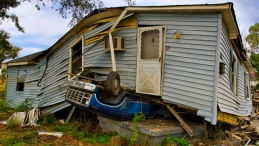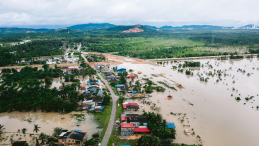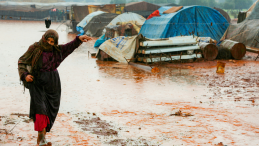


Earth is home to more than 8 billion people, yet the world is smaller – and more connected – than we often think. The systems we rely on link our daily lives to places far away – for better and worse. As global challenges intensify, from climate change to pollution, their impacts do not stop at borders – and neither should responsibility. Yet too often, little thought is given to the wider consequences of our decisions, especially when they shift negative impacts elsewhere. The Interconnected Disaster Risks report, Turn Over a New Leaf, and its Reconsider Responsibility case explore the patterns and assumptions behind this mindset, while calling for a shift in perspective – one that reflects how closely our actions, and their consequences, are shared.
Here are five ways we can think and act more globally:
Understand that global challenges are interconnected
We tend to focus on our own communities first, and many of our systems reflect this – prioritizing local needs over global ones. But today’s crises are providing a stark warning that this notion no longer holds. Climate change, for example, highlights how unevenly impacts are shared: while wealthier countries account for a majority share of emissions, lower-income countries often face the greatest consequences. In an increasingly interconnected world, disruptions in one place can ripple across others, whether that is from a disaster or conflict. But effectively addressing today's global challenges requires recognizing shared patterns, such as common root causes and underlying drivers.
Avoid shifting negative impacts to other parts of the world
Moving problems elsewhere does not make them disappear. Large amounts of plastic waste are exported from wealthier countries to regions that often lack the infrastructure to manage it safely. Much of this waste ends up polluting forests, rivers and oceans in the places it is sent. Similar consequences can occur with carbon offsetting projects, where emissions reduction efforts are outsourced to distant communities in low-income countries, sometimes with unintended impacts such as displacement. These approaches may offer short-term relief, but they often deepen inequalities rather than solve the underlying problem.
Identify and question superficial fixes
Not every solution is as effective as it seems. One often-discussed solution to climate change, solar geoengineering, involves spraying aerosols into the stratosphere to reflect sunlight back to space to cool Earth. At first glance, this seems innovative and high-tech, but it actually only counteracts symptoms rather than causes. This technology is already being explored, in some cases without broad global governance, raising concerns about unintended consequences for others, including disruptions to weather patterns and food systems. Looking more critically at these approaches helps distinguish between meaningful progress and temporary fixes.
Promote projects that benefit local communities and ecosystems
Effective solutions are not always large-scale, as often assumed. In many cases, local initiatives can deliver significant global benefits. The United Kingdom’s Peatland Code, for example, supports peatland restoration and conservation, while ensuring that carbon storage and other benefits are retained locally and equitably. Healthy peatlands are major natural carbon stores, and UK peatlands alone hold an estimated 3.2 billion tonnes. By working with natural systems and supporting local communities, these approaches can address environmental challenges while strengthening resilience.
Embrace our shared responsibility as part of the solution
Rethinking responsibility means shifting from “me” to “we.” While meaningful change can feel overwhelming, progress often begins with small, collective steps. The Interconnected Disaster Risks report highlights two types of “levers” for change: inner and outer. Inner levers focus on shifting our underlying assumptions (eg. caring for natural resources as shared commons to be looked after collectively), while outer levers refer to structural changes in society (eg. government policy). These levers are most effective when used together. History shows what is possible when they work together – in 1987, 187 countries adopted the Montreal Protocol to protect the ozone layer, putting it on track to recover by 2066. It is a reminder that when responsibility is shared more fairly, meaningful and lasting change becomes possible.
Suggested citation: "5 Ways We Can Think – and Act – More Globally," United Nations University, UNU-EHS, 2026-04-23, https://unu.edu/ehs/article/5-ways-we-can-think-and-act-more-globally.