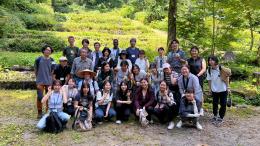


On 18–21 August 2026, UNU-IAS organized a special session of the UNU Global Seminar in Ishikawa Prefecture, Japan, exploring community resilience and sustainability in an era of increasing uncertainty due to climate change, demographic shifts and natural hazards.
Engaging 31 participants from 11 countries, the seminar combined lectures and discussions with experiential learning through two interconnected regional perspectives. In Kanazawa City, participants learned about local initiatives to promote sustainable urban nature and biocultural diversity. On the Noto Peninsula, they interacted with communities affected by the 2024 Noto Peninsula Earthquake and heavy rains, learning from local experiences of recovery and preparedness.
The seminar highlighted how local knowledge and community-based approaches can contribute to more sustainable and resilient futures. It also provided an opportunity for participants to expand their professional networks to support collaboration between different universities and disciplines.
The session was organized by the UNU-IAS Operating Unit Ishikawa/Kanazawa (OUIK) with support from Ministry of Education, Culture, Sports, Science and Technology, Japan (MEXT), The Japan Foundation for UNU (JFUNU) and Ishikawa Prefecture.
About UNU Global Seminars
The UNU Global Seminars began in Japan in the Kanto area in 1985 with the first Shonan Session, and in the Kansai area in 1995 with the Kobe Session. Since then, UNU Global Seminars have been held in Hokkaido, Kanazawa, Kobe-Awaji Tohoku, Okinawa and Shimane-Yamaguchi. Sessions have also been held abroad, including in Seoul, Republic of Korea in 2003. Detailed information is available here.