


Geneva, Switzerland – 26 March: The United Nations University Institute for Water, Environment and Health (UNU-INWEH) and Geneva Environment Network (GEN) convened a high‑level stakeholder briefing and dialogue convened at the International Environment House II to present and discuss the findings of the UNU-INWEH flagship report Global Water Bankruptcy: Living Beyond Hydrological Means in the Post‑Crisis Era. The event brought together representatives from Member States, United Nations entities, international organizations, academia, and civil society to discuss the implications of accelerating water system failures for global governance, development, and cooperation.
In her opening remarks, Ms. Diana D. Rizzolio, Coordinator of GEN, underscored the importance of moving beyond awareness to action: “This dialogue reflects the urgency of translating the findings of the Global Water Bankruptcy report into concrete policy and governance responses. Geneva provides a unique platform to connect science, diplomacy, and multilateral action.”
H.E. Ambassador Peter MacDougall, Permanent Representative of Canada to the United Nations Office in Geneva and to the Conference on Disarmament, delivered opening remarks reaffirming Canada’s longstanding support to UNU-INWEH, as the Institute marks its thirtieth anniversary. He highlighted UNU-INWEH’s role in bridging science, policy, and practice—particularly in support of Member States in the Global South—and noted Canada’s ongoing efforts to develop its first national water security strategy through the Canada Water Agency.
Ambassador MacDougall also congratulated Professor Kaveh Madani, Director of UNU-INWEH, on being named the 2026 Stockholm Water Prize Laureate, noting that the distinction reflects his “sustained dedication and interdisciplinary leadership in addressing some of the world’s most complex water and sustainability challenges.”
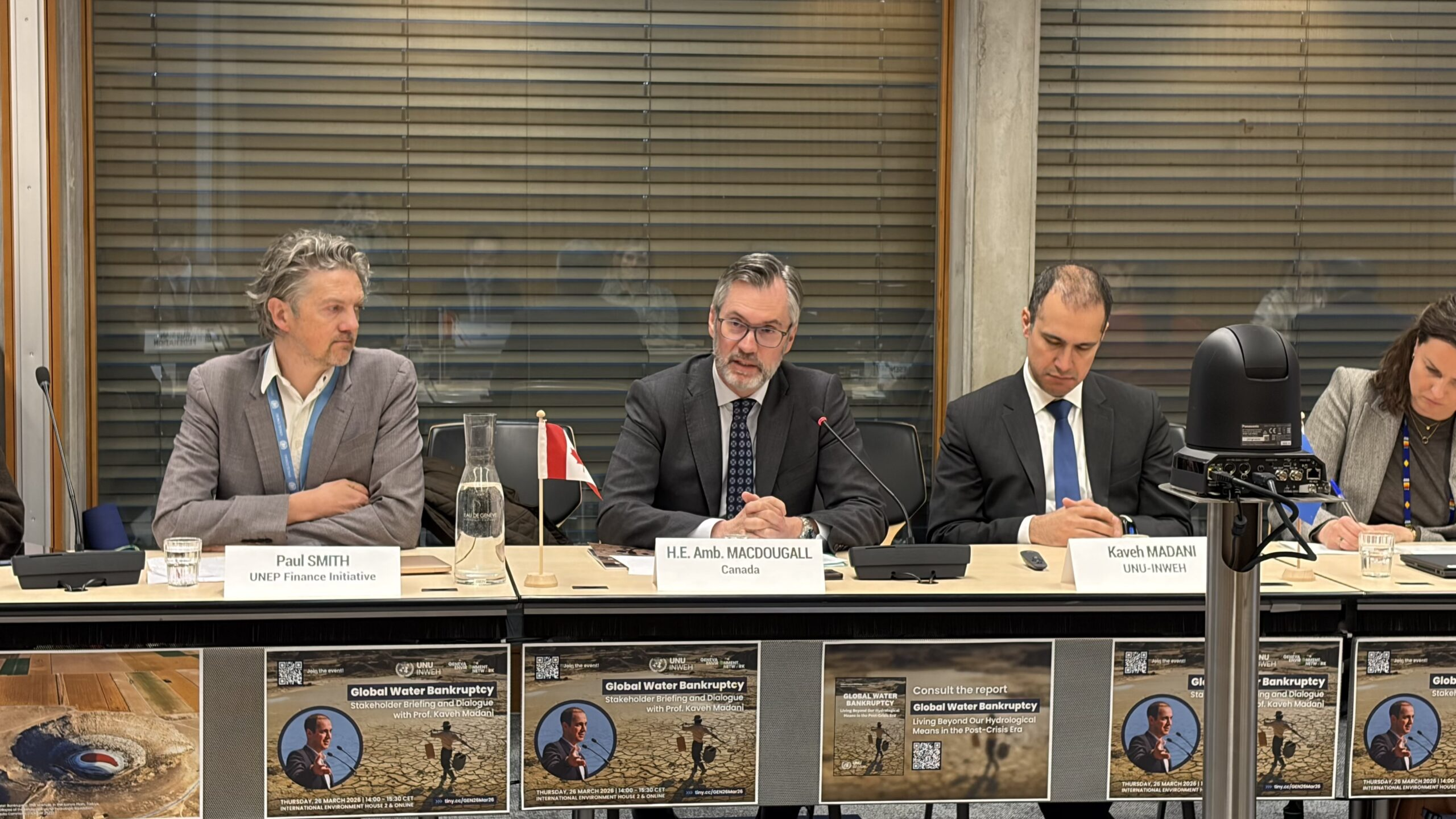
H.E. Ambassador MacDougall, Permanent Representative of Canada to the United Nations Office in Geneva and to the Conference on Disarmament, spotlights UNU-INWEH's role in developing evidence-based solutions that strengthen human security, resilience, and sustainability worldwide.
The opening was followed by a moderated dialogue between Ambassador MacDougall and Professor Madani, during which the report’s key findings and analytical framework were presented. Professor Madani introduced the concept of “water bankruptcy” as a condition in which persistent overexploitation of freshwater resources coincides with irreversible degradation of the natural systems that produce, store, and regulate water—including aquifers, glaciers, wetlands, and soils. He emphasized that, unlike water stress or water crises—which are often temporary and potentially reversible—water bankruptcy represents a chronic, structural condition driven primarily by governance and management failures rather than absolute scarcity.
While acknowledging the scale of irreversible losses already underway, Professor Madani highlighted water as a strategic entry point for cooperation, capable of delivering co-benefits across climate mitigation and adaptation, biodiversity conservation, food security, livelihoods, and peacebuilding. “Water is one of the few issues on which there is universal recognition of its importance,” he noted, adding that this shared understanding presents a critical opportunity for collective action.
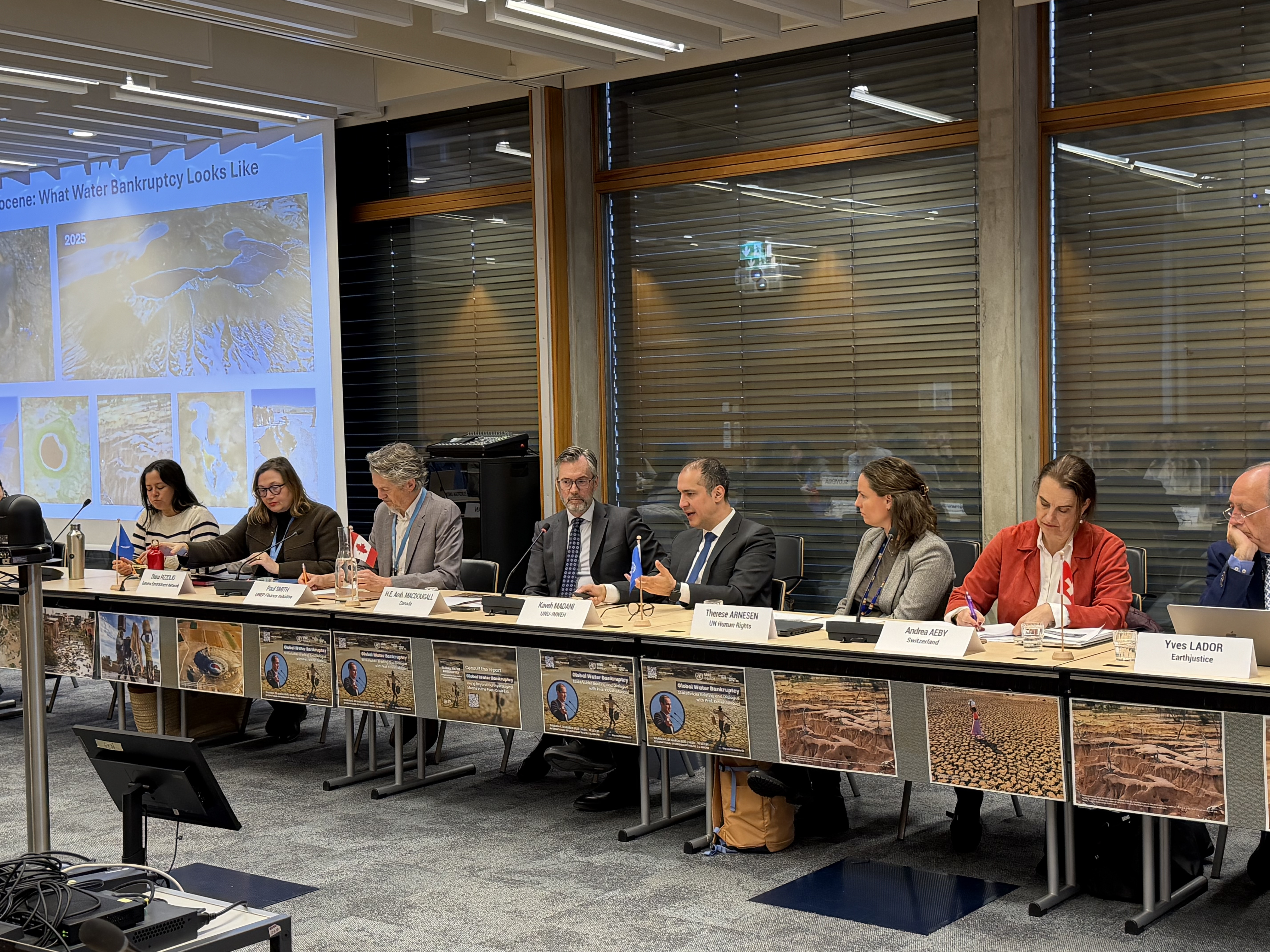 Stakeholders reflect on the wider ramifications of water bankruptcy.
The discussion was followed by reflections from representatives of United Nations entities, international organizations, and civil society, who examined the cross-cutting implications of water bankruptcy across policy domains.
Ms. Therese Arnesen (OHCHR), Mr. Maikel Lieuw-Kie-Song (ILO), Mr. Paul Smith (UNEP Finance Initiative), and Mr. Yves Lador (Earthjustice) highlighted the cross-cutting implications of water insecurity across human rights, employment, finance, and governance. Their interventions emphasized disproportionate impacts on vulnerable populations, the interlinkages between water, ecosystems, and livelihoods, and the growing recognition of water as a systemic financial risk. They underscored the need for rights-based, ecosystem-based, and economically inclusive approaches, including just transition principles, improved data and risk integration, and strengthened collaboration among policymakers, financial institutions, and communities.
In closing remarks, Ms. Andrea Aeby (Permanent Mission of Switzerland to the United Nations Office and other international organizations in Geneva) reaffirmed the strength and policy relevance of the report’s evidence base and highlighted Geneva’s role as a global hub for integrated water governance across environmental, human rights, development, and peace dimensions.
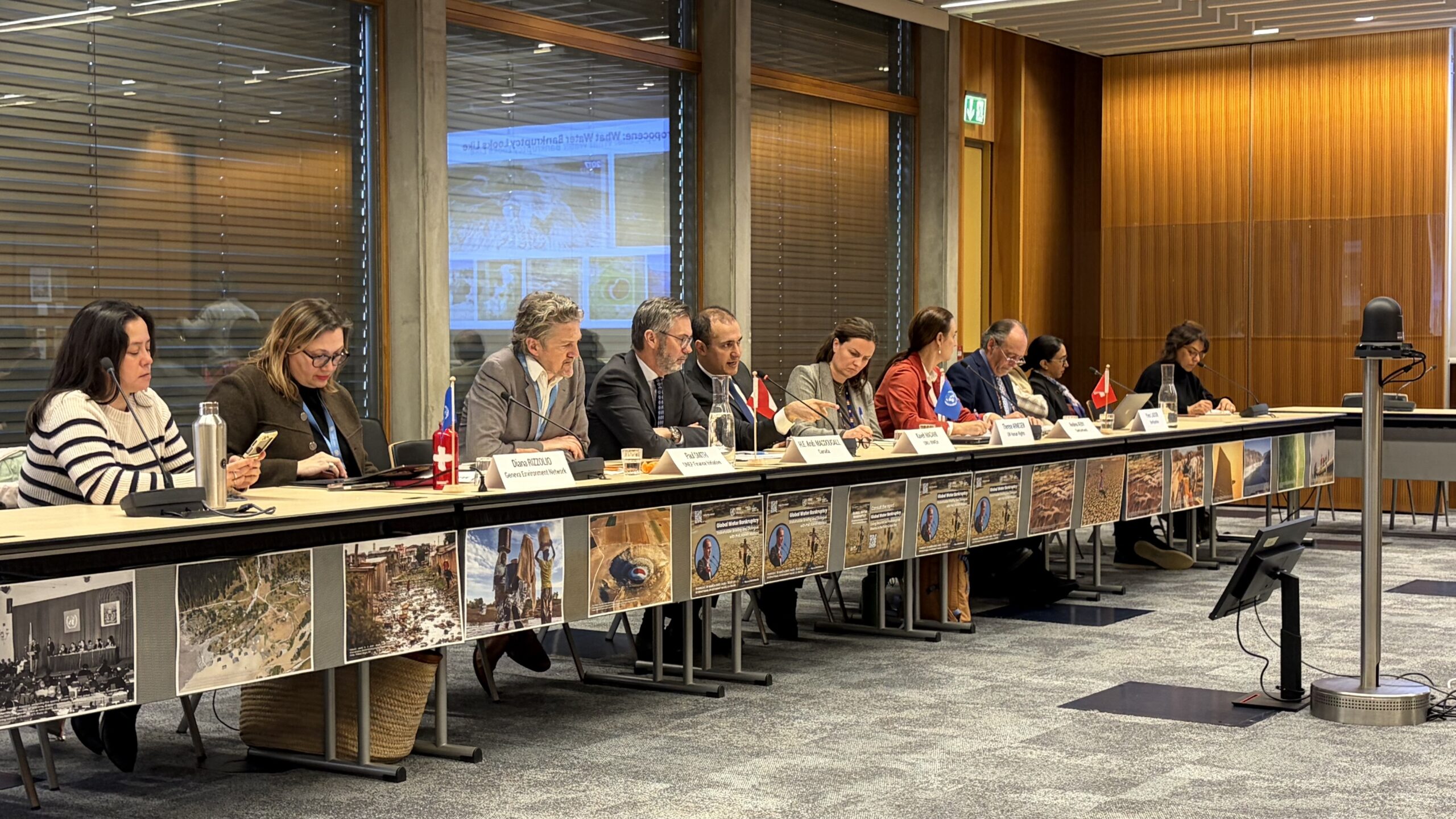
Prof. Kaveh Madani, Director of UNU‑INWEH, emphasizes water’s role in fostering cooperation across communities and borders.
The dialogue underscored the urgency of recognizing global water bankruptcy as a defining challenge of the current era and called for coordinated, evidence-based, and context-specific responses across governance levels.
Access to the event page and recording can be found here: Global Water Bankruptcy | Stakeholder Briefing and Dialogue with Prof. Kaveh Madani – Geneva Environment Network
About GEN: The Geneva Environment Network (GEN) is a cooperative partnership of more than 100 environmental and sustainable development organizations based at the International Environment House in Geneva and at other locations in the surrounding region. Established in 1999, GEN is the oldest of the thematic platforms of International Geneva, specialized in conducting multilateral activities, conferences and other events, and promoting awareness on environmental issues. The Secretariat is supported by the Swiss Federal Office for the Environment and is administered by the United Nations Environment Programme.
About UNU-INWEH: The United Nations University Institute for Water, Environment and Health (UNU-INWEH) addresses critical global challenges at the intersection of water, environment, climate change, agriculture, and health. Through research, capacity development, policy engagement, and knowledge dissemination, the Institute bridges the gap between scientific evidence and the practical needs of policymakers and UN Member States, with particular attention to the Global South. Headquartered in Canada, UNU-INWEH works with a diverse range of partners, including UN agencies, governments, academia, the private sector, and civil society, to develop solutions that advance human security, resilience, and sustainability worldwide.