


UNU-INWEH Report: Madani, K. (2026). Global Water Bankruptcy: Living Beyond Our Hydrological Means in the Post-Crisis Era. United Nations University Institute for Water, Environment and Health (UNU-INWEH), Richmond Hill, Ontario, Canada. DOI: 10.53328/INR26KAM001
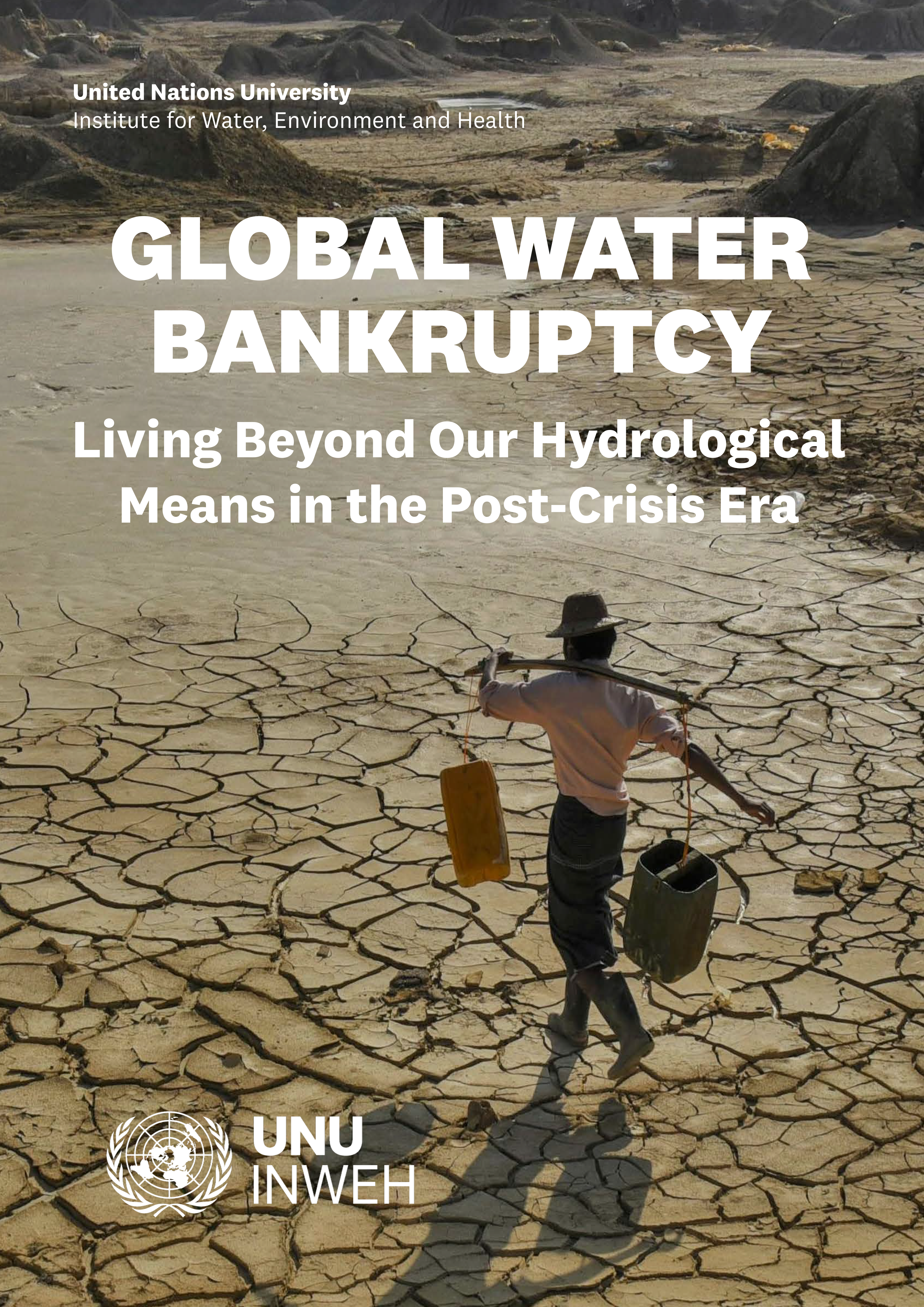
Published on the occasion of UNU-INWEH’s 30th anniversary, and ahead of the 2026 UN Water Conference, this flagship report, Global Water Bankruptcy: Living Beyond Our Hydrological Means in the Post-Crisis Era, argues that the world has entered a new stage: more and more river basins and aquifers are losing the ability to return to their historical “normal.” Droughts, shortages, and pollution episodes that once looked like temporary shocks are becoming chronic in many places, signalling a post-crisis condition the report calls water bankruptcy.
The report makes the case for a fundamental shift in the global water agenda—from repeatedly reacting to emergencies to “bankruptcy management.” That means confronting overshoot with transparent water accounting, enforceable limits, and protection of the water-related natural capital that produces and stores water—aquifers, wetlands, soils, rivers, and glaciers—while ensuring transitions are explicitly equity-oriented and protect vulnerable communities and livelihoods.
Crucially, the report frames water not only as a growing source of risk, but also as a strategic opportunity in a fragmented world. It argues that serious investment in water can unlock progress across climate, biodiversity, land, food, and health, and serve as a practical platform for cooperation within and between societies. Acting early, before stress hardens into irreversible loss, can reduce shared risks, strengthen resilience, and rebuild trust through tangible results.
Support Paper
Madani K. (2026) Water Bankruptcy: The Formal Definition, Water Resources Management, 40 (78) doi: 10.1007/s11269-025-04484-0