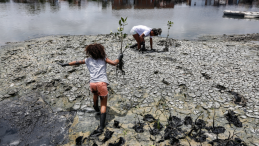


On India’s eastern coastline, the city of Visakhapatnam has in recent years experienced cyclones, flooding and rising heat. For the city’s residents, these hazards are part of their lived experience.
When Dr. Himanshu Shekhar and his colleagues began working in Visakhapatnam, residents would repeatedly point back to cyclone Hudhud that struck in 2014. It was a moment that made climate risks real and personal for many, and allowed people to deeper understand their local conditions.
Rather than starting from scratch, when Dr. Shekhar and his partners assisted urban local bodies and stakeholders in gathering and analysing data for policymaking and jointly implementing transformative climate actions, they found a strong foundation of awareness and willingness to engage already in place.
Now, Dr. Shekhar explains what made change possible and what other cities can learn from the journey of Visakhapatnam and its residents.
How would you describe Visakhapatnam’s initial approach to climate action?
Vishakhapatnam is a medium-sized, fast-emerging city in India, with around 2.5 million people. Compared to many cities of that size, it had already been quite active in enhancing urban resilience, although the approach was often reactive and top-down. There were initiatives and plans, but they often focused on immediate environmental issues such as pollution or waste. Climate-related challenges like flooding or heat stress were addressed more indirectly, often through isolated actions.
What role did citizens play in decision-making at that time?
There were mechanisms to gather feedback from residents, but not necessarily to involve them in shaping solutions. For example, there was a system where volunteers collected input from households, and government officials regularly visited neighbourhoods. But ultimately, decision-making remained within government structures. Citizens were heard, but they were not part of the process of designing or implementing solutions.
Did everyone benefit equally from the already present awareness and existing systems?
Not quite. When we looked more closely, we saw clear differences in how people were affected and what they could do in response. Certain groups, such as those with fewer socioeconomic resources, faced greater challenges. For example, some forms of early warning systems existed but did not always reach everyone, as access to smartphones or language barriers limited their usefulness. Another issue was the ability to act on the information received. If responding to a warning means losing a day’s income, many people simply cannot afford to do so.
What changed in the way decisions are made in the city?
Our IKI funded T-CAP project created a space where citizens could take part more directly. Through its Urban Living Lab (named V-PULL), residents and other stakeholders, such as NGOs, academics and policymakers were involved in sharing concerns, identifying problems and contributing to solutions. Citizens were trained to collect data, for example by neighbourhood flooding hotspot mapping. This information was then brought into a structured process where it could inform decision-making. In that sense, participation became more than consultation. It became the process co-creating solutions.
There has also been a shift in how people engage. Citizens use the lab as a platform to amplify their voice. Even when participation was still limited to a smaller group, it created a sense of ownership for people.
What also helped tremendously was that, in addition to existing awareness and engaged citizens, the city government was extremely motivated and open to new approaches. The Urban Living Lab was a mechanism to bring these elements together in a structured way. Without such a mechanism, even strong interest and good intentions tend to fade over time.
For us, one of the most important outcomes is that through the institutionalization of participatory governance, the system continues to function even after the project has ended. The Urban Living Lab is quite active and has evolved beyond the initial pilot.
What can other cities take away from this experience?
Following the pilot phase, the city continued to build on the approach and presented the Urban Living Lab as a model for participatory governance. This led to international recognition, as Visakhapatnam was selected as one of 24 cities worldwide to receive USD 1 million in funding from Bloomberg Philanthropies. The funding will support further scaling and integration of participatory and data-driven approaches across the city.
In addition to technical solutions, climate action is about how decisions are made. Often, people already experiencing climate impacts have valuable knowledge about their surroundings. The challenge is to create systems that allow that knowledge to feed into decision-making in a meaningful way. When that happens, climate action becomes more inclusive and responsive to local needs.
More information and reading are available here and here.