

An international photography exhibition exploring how cities around the world are being reshaped in response to social and environmental challenges has been drawing attention in Bonn, Germany. The exhibition Urban Transformation: Inspiration from Cities Worldwide officially opened on January 27 at P26 – the House of Knowledge and Research, where it attracted a broad and engaged audience.
Hosted by the University of Bonn’s Vice Rectorate for Sustainability in cooperation with the Transformative Urban Coalitions (TUC) project’s consortium lead, the United Nations University Institute for Environment and Human Security (UNU-EHS), the opening event brought together visitors from academia, civil society and international institutions. Conversations sparked by the photographs continued well beyond the formal programme, underscoring the exhibition’s aim to encourage exchange and reflection on sustainable urban futures.
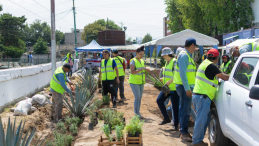
The photographs on display offer diverse perspectives on urban transformation, documenting grassroots initiatives, community-led projects and urban change across different regions of the world. Many of the images were previously exhibited at United Nations Climate Change Conferences, namely the Conference of the Parties (COP) 27, 28 and 29, where they served as visual entry points for discussions on climate action, equity and participation at the Capacity-building Hub in collaboration with the Paris Committee on Capacity-Building. Now shown in Bonn, they invite local audiences to engage with global experiences of transformation and co-creation in cities.
At the opening, welcoming remarks were delivered by Prof. Dr. Annette Scheersoi, Vice Rector for Sustainability at the University of Bonn, alongside Prof. Dr. Shen Xiaomeng, UNU Vice-Rector in Europe and Director of UNU-EHS, Sandra Müller-Tietz, Deputy Managing Director of P26, and Dr. Simone Sandholz, Head of the Urban Futures & Sustainability Transformation Programme at UNU-EHS. Speakers emphasized the importance of participation and dialogue in addressing sustainability challenges and highlighted the exhibition as a space where science, art and urban society intersect.
The TUC project, which is now approaching the final phase of its multi-year run, focuses on fostering transformative urban change through coalitions in five Latin American cities. Central to the project is the Urban Lab approach, which brings together stakeholders from different sectors to jointly develop solutions to complex urban challenges in an inclusive and participatory way. By linking climate action with social justice, the project aims to reduce both carbon emissions and urban inequality.
The photo competitions formed an integral part of this work. The first competition, titled “Visions of sustainable cities”, portrayed global visions of more desirable and more sustainable cities. Under the 2023 theme “Co-creating the cities we deserve,” participants were invited to capture initiatives contributing to zero-carbon, inclusive and sustainable cities, highlighting the role of storytelling and shared learning in driving climate action. In 2024, the focus shifted to “Portraits of Urban Change,” showcasing community-driven transformations such as revitalized green spaces, renewable energy projects, sustainability education initiatives and circular economy practices. Many of the submissions also feed into ongoing UNU-EHS research on how urban transformation is perceived and communicated through visual art.
The project, funded by the German Federal Government’s International Climate Initiative (IKI), has demonstrated how photography can make complex processes of urban change tangible and accessible. The exhibition in Bonn offers an opportunity to reflect on the stories, experiences and collective efforts that have shaped its work and to consider how urban transformation can continue as a shared, collaborative process.