

After speaking with Dr. Ambe Emmanuel Cheo about the vision behind the Agrophotovoltaics in Mali and the Gambia (APV-MaGa) project, we now turn to the field. In case you missed the interview with Dr. Ambe, the project explores how solar panels installed above crops can generate clean energy, improve water management and support more resilient farming systems.
Flannery Johnson, a UNU-VIE researcher involved in the project, recently spent nearly two weeks in The Gambia visiting the pilot sites. From long drives across the country to conversations with farmers and students, her visit offers a ground-level view of how agrivoltaics function and are perceived in practice.
What do the APV-MaGa sites actually look like on the ground?
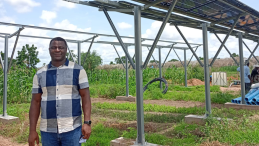
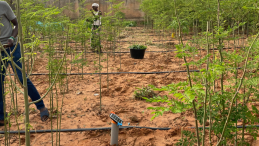
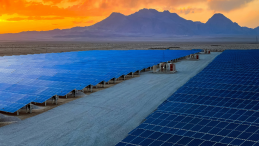
When you stand at the pilot sites, you see these rows of solar panels arranged in a V-shape. They are designed to collect rainwater but also to create shade for crops, the benefits of which we’re testing with this project. Under the panels, drip irrigation lines run through the soil, while nearby fields are used as reference plots or for conventional farming. Across all three sites – the university, the private farm and the community garden – the set-ups are similar, but used differently.
At the private site, for example, the farmer is already using the system for crops like peppers, tomatoes and onions. He can control irrigation through a dashboard instead of doing everything manually. At the university, the system is embedded in a new agricultural campus. It is still being developed, but it is already set up as a space for testing and research.
What was your first impression when you arrived and met the community?
My first stop was the community site in Fass, which is a journey to get to. The community, which hosts a women’s cooperative garden, has been involved in the project development and will be one of the test sites for developing a business case around agrivoltaic systems. When we arrived, people were curious about the sensors being installed, and community members gathered to watch. Communication between them and us required translation, but that quickly became part of the interaction. By the second or third day, people were asking questions, such as about the weather station and what data it collects.
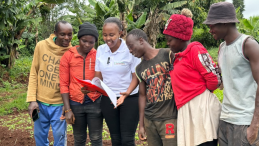
In communicating with the community, we were supported by a few young women from the village. They stepped in as translators and explained what we were doing to the rest of the community and relayed important aspects of the installation of the sensors to the farmers. The young women were from there and attending university and it was really cool to see them lead in that way for their community.
What did you observe about daily life for the farmers?
One of the clearest things for me was how much work goes into watering. The women in the community garden spent their days manually drawing water from wells and carrying it across the fields. They were doing that for hours every day, which is physically demanding and very time-consuming.
Seeing that made the idea of irrigation systems much more concrete. When you have watched that kind of work up close, the benefit of being able to turn on a system instead becomes very real.
Additionally, there was a lot of excitement around what the energy could be used for. In Fass, groundnuts are a central part of livelihoods. People already have processing mills, and with expanded access to electricity, there is a lot of interest in what that could mean for production.
Another example is the cooling room installed as part of the system. It can be used to store the crops harvested to keep them fresher for longer before taking them to market or, because the community is quite isolated, food like fish or chicken that has to be brought in from elsewhere could be stored for longer, which could make a real difference.
At the private farm, the response was equally forward-looking. The farmer was very excited. Not just about what is there now, but also about what he could build on top of it, pointing to ideas like adding additional solar panels, expanding irrigation or adding processing technologies.
What stayed with you most after returning from your mission?
Seeing both where things are now and what people are already imagining. Between the physical effort of daily farming and conversations about new opportunities through irrigation, energy use or connectivity, it was impressive how quickly interest in the system can grow once people engage with it directly.