

When Maryanne Gichanga was growing up in rural Kenya, much of her family’s livelihood depended on rainfall. Her parents were farmers, and the success or failure of their crops determined everything from daily meals to whether school fees could be paid. She remembers both “good seasons and bad seasons”, as she puts it, but when climate change began disrupting familiar weather patterns, the impact was intense and personal. Crops failed without warning, and her parents no longer understood what was happening on their own land.
This experience, she explains, inspired her from a young age. She wanted to help farming families like hers access the knowledge and tools that could protect them from the growing unpredictability of climate change. That desire would eventually lead her to found Agritech Analytics, a company that equips farmers with real-time insights into soil health, crop conditions and shifting weather patterns by combining Internet of Things (IoT) sensors with satellite data. These tools help farmers build resilience, make informed decisions and strengthen their livelihoods. Because, Maryanne believes, “When you empower farmers, their lives change.”
It was with this mission already in motion that the next chapter of her story began. As with many entrepreneurial journeys, it started long before the innovation itself. For Maryanne, that point came when her early-stage company joined Greenovations, an initiative by UNU-VIE and partners to support women and youth entrepreneurs across Africa who are driving climate solutions.
From farming roots to founding a company
Maryanne describes her childhood as a lesson in responsibility and resourcefulness. For her and her family, farming was more than a source of food. In fact, it was the foundation of their well-being. “If farming was not working,” she recalls, “it meant that we could not go to school and had trouble with our school fees.” That experience made her understand how climate change can threaten the futures of families like hers from a young age.
This personal connection is what inspired her to start Agritech Analytics, she explains: “To get people who are like-minded to be able to build this solution to support smallholder farmers.” Together, they built tools that could translate data into practical advice, something her own parents never had access to.
"When you empower farmers, their lives change." – Maryanne Gichanga
By the time Maryanne joined the Greenovations programme, her company already had a compelling mission. However, she still faced challenges that many early-stage entrepreneurs run into. “One of the greatest challenges we had early on was understanding personas,” she mentions. “Most of the time, you believe you have a solution that fits many, until someone breaks it down for you and shows you that while people’s profiles may seem similar, they are actually very different. Greenovations really shed light on learning how to unwrap those personas, tailor solutions to fit them and approach customers with empathy.” This insight allowed her team to tailor solutions more effectively and approach customers with deeper empathy, she explains: “From participating in Greenovations, we learned to understand our customers better, and because of that we were able to set different pricings for different services that we offer farmers. The programme supported us in growing into a better-functioning organization.”
According to Maryanne, her company also profited from Greenovations’ lessons on investor readiness and financial management. “When you are just starting out with your company, you do not always think about the business aspect. You just want to offer your solution. However, even if you run a social enterprise, it is still a business. To manage it well, you need to understand operations,” she elaborates, recalling the value of what she learned. “When you are employed by someone else, structures already exist, but when you start your own company you are the one deciding what happens and when, so you have to learn how to do that.”
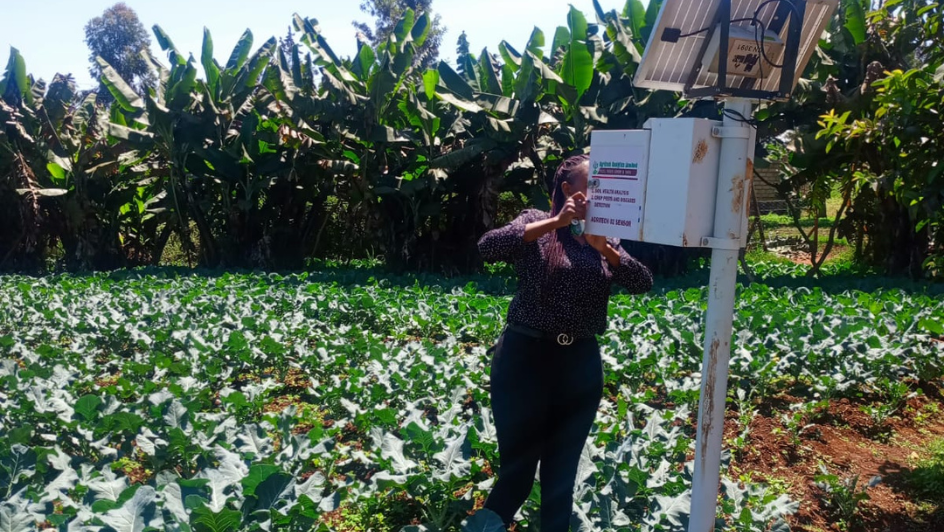
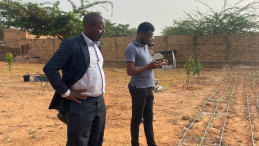
Checking the device health during a farm visit. © Agritech Analytics
Breaking barriers in a male-dominated sector
Despite the strength of her ideas, Maryanne often found herself navigating a sector where women’s leadership is not always welcomed. Agriculture in many African communities remains heavily patriarchal, and she frequently encountered skepticism about her expertise simply because she was a woman.
“I experienced that people would rather work with men. They feel that men understand better than you what it is that you do,” she shares, while adding how certain communities refused to accept solutions coming from a woman. Instead of letting these barriers discourage her, she focused on her goal. She travelled to communities to demonstrate her tools in person, worked hands-on with farmers and built trust through results that could not be denied.
She now encourages other women to pursue similar paths. There is enormous need, she says. “So many farmers are waiting for solutions.” Her advice is simple: Find your niche, stay persistent, collaborate widely and trust that the support you need will come.
Seeing lives transformed is what makes it all worthwhile
For Maryanne, the true reward of her work comes from the farmers whose lives she sees changing. She speaks with pride about families who were once unable to afford seeds but now can buy what they need, as well as farmers who now have control over the prices they sell their produce for. “It is what keeps me motivated on days that are challenging. You have to keep your eyes on why you started your journey,” she points out. “Knowing that my parents are no longer struggling, and thinking about the millions of children whose parents are farmers – the futures of those children would be jeopardized by them not having stable incomes. That is what keeps me focused.”
Maryanne and her colleagues are well aware that social issues, such as those connected to the Sustainable Development Goal 2 (Zero Hunger) for example, involves far more than addressing hunger alone. Hunger is closely connected to poverty, and limited access to education increases the likelihood that people remain in poverty. Preparing individuals and communities requires creating equitable conditions, something that is only possible when everyone has the resources needed to access what should be basic rights, even though these rights are often not truly accessible in practice. This understanding is what pushes Maryanne and her team beyond obstacles. “When you look back and realize how far you have come,” she says, “it is a reminder that giving up is not an option.”
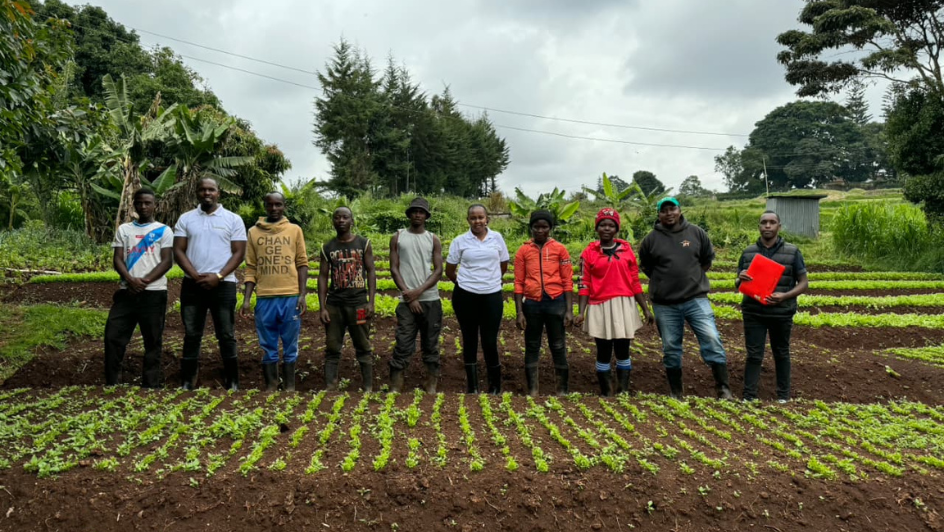
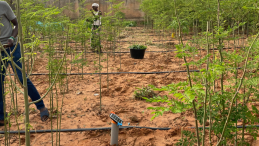
In the field during a youth empowerment training. © Agritech Analytics
Overcoming early challenges with Greenovations’ support
When Maryanne describes the early days of her company, she again emphasizes how Greenovations influenced her journey. Without the programme, she believes she would have faced much greater losses, delays and frustrations. There were moments when she questioned whether the obstacles meant something fundamental was wrong. “Sometimes, when you think you are doing everything right and there is no conversion, it makes you wonder if you hired the wrong people, if you offer the wrong trainings or if there is a barrier you do not see or understand,” she says.
Greenovations, she explains, “helped to shape what we wanted to do and how to do it,” preventing trial-and-error that could have harmed her company’s reputation. This clarity saved her team time, money and significant stress.
“Greenovations believes in small companies and offers trainings and seed capital to help such companies grow. We cannot talk about the success of our company without mentioning Greenovations.” – Maryanne Gichanga
Looking back, Maryanne sees Greenovations not only as a support system but as a catalyst that helped her company avoid missteps and grow with intention. For her, it represents the kind of initiative that truly understands the power of small companies. “It is a very important initiative, because those involved believe in the power of small companies by offering trainings and seed capital to help such companies grow. We cannot talk about the success of our company without mentioning Greenovations. I am sure many other company founders will say the same,” she expresses gratefully.
She emphasizes her deep gratitude to Greenovations and everyone involved in providing training, mentorship and belief in Agritech Analytics’ mission by stating that she hopes the programme continues to expand, so other emerging entrepreneurs can access the same support: “I hope Greenovations will remain and grow, so that the people involved can support more future entrepreneurs who need them the same way we did as we try to deal with climate change and contribute to achieving the Sustainable Development Goals.”
-----------------
Greenovations Africa is a pan-African initiative that brings together innovators, entrepreneurs, mentors, technical experts, investors and support organizations — with a special focus on women and youth — to turn green ideas into viable, climate-smart businesses. Through a virtual incubator and mentorship programme, it offers participants online courses, technical training, business coaching and mentorship. Selected early-stage ventures also received seed grants and access to a network of funders, investors and “green hubs” to scale their impact. Applications to take part in the programme are closed. Greenovations Africa Phase Two aims to accelerate women’s entrepreneurial leadership in climate action in Africa and Latin America, through tackling the heavy load of unpaid care work and limited access to climate finance. More information about Greenovations, funded by the International Development Research Centre, is available here.