

In hot and dry regions in West Africa, farmers are facing growing pressure from climate change, water scarcity, land conflict and rising energy needs. The Agrophotovoltaics in Mali and the Gambia (APV-MaGa) project explores a simple but promising idea to address such pressures through using the same land to grow food, produce clean energy, harvest rainwater and manage water more efficiently.
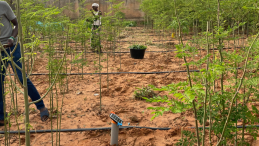
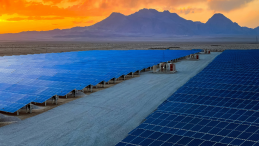
By installing solar panels above crops, the project creates shade that helps protect plants from extreme heat and weather, while also generating electricity and collecting rainwater. Smart monitoring tools support better irrigation decisions, helping farmers use water more carefully and sustainably.
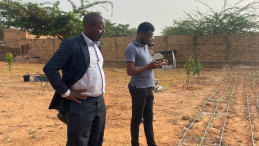
One of the people closely involved in this work is Dr. Ambe Emmanuel Cheo, Head of UNU-VIE’s Pan-African Cooperation and Educational Technologies division, who recently travelled to The Gambia to visit the project sites where the initiative is currently being tested through three different pilot models: one hosted by a private actor, one embedded in a community setting and one based at a university.
“We did not want people to be the only beneficiaries, but also generate environmental benefits,” Dr. Cheo explained. “The goal is to ensure that energy solutions create a real impact at community level, while also offering alternative sources of income that can be sustained and scaled up.”
This emphasis on community ownership and capacity-building is central to the project’s design. After his field visit, we sat down with Dr. Cheo to talk about the people behind the project, the challenges they face and what success could look like in the years to come.
Who are the people APV-MaGa is designed for in The Gambia, and what does their daily reality look like today?
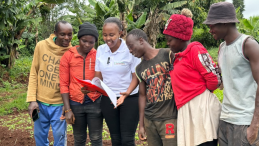
At the heart of the community pilot is a group of women smallholder farmers who collectively manage a community garden. Like many women farmers across the country, they balance farming with responsibilities at home and within their wider community.
The project introduces a solar-powered irrigation system equipped with solar-powered irrigation. In the other two project sites, the system even allows farmers to give their crops the right amount of water at the right time. A lot of farming in the region relies on manual labour, especially when it comes to watering. By automating irrigation, we reduce the physical workload and free up time for farmers to engage in other income-generating activities.
How will the smart irrigation and sensors improve farmers’ control over water, and what does “better water control” mean for a farming household or a growing season?
Water scarcity is a critical issue in The Gambia, especially during the dry season. Without reliable information on crop-specific water needs, farmers sometimes over-irrigate, which can contribute to groundwater depletion.
By combining smart irrigation with rainwater harvesting, the system helps reduce pressure on groundwater while supporting year-round farming. Better water control is not just about efficiency, but also about stability for a household and for a growing season.
How are local participants involved, and why is them building capacities so important?
Capacity-building is a cornerstone of the project. Throughout the implementation, including during the field mission, training sessions were held with universities, local stakeholders and farmers. These sessions focus on system operation, basic maintenance and troubleshooting.
Universities play a dual role. They act as research hubs while also employing community members on their farms. Students are equally involved, using the system as a platform for applied research and innovation.
Building trust, however, took time. Some communities have seen projects come and go. There were understandable concerns about continuity. Clear communication about the project’s objectives, business model and long-term vision was essential. But through that and over time, consistent engagement helped build confidence and local ownership among community members.
What do you hope will be different in five or ten years?
Looking ahead, we are confident that the benefits will extend well beyond the pilot phase. Reduced labour, more predictable yields and improved water management can strengthen household resilience and lower farming costs. Digital tools also open new opportunities for learning, collaboration and innovation. When I was in the Gambia, farmers told us how they often invest what little they have in seeds and inputs, only to lose everything because the rains don’t come. Being able to control water access can make a lasting difference.
--
Through the integration of crops and solar panels on the same land, APV-MaGa explores new ways to strengthen food, energy, and water security in Mali and The Gambia. By making agricultural systems more resistant to climate stress, the project funded by BMFTR and implemented in collaboration with German and African partners aims to develop practical and sustainable solutions that could be adopted more widely in West Africa.