

Who: Yauheniya Shershunovich, Associate Academic Officer, Well-being and Equity (WE) Initiative, UNU-EHS
When: 19–24 July 2026
Where: Thimphu, Bhutan
Why: To explore how well-being can shape future governance, climate action and the post-2030 sustainable development agenda.
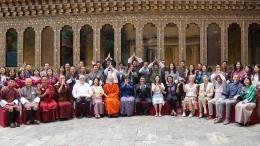
We often measure progress by looking at economic growth. The question is if a growing economy automatically means people are healthier, happier or living in a better environment. Bhutan has been part of this conversation through its philosophy of Gross National Happiness since decades. In July 2026, researchers from three United Nations University institutes (UNU-EHS, UNU-IAS and UNU Global Health), came together in Thimphu for the first Well-being Alliance for Research and Policy workshop. Together with partners from Bhutan and beyond, they explored how different ways of understanding well-being can strengthen policymaking and contribute to the post-2030 sustainable development agenda.
As an economist researching well-being, UNU-EHS expert Yauheniya Shershunovich explores how societies can better understand progress beyond economic growth.
Humanity is facing multiple interconnected crises. Why is well-being such an important lens for understanding sustainable development?
The goal of development is not simply economic growth, but the well-being of both people and planet. The crises we face today – climate change, biodiversity loss, growing inequalities and declining trust, among others – show that our current development model is not delivering that outcome.
For decades, Gross Domestic Product (GDP) has been the main indicator of measuring progress. While useful for tracking economic activity, it was never designed to indicate whether people are healthy, thriving or living in harmony with nature.
Well-being offers a broader lens. It recognizes interconnected factors like health, education, meaningful work, strong communities, a healthy environment and opportunities for future generations. Because the well-being of people and planet cannot be separated, there is growing recognition that these things tell us more about whether development is truly improving lives while respecting planetary boundaries.
Why was Bhutan the right place to have these conversations?
To have such conversations, you need to be willing to step outside mainstream thinking. Bhutan has a long history of questioning how progress should be defined and one of the few countries that tried to build development around well-being rather than economic growth alone.
The best-known example is Gross National Happiness (GNH). In the 1970s, when the Fourth King of Bhutan, Jigme Singye Wangchuck, was asked about the country's Gross National Product, he replied that Gross National Happiness was much more important. That idea became the guiding philosophy behind Bhutan's approach to development ever since. It does not reject economic growth, but asks a bigger question of growth for what?
You can still see that thinking in Bhutan today. It is one of the few carbon-negative countries in the world, and initiatives like “Gelephu Mindfulness City” try to combine economic opportunities with the country's values and long-term vision.
What stood out most during the workshop?
The workshop was designed to combine scientific discussions with creative and reflective activities. Alongside presentations and moderated discussions, participants took part in a guided drum circle, immersive theatre imagining post-2030 futures and mindfulness sessions. I was impressed by how naturally people engaged and how this created conversations that might not have emerged in a more traditional workshop setting.
The discussions themselves covered a wide range of topics, from well-being indicators beyond GDP and circular economy to mental health, equity and different relationships with nature. One theme that kept coming back was that values and spirituality matter in shaping development decisions.
Another conversation that stayed with me was whether economic development and long-term well-being really have to compete. Rather than treating them as opposites, participants explored how diverse knowledge systems can help find approaches that support both.
How can these conversations and ways of thinking influence future research and policymaking?
A big takeaway for me was that improving well-being requires closer collaboration between researchers, policymakers, practitioners and communities who all have different knowledge to contribute. None of today's interconnected challenges can be solved by one group alone.
The conversations also reinforced the need for stronger evidence on well-being-led governance and for that evidence to inform future policy discussions, including the post-2030 sustainable development agenda. One important outcome is the proposed Well-being Alliance for Research, Policy and Practice, which will likely launch next November to strengthen global collaboration across research and policymaking.
For me, the most valuable outcome is less tangible. The perspectives, ideas and experiences shared throughout the workshop will continue to shape how we approach our research, partnerships and engagement with policymakers. In that sense, the workshop was not an endpoint, but the beginning of an ongoing collaboration.