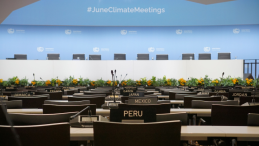


Every June, countries party to the United Nations Framework Convention on Climate Change (UNFCCC) make an annual stop in Bonn for the June Climate Meetings. Here, the parties continue the work decided at the previous Conference of the Parties (COP) held each November.
Officially called the Subsidiary Bodies (SBs), these meetings are smaller and meant for getting the legwork done. They are crucial and often work on heavy items, such as climate finance or the implementation of the Global Goal on Adaptation, continue. Its size allows for an intimacy that the big conference does not, which is helpful for negotiators and scientific experts, but also for those new to or learning the processes of international climate policymaking.
For students of the Joint Master’s Programme of Geography of Environmental Risks and Human Security, this can be the case. With the meetings taking place just below the UN Campus, at the World Conference Center in Bonn, the action happens at the programme’s doorstep.
Delegates have access to the UN campus during the meetings and literally walk the same halls as students for two weeks. It can be an inspiring moment for the students who learn about the process in their joint master’s courses and even participate in a mock COP.
One moment, they are learning the processes and key roles, such as the COP President, and the next, they are watching the actual COP President move between meetings on campus.
Each year, the Master’s Programme organizes a talk by delegates and staff of the UNFCCC at the UN Campus, who share their knowledge of the process. The discussion is always an insightful one that allows students to learn the nuances a textbook cannot teach. The topic this year was just transition and equity.
“Hearing from people involved in the negotiations is incredible,” said student Elisha Darko of Ghana. “We often hear the geopolitical sides of things on the news, but we got a glimpse behind the curtain. I like how they highlighted the importance of countries fulfilling their commitments and preparing for climate impacts.”


Though students cannot obtain accreditation through UNU-EHS to attend and observe the official meetings, some students do gain accreditation through other means.
At SB 64 this year, current student Odette Ferrer of Mexico, supported the Mexican delegation. She was tasked with following meetings and negotiations on the adaptation agenda and writing daily reports detailing the discussions.
Ferrer was also a part of the ACE Youth Hub at UN Climate Change, which connected her with other young changemakers involved in climate action. With the hub, she participated in training seminars aimed at deepening skills in climate policy.
“The SBs offered a space to talk with negotiators and experts and to learn more about this multilateral process,” said Ferrer. During the meetings she also tried to draw connections to the Master’s Programme curriculum: “For me it, was important to see the linkages of disaster risk management and climate adaptation. We learn about risk assessments and resilience in the classroom, and here we see them as integral parts of the negotiations.”
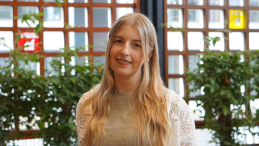
Other students attended as observers through non-governmental organizations. Stella Eick of Germany followed the climate finance negotiations.
"Following the climate finance negotiations made it clear that adaptation and resilience depend on more than just climate action plans – they require strong scientific evidence and adequate finance”, said Eick. "Seeing how countries negotiate the resources needed to put those ideas into practice gave much more meaning to what we study."
Though smaller, the SBs still provide some of the same energy as the larger COP and are a rallying point for climate action. The students left with a deeper understanding that while international climate negotiations are challenging, they remain essential – and that progress will require greater urgency, more science, cooperation and international commitment.
“Though it is a challenge, these conferences show how important international cooperation and finding common ground are,” reflected Eick. "They also reinforce the need for greater solidarity with the countries most vulnerable to the impacts of climate change."
To learn more about the Master's Programme, click here.