

In 2015 and 2016, successive disasters in Nepal brought prolonged hardship to the country – first a devastating earthquake and then extreme flooding. Master’s Programme alumnus Niroj Sapkota remembers all too well. From the earthquake he remembers the rubble, the chaos and the feeling of being trapped in Kathmandu. From the floods he remembers the weight of the sandbags he stacked to protect homes.
At the time, he was 23 years old and studying at Kathmandu University to become an environmental engineer. He was the class representative. Outside of university, he dedicated time to student-led conservation efforts, supported rural health projects and often returned to his birth village to help his family’s agricultural work. He was on a path.
The earthquake and the floods could have easily knocked him off. But, seeing the devastation around him, Sapkota realized he could do more. Beyond what he already knew, he wanted to understand why these events were happening and how he could be a part of the solution.
I definitely did not hear about it before, but I saw the potential to be at the forefront of making an international difference.
After his bachelor's degree, he joined a sustainable water solutions company focused on designing things like filtration and rainwater harvesting systems. At the same time, he geared his next academic steps toward finding a master’s degree that dove into the social aspects of disasters and environmental risks in the hope that it could help explain the things he saw but did not fully understand.
Chasing an academic goal to study abroad, he saw great options around the world. However, while looking for scholarship opportunities through the German Academic Exchange Service (DAAD), he stumbled upon a programme he had not heard of, the Joint Master’s Programme Geography of Environmental Risk and Human Security at the United Nations University Institute for Environment and Human Security (UNU-EHS) and the University of Bonn.
“I definitely did not hear about it before, but I saw the potential to be at the forefront of making an international difference”, he said. With that in mind, he set his sights on Bonn.


Making the leap
Arriving in Bonn in the fall of 2019, he hit the ground running. “I was in a very international class, and I immediately felt the excitement that you get from talking to people from so many different cultures”, said Sapkota, who once again took on the role of class representative.
The curriculum was enlightening, too. He learned valuable lessons in vulnerability, resilience and preparedness and drew connections from his experiences back home in Nepal.
“My eyes opened to the progression of vulnerability. It got me thinking about why things happen when they do”, recalls Sapkota. Things were clicking.
However, life came to a halt again. This time it was not an earthquake or flood; it was the COVID-19 Pandemic, which brought the entire world to a standstill.
As distancing measures took effect and the pandemic went on, the mental toll weighed. Taking the lessons learned from only a few years prior, he had no choice but to be resilient. He kept his head in the books and banded together with his classmates, despite the challenges of distance learning.
He got his hands dirty however he could. As a student assistant, he co-authored research papers and put newly learned GIS and data analysis skills to use by remotely supporting UN-OCHA response efforts to the La Soufrière volcano eruption on the island of Saint Vincent in 2021.
As Sapkota finished his thesis, he applied for a 6-month internship at the UN Secretariat in New York. Initially unsure of his chances, he soon found himself in the Big Apple working for the United Nation’s Central Emergency Response Fund (CERF). “By the end of the internship, I was learning so much and applying what I learned theoretically through the Master’s Programme”, he said.
He finished the programme in exactly two years, and then prepared for a return to Nepal in 2022. Satisfied with his experience abroad for the time being, he was eager to take what he learned back home.
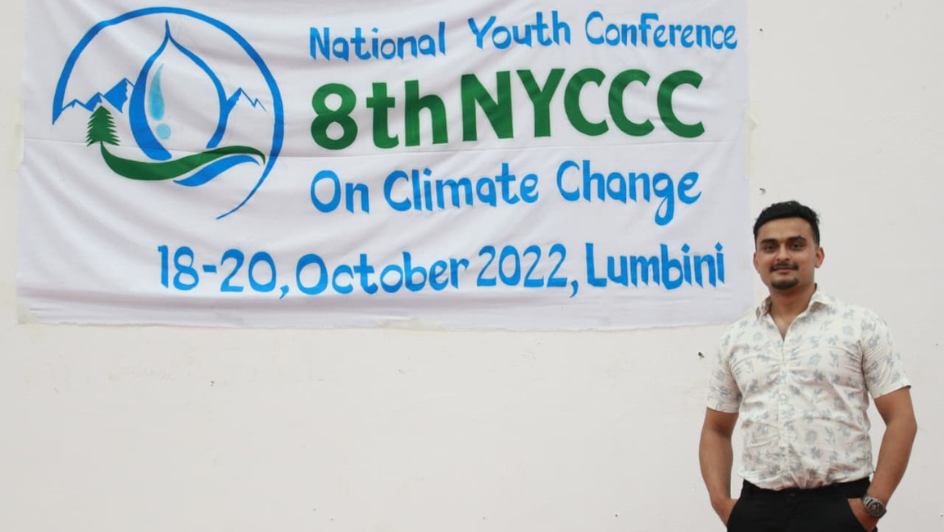
Sapkota at a youth climate change conference in Nepal. ©Kamal KC
Making an even bigger leap
First, he rejoined the water company, using his knowledge to integrate climate and disaster risk reduction measures into its portfolio. In his next job, he led a network of 32 NGOs and INGOs in implementing anticipatory action and early warning measures in Nepal. As he travelled to villages and cities to implement their projects, he felt the impact he was making at home.
“A lot of things I was able to spearhead are still being implemented there”, he said.
However, it was not long before the opportunities back in the UN came calling. A position opened up at the Complex Risk Analytics Fund (CRAF’d), which is under the Executive Office of the Secretary General. Fitting his profile, he decided to apply. A full-time move to New York felt daunting, but previous experience told him he could do it. The opportunity was too good to pass up.
The work I am part of is crucial. It can help understand where the next displacement might occur or where climate impacts are being felt.
Now, at the UN Secretariat, Sapkota sits a floor below the Secretary-General – a world leader he is now accustomed to seeing occasionally walking the halls. As a Programme Manager, his work supports the funding of projects that collect data and information used by NGOS/INGOs, UN organizations and policymakers to make informed decisions to prevent and respond to crises. He leans on the multidisciplinary skills he gained in the Master’s Programme as the fund’s work touches on a range of thematic issues, from climate change to food insecurity to conflict.
“What we do is try to connect all the dots of crises or issues through data and analysis”, said Sapkota, who helps manage 19 projects. “The work I am a part of is crucial. It can help understand where the next displacement might occur or where climate impacts are being felt.”
He gets to be a part of big things at the UN, including its innovation drive. Working closely with partners like tech companies and academia, CRAF’d is at the forefront of integrating artificial intelligence into crisis action. In being part of such work, Sapkota credits the role of the programme in preparing him.
“I am grateful I made it here and grateful to the programme that helped lead me to this. It was just a step, but a big step”, he said, before acknowledging those who matter the most. “But I really owe it to my family, the village that raised me and the supportive people I have met along the way.”
Learn more about the Master’s Programme here.