

What does the first Strasbourg forum reveal about the gaps in protecting environmental human rights defenders in Europe and beyond?
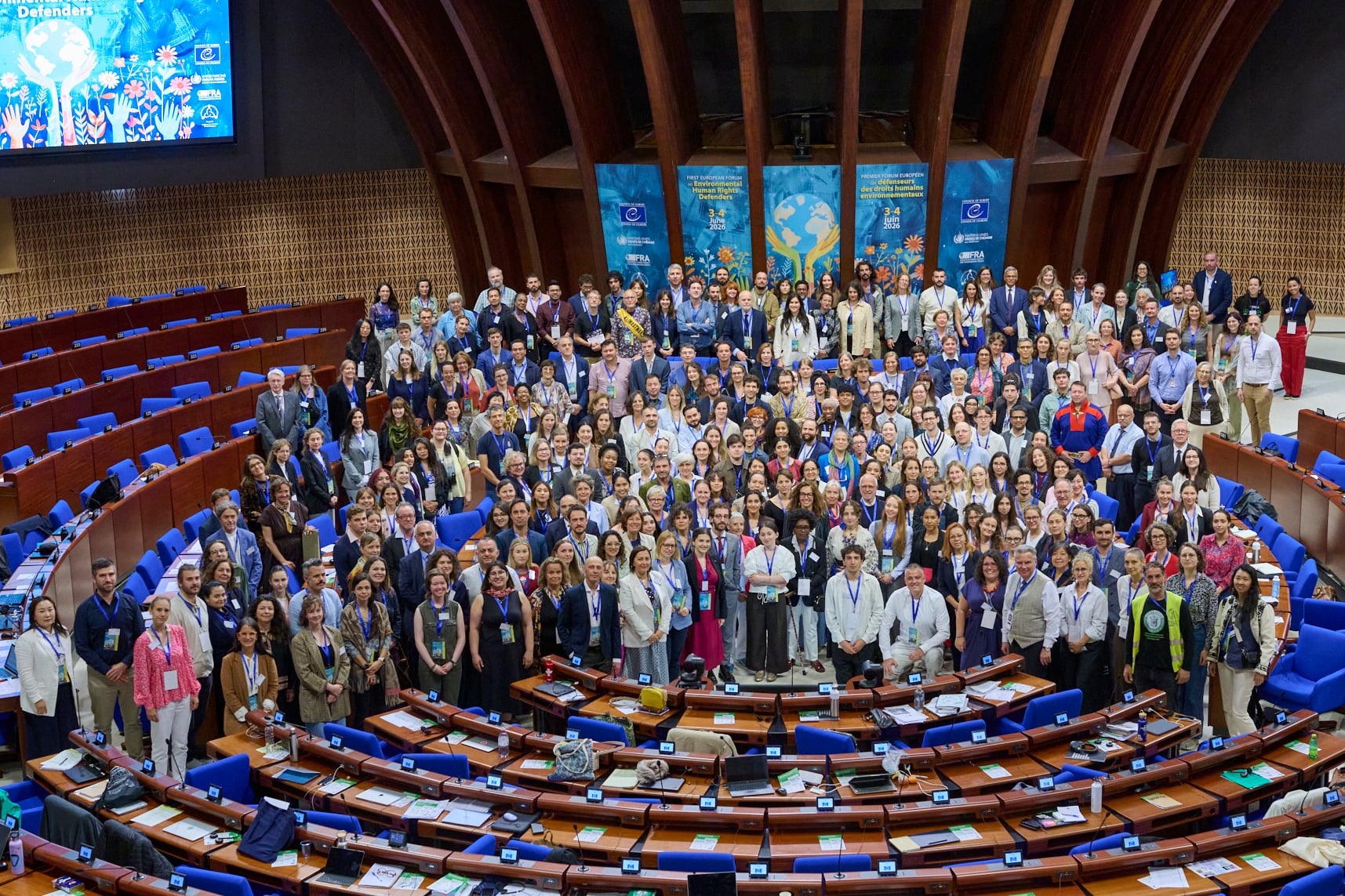
Group photo of the First Environmental Human Rights Defenders Forum (Strasbourg, June 2026)
Source: Council of Europe.
From Dialogue to Structure
For the first time in Europe, at the heart of democracy, the rule of law, and human rights, Environmental Human Rights Defenders (EHRDs) gathered at the Council of Europe (CoE) in Strasbourg. Participants from across the world, from Uzbekistan to French Guiana, and from Norway to Chile, became the voice of human rights defenders, both for those who could be present and in memory of those who could not.
The two-day forum began the previous evening with a meeting of young environmental human rights defenders. The discussions initiated there continued during the first day of the forum with civil society representatives, lawyers, and Indigenous people. The first day–which was closed to institutions, media representatives, and academics–was dedicated exclusively to experience-sharing among environmental human rights defenders. Participants worked in groups under the themes of “Environmental Deregulation and the Right to a Healthy Environment”, “Criminalisation and SLAPPs”, and “Corporate Harm”. Through group discussions and collaborative work, participants exchanged views, challenges, and proposals.
The objective of the first day was to formulate a clear set of challenges, expectations, and proposed solutions to be presented to representatives of states, political parties, and institutions invited to the second day of the forum. At the end of the day, all problem statements and proposed solutions were presented and democratically voted on by participants in the hemicycle. Through discussion and voting, participants collectively decided what messages would be shared on the following day.
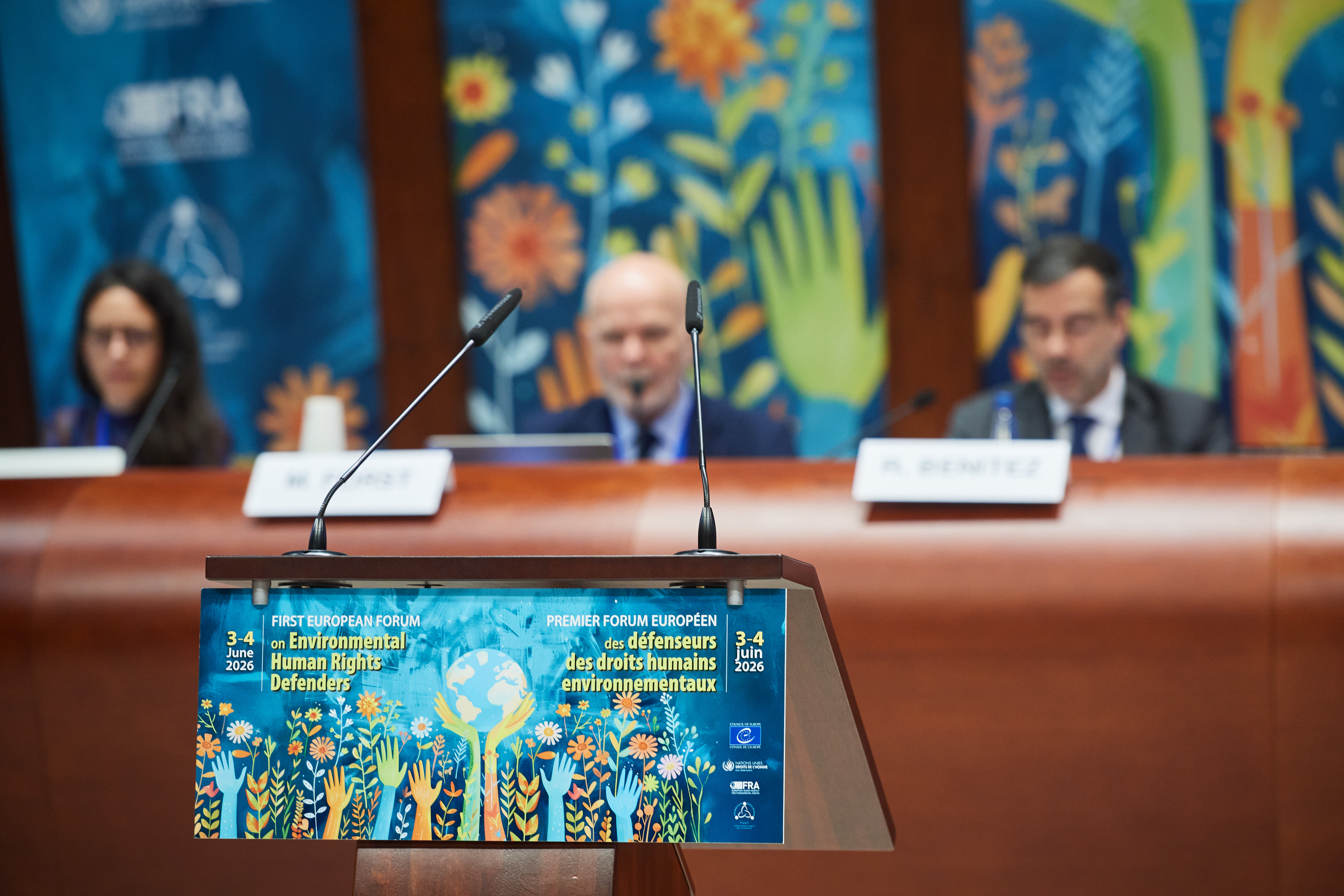
Event banner with Michel Forst (UN Special Rapporteur on Environmental Defenders under the Aarhus Convention) and forum participants in the background.
Source: Council of Europe.
Protection Gaps Exposed
The forum identified several major challenges faced by Environmental Human Rights Defenders. These included the misuse of legal frameworks against EHRDs; the use of legal mechanisms to pressure those defending the environment; and restrictive and deterrent policies adopted by governments and politicians against environmental advocacy.
Participants highlighted the limited recognition of EHRDs as human rights defenders and concerns regarding their criminalisation through anti-terrorism and criminal legislation. Additional forms of pressure included punitive taxation measures, repeated questioning at airports, restrictions on opportunities to speak publicly, and other practices aimed at silencing defenders. Concerns were also raised regarding censorship in the media and restrictions on public gatherings through violations of the freedom of assembly.
Furthermore, participants pointed to administrative decisions and regulatory changes that weaken the implementation of existing environmental protections. A recurring concern was the lack of recognition of the right to a healthy environment at the CoE level, as well as the lack of enforcement and political commitment even in states where this right is recognised constitutionally.
Beyond these substantive discussions and conclusions, participants acknowledged that many of these problems reflect a broader decline in the CoE’s three core values: human rights, democracy, and the rule of law. Environmental degradation was consistently linked to the weakening of these principles.
Authoritarian governance, corruption at the state level, and conflicts between governmental interests and the interests of local communities were identified as recurring patterns across different regions of the world. These underlying structural problems were recognised as key factors creating the need for EHRDs in the first place.
A Dialogue Without Partners
The efforts made by Environmental Human Rights Defenders to gather in Strasbourg should not be underestimated, as many participants attended despite serious security concerns, fully aware that their participation could expose them to further risks, reprisals, and intimidation both during and after the forum.
However, the participation of invited state representatives, public officials, and international organisations fell short of expectations. Beyond the absence of many invited representatives, several of those who attended delivered prepared statements and left immediately afterwards, without engaging in the discussions. The forum therefore highlighted not only the challenges faced by EHRDs in the field, but also the difficulty of finding responsible counterparts willing to listen, engage, and respond. Participants emphasised that meaningful environmental governance requires dialogue between those experiencing the realities on the ground and those responsible for shaping policy and ensuring accountability. Without such engagement, the gap between environmental defenders and decision-makers risks becoming even wider.
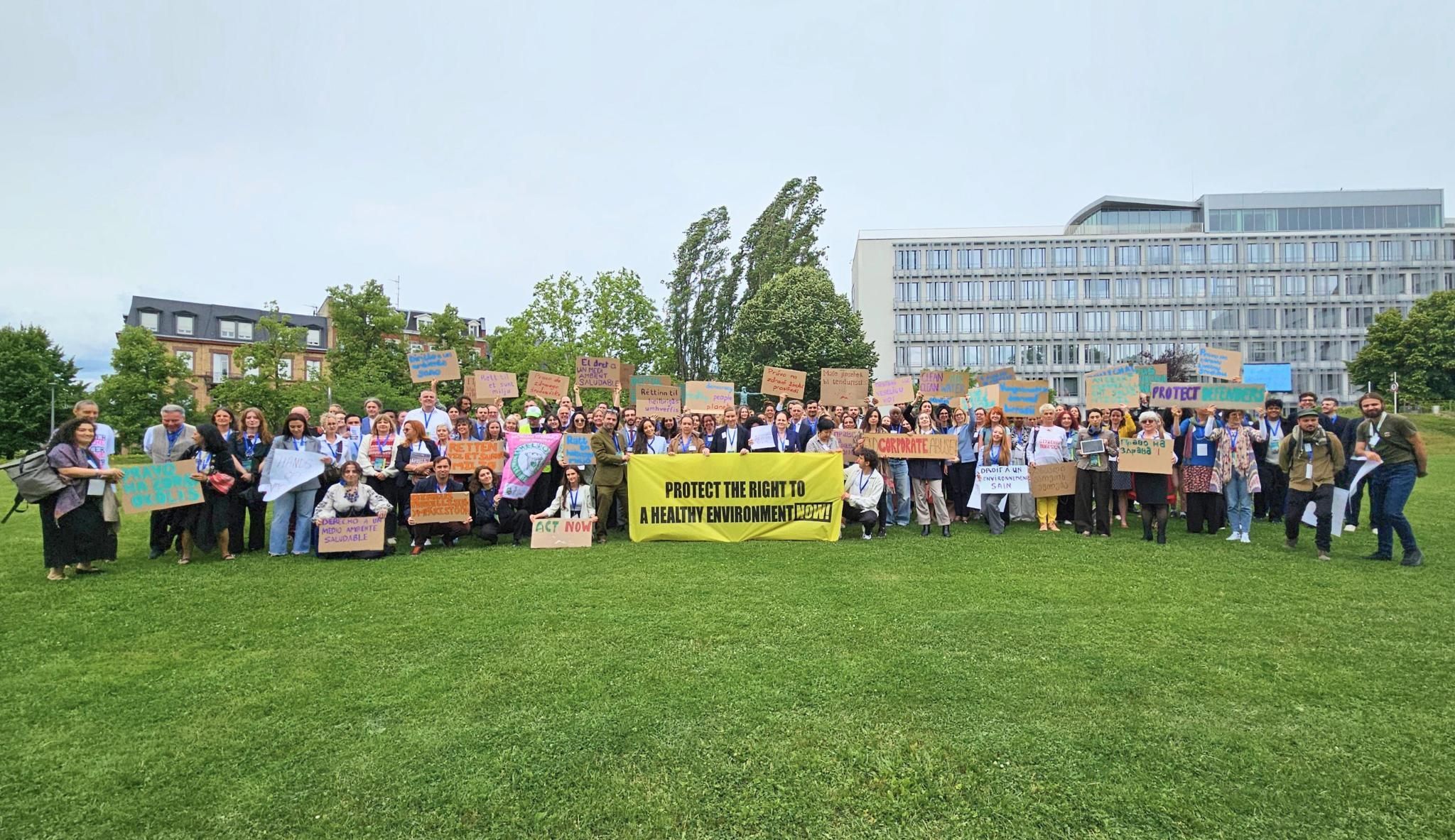
Environmental Human Rights Defenders standing in the Council of Europe’s garden in front of “Right to a Healthy Environment” banners in different languages.
Source: Anonymous.
Towards Effective Protection
Several practical recommendations emerged from the discussions.
Environmental and social impact assessments should be conducted before projects begin, and their findings must be legally binding within a coherent framework. Full compliance with existing environmental laws is essential.
Transparency and access to information must be guaranteed from the earliest stages of decision-making to ensure informed public participation.
Meaningful public participation should be ensured through a bottom-up approach, with the genuine inclusion of local and affected communities, including their environmental, cultural, and social values.
Decision-making processes should systematically integrate public input, with stronger engagement between international organisations and local communities.
Monitoring and accountability mechanisms must be strengthened to ensure state compliance and effective oversight of environmental impacts, including clear identification and responsibility of corporate and institutional actors.
Access to justice and legal protection must be reinforced through effective enforcement of anti-SLAPP regulations, removal of procedural and financial barriers, and adequate training for judicial actors. Existing CoE standards should be fully implemented.
Democratic freedoms including expression, assembly, and participation must be protected without creating a chilling effect on EHRDs and the public.
Sanctions and enforcement tools should be proportionate and effective, including financial penalties for non-compliance with anti-SLAPP obligations, and consideration of funding consequences for repeat offenders. Cross-sector environmental case monitoring should be reinforced.
To conclude, the forum began with the testimonies and experiences of environmental human rights defenders, highlighting the wide range of pressures they face, including killings, enforced disappearances, strategic lawsuits, misuse of legal frameworks, and other forms of intimidation aimed at silencing environmental advocacy. Building on these experiences, participants discussed the broader implications of such practices for environmental protection and democratic governance. The overarching conclusion of the forum was that environmental protection and democracy are intrinsically linked.
Achieving an ecological transition that benefits present and future generations requires meaningful public participation, trust in democratic institutions, and effective accountability mechanisms. Courts must play a central role in holding states accountable, while governments should ensure openness to public debate and scrutiny. Access to environmental information, access to justice, and the protection of freedoms of expression, assembly, and association were identified as essential pillars of environmental democracy and indispensable conditions for addressing current environmental challenges.
Suggested citation: Hatice Nihan Sarihan., "Protecting Those Who Care: Reflections from the First Environmental Human Rights Defenders Forum," UNU-CRIS (blog), 2026-06-23, 2026, https://unu.edu/cris/blog-post/protecting-those-who-care-reflections-first-environmental-human-rights-defenders.