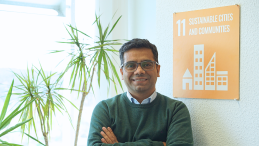


Who: Tarisai Kanyepi, Senior Programme Associate at UNU-VIE’s Pan-African Cooperation and Educational Technologies (PACET) unit
When: 07–09 July 2026
Where: Villages of Nakpanyoo, Sabangu and Chegu, Ghana
Why: To work with farmers to make sustainable farming knowledge easier to understand and use
Agricultural training often relies on workshops or demonstration farms, but these approaches do not always reach everyone. As part of the COINS project, our expert Tarisai Kanyepi worked with partners in Ghana and Senegal to co-create tools that make sustainable farming practices easier to understand and apply. We spoke with her about what the project taught her about learning, inclusion and listening to farmers.
What was the main challenge you were trying to overcome?
We were trying to promote what we call “sustainable intensification”. That means increasing productivity on the same piece of land while maintaining healthy soils, instead of expanding farmland. A big part of that is maintaining good soil fertility through integrated soil fertility management practices.
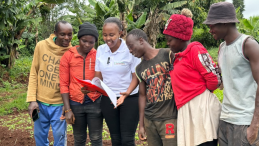
Many farmers are already familiar with practices that improve soil fertility, but some of the techniques are quite complex. Our role was to explore with them how together we could develop ways all farmers could understand and use these techniques. We found it important that learning shouldn't be boring, so we developed different tools together with farmers and local agricultural experts. These included picture-based storybooks, videos in local languages and games that people could play in groups. All of these were designed to make learning more engaging and accessible.
What makes an agricultural training programme truly effective?
An effective training programme is one that is inclusive. It should certainly succeed in sharing knowledge, but it also has to reach everyone who is a farmer. For example, in many agricultural programmes, women are often left out. In the communities where we worked, certain training activities are attended mainly by men. We also have young farmers and farmers with limited literacy. If we want knowledge to make a difference, we have to think much more broadly about who should be able to access it and consider how they learn best.
What have you learned about the role of visual and hands-on learning in helping farmers adopt new practices?
Knowledge alone is not enough. If information is not presented in a format that farmers understand, adoption becomes much more difficult. The videos were one example. Rather than having an outside expert explain a practice, we worked with farmers who had been using these methods for years. They spoke in their own language and showed the practices on their own farms. They also shared their experiences, including the concerns other farmers might have and why they believed the practices were worthwhile.
Farmers trust other farmers. Trying a new practice is always a risk, so seeing someone from your own community explain why it works makes a real difference.
What changes when farmers become co-creators of learning materials instead of recipients only?
It changes a lot. We started with ideas for the storybooks, but farmers quickly pointed out where things did not reflect reality. Together with local agricultural experts, they helped us adapt the materials so they actually matched the local context.
For me, one of the biggest “aha” moments came after that. When we shared our findings with the farmers, they challenged them. They acknowledged the benefits of combining manure and fertilizer but pointed out the additional labour it required – something we had overlooked. Suddenly, the researchers became the students. It was a strong reminder that also in research, knowledge flows in both directions.
What helps new knowledge become part of everyday farming practices?
I think we should move beyond relying only on demonstrations or conventional farmer training schools. Those approaches can work, but they have limitations because people learn in different ways. Some people may struggle with written materials, while others learn better through discussion or by seeing another farmer practice a certain technique. Giving people different ways to learn makes it more likely that new knowledge becomes something they actually use in their daily work.
What lessons from this work do you think should influence the future of agricultural extension in Africa?
We need more innovative ways of sharing knowledge. Additionally, there is so much value in working with local institutions and local expertise. In our case, for example, the videos remain with our project partners, who can continue sharing them with communities long after the project has finished. That was also what we wanted: to create something that stays with communities after the project ends.
More broadly, I think we need to see farmers as partners in learning rather than only recipients of information. When we create knowledge together, the results are much more relevant, practical and inclusive.