


To mark the International Day of Commemoration in Memory of the Victims of the Holocaust (27 January), the United Nations Regional Information Centre (UNRIC), in cooperation with United Nations University – Maastricht Economic and Social Research Institute on Innovation and Technology (UNU-MERIT) and the United Nations Student Association Maastricht (UNSA), organised a UN Cinema screening of the documentary The Last Ones of Auschwitz at the United Nations University in Maastricht, the Netherlands.
The 70-minute film by Sophie Nahum and Leslie Benitah brings together the testimonies of Holocaust survivors, with a particular focus on those who endured the atrocities of Auschwitz-Birkenau. Filmed over several years, the documentary forms a powerful historical record and highlights the human cost of hatred, persecution, and systematic violence.
The screening and panel discussion, attended by about 50 students, was part of the UN Outreach Programme on the Holocaust.
The screening was followed by a moderated panel discussion with Frédéric Crahay, Director of the Auschwitz Foundation in Belgium; Mila Paspalanova, OHCHR Anti-Racial Discrimination Advisor for Europe; and Dr. Julieta Marotta, Assistant Professor at UNU-MERIT. The discussion was moderated by Marian Blondeel, Head of Benelux & EU Desk at UNRIC.
Reflecting on the survivors’ testimonies, OHCHR’s Mila Paspalanova asked, “What makes us survive? I don’t see any bitterness in any of these testimonies,” underscoring the importance of remaining connected to one’s dignity and humanity. She noted that trauma can be carried across generations. She also spoke about various human rights frameworks specifically created to protect vulnerable groups, and grounded in international resolutions.
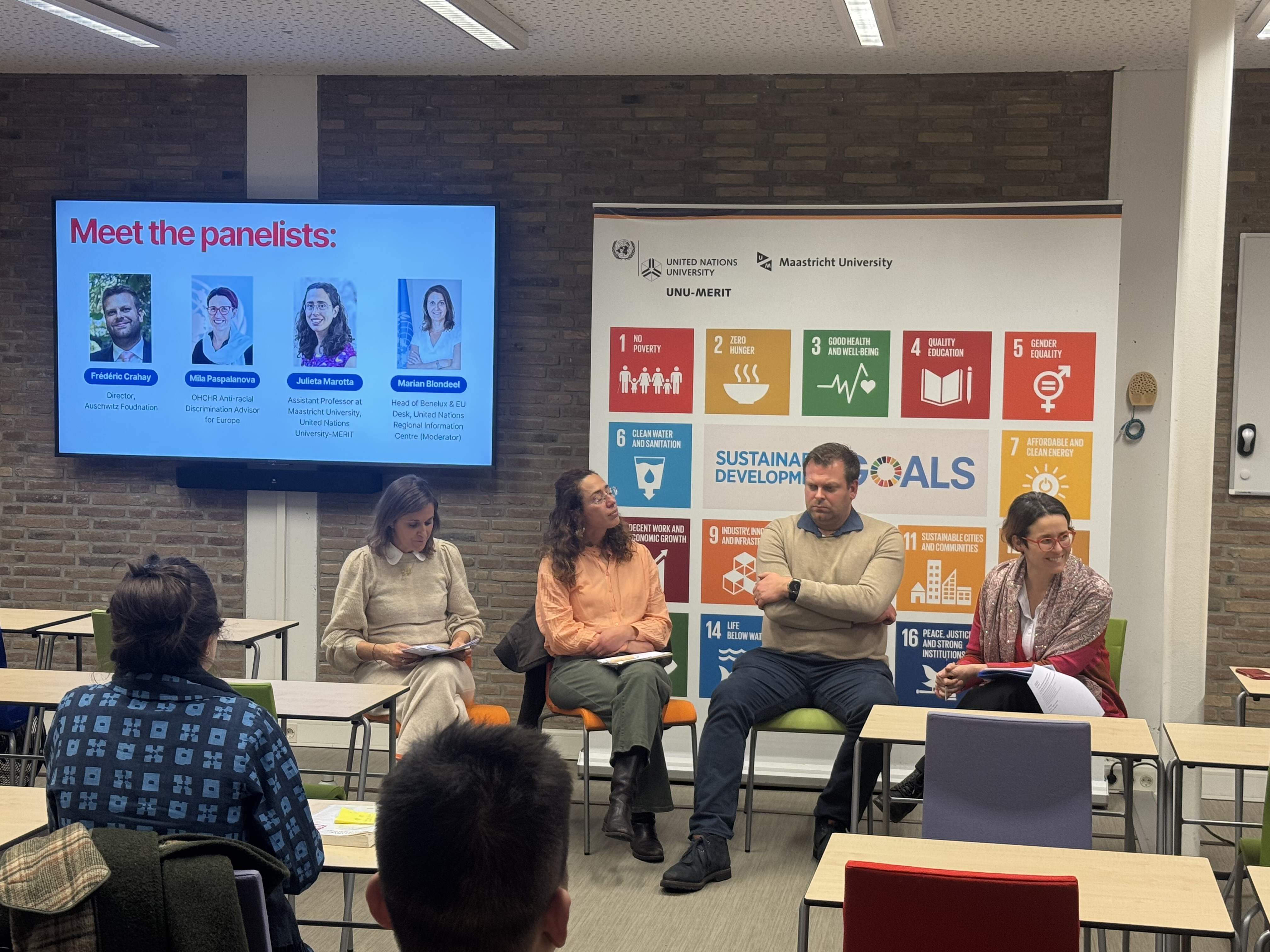
Historian Frédéric Crahay emphasised that remembrance must go beyond symbolic acts, explaining that his organisation was created “to do more than put flowers on monuments.” He highlighted a growing focus on the archaeology of the Holocaust and warned of the risks posed by new means of communication, including artificial intelligence, stressing that “the solution is real scientific work” to prevent distortion of historical truth.
Assistant Professor Dr. Julieta Marotta mentioned the value of survivor testimonies “for the past, present and future,” and stressed the need for inclusive legal systems that truly contemplate diversity as a way to legally empower vulnerable groups. She also cautioned against highly competitive social models, noting that they can foster harmful feelings of superiority rather than solidarity.
Students engaged with the panelists on topics such as colonialism, how language is related to trauma, signs to recognise hatred and bigotry, and human rights frameworks to protect populations.
During an engaging discussion, speakers and participants reaffirmed the continued relevance of Holocaust remembrance more than 80 years later, and its role in fostering empathy, countering hate speech and disinformation, and strengthening a shared commitment to human rights. As Mr. Crahay concluded, “In darkness, there is also light.”
Additional resources:
- A/Res/60/7 Holocaust Remembrance
- A/Res/61/255 Holocaust Denial
- A/Res/76/250 Holocaust Denial
- Monitoring and Recording Antisemitism in the EU, FRA (2026)
To read the original article in full, please visit the UNRIC website here.
Suggested citation: United Nations Regional Information Centre for Western Europe., "UN Cinema screening of The Last Ones of Auschwitz held in Maastricht for Holocaust Remembrance Day," UNU-MERIT (blog), 2026-02-01, 2026, https://unu.edu/merit/blog-post/un-cinema-screening-last-ones-auschwitz-held-maastricht-holocaust-remembrance-day.