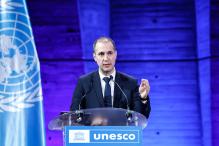


Hamburg, Germany — 06 June 2025, The United Nations University Institute for Water, Environment and Health (UNU-INWEH) in collaboration with the UNU Hub on Engineering to Face Climate Change at the Hamburg University of Technology (TUHH), convened the First Annual Meeting of the UNU Hubs from June 4–6, 2025. The meeting marked a milestone in UNU’s commitment to bridge science, policy, and practice in service of global sustainable development. Academic leaders, scientists, and policymakers from around the world came together to strengthen cooperation and chart a shared roadmap for transformative action.
In 2024, UNU launched the UNU Hubs Program - a system-wide initiative to develop a global network of excellence across research, education, innovation, and advocacy. Designed to bridge academia and the UN system, the Program enhances accessibility for students and researchers while advancing state-of-the-art, policy-relevant research to address complex sustainability challenges. It also strengthens the impact of university-led research, training, and outreach by linking them more directly to practice, while providing capacity-building opportunities that equip the next generation of global change-makers to advance a more sustainable, just, and inclusive world.
“The UNU Hubs represent a bold step toward realizing the United Nations University’s mission as a truly networked institution,” said Professor Tshilidzi Marwala, Rector of the United Nations University and UN Under-Secretary-General. “By bringing together world-class research and education partners under a shared vision for impact, we are translating knowledge into action for people and planet.”
Hosted by the UNU Hub on Engineering to Face Climate Change at TUHH, the first annual UNU Hubs meeting brought together representatives from five additional UNU Hubs and partner institutions: The UNU Hub on Empowering Communities to Adapt to Environmental Change at the University of Calgary, The UNU Hub on Water in a Changing Environment (WICE) at Lund University, The UNU Hub on Remote Sensing and Sustainable Innovations for Resilient Urban Systems (R-SIRUS) at The City College of New York, The UNU Hub on Climate Resilience and Sustainable Technologies at Dresden University of Technology, and The UNU Hub on the Future of Learning with Youth at the Learning Planet Institute. These institutions form the initial backbone of the UNU Hubs network and advance collaborative work across disciplines.
Over the three days, participants engaged in plenary discussions, thematic workshops, and bilateral meetings. Topics for these discussions included Research and Innovation, Education and Capacity Building, Outreach, Advocacy and Impact, as well as Collaboration with the Global South. These sessions concluded with tangible outputs including plans for joint degree programs, novel research partnerships and knowledge products, co-supervision, and other collaborative exchanges.
“The Hubs are a model for how the UN system can collaborate across borders, sectors and disciplines to address humanity’s most complex sustainability challenges,” said Professor Kaveh Madani, Director of UNU-INWEH. “By bridging science, policy, and practice, and connecting leading academic institutions with the UN system, we can deliver solutions that are not only innovative but impactful.”
The meeting featured the inauguration of TUHH’s CampusLABs on “Global Soil Health, Water & Climate” and on “Circular Economy,” underlying the value of private sector partnership and the emphasis on innovation and solution-orientation within the Hubs network. Delegates also heard from Industry and research leaders including Nestlé Chief Technology Officer, Professor Stefan Palzer, Max Planck Institute for Meteorology Director, Professor Björn Stevens, and Airbus Vice-President of Research & Technology, Nicole Dreyer-Langlet, who also joined the event to share insights on advancing sustainability through innovation.
The second day of the meeting focused on developing a UNU Hubs Implementation Roadmap, a collective action plan to guide the network’s next phase of work. Focusing on UNU Hub research clusters, governance structures, joint degree programs, partnerships for impact, and harmonizing educational offerings. Dr. Rohit Ramchandani, UNU-INWEH’s Innovation and Strategic Partnerships Officer and Coordinator of the UNU Hubs noted, “this first annual meeting demonstrated what is possible when the UNU system and leading universities act together. We now have clearer pathways for joint research, shared learning, and coordinated outreach that will amplify evidence-driven impact on critical sustainable development challenges, including in water, environment and health.”

Together, the UNU Hubs are shaping a new model for global collaboration, uniting leading universities, UN agencies, and communities, in pursuit of sustainable development. As Professor Marwala reflected, “The Hubs embody the very essence of what the UNU was created to do, harness knowledge, innovation, and global cooperation to drive progress for humanity.”
The inaugural UNU Hubs Meeting in Hamburg marks the beginning of a new model of coordinated, system-wide collaboration. With a shared vision, a clear roadmap, and an expanding global network of thematic Hubs, UNU and its academic partners are strengthening their collective capacity to co-develop and scale evidence, partnerships, and solutions that advance the Sustainable Development Goals and improve lives around the world.