

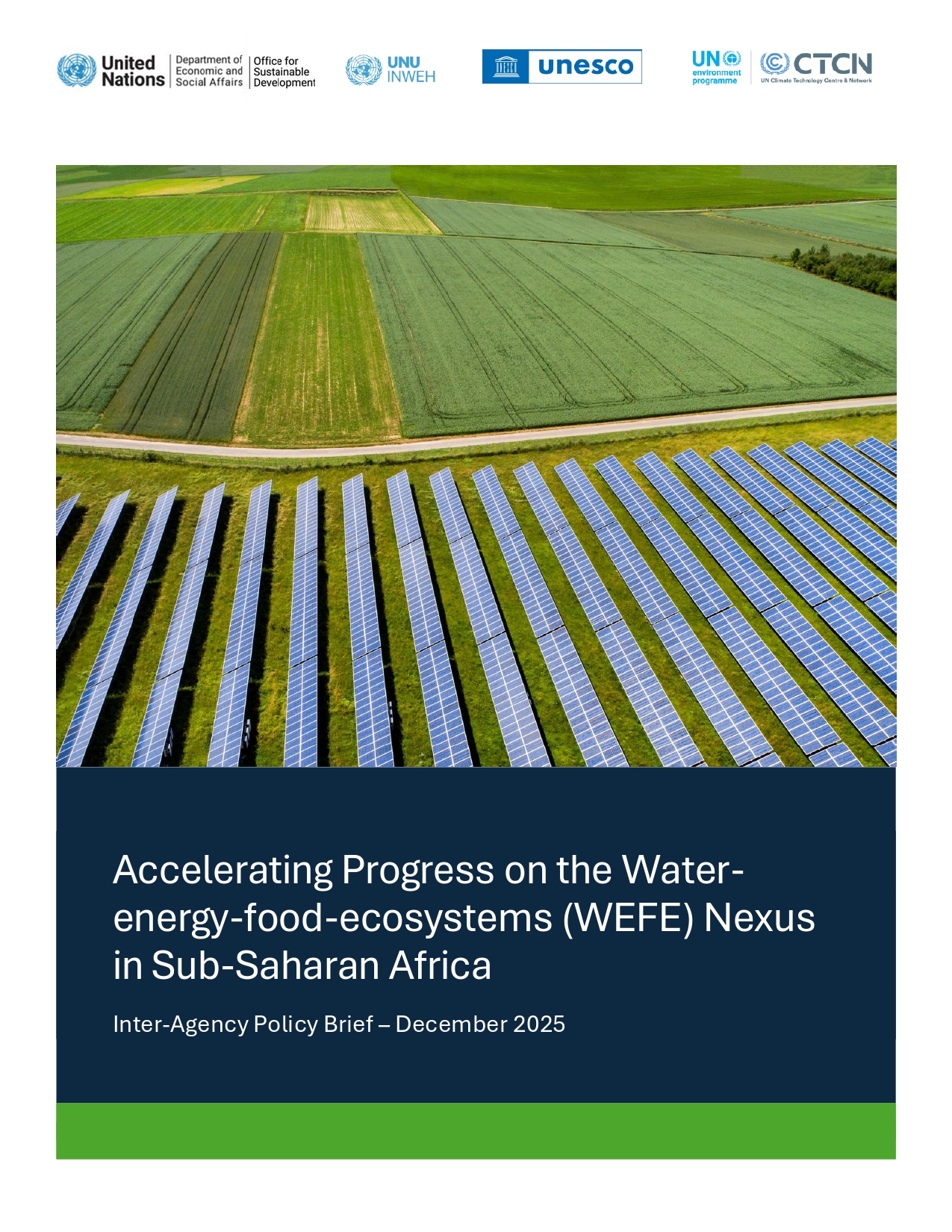
A key constraint to accelerating sustainable development in Sub-Saharan Africa is the fragmented management of water, energy, food, and ecosystems. While progress toward the 2030 Agenda for Sustainable Development and AU Agenda 2063 has been made, implementation remains slow, with only a small share of SDG targets on track. In this policy brief, the interconnected pressures facing water, energy, food security, ecosystems, and climate resilience in Sub-Saharan Africa are examined through the lens of the Water-Energy-Food-Ecosystems (WEFE) nexus.
Drawing on regional and global assessments, the brief highlights how rising energy demand, continued reliance on hydropower, and agricultural water use accounting for the majority of freshwater withdrawals are intensifying competition over natural resources. Despite improvements in electricity access, rapid population growth has left nearly 600 million people without power, while hunger and poverty continue to rise. These challenges are occurring in a region that is highly vulnerable to climate change, despite contributing minimally to global emissions.
Strikingly, the brief finds that sector-by-sector approaches and siloed governance structures often exacerbate trade-offs between water, energy, food, and ecosystem objectives. Policy fragmentation has led to inefficiencies, resource degradation, and missed opportunities to generate synergies that could accelerate SDG progress. In contrast, integrated planning across sectors can create multiplier effects, particularly where coordinated action is most urgently needed.
A tension is thereby revealed between meeting immediate development needs and safeguarding long-term resource sustainability. Without coordinated, cross-cutting approaches, efforts to expand access to energy, food, or water risk undermining ecosystem health and climate resilience, ultimately slowing progress across multiple SDGs.
This inter-agency policy brief calls for the adoption of the Water-Energy-Food-Ecosystems (WEFE) nexus as a governance and planning framework, emphasizing whole-of-government coordination, systems thinking, and high-impact, evidence-based interventions to accelerate sustainable development and improve community well-being across Sub-Saharan Africa.