

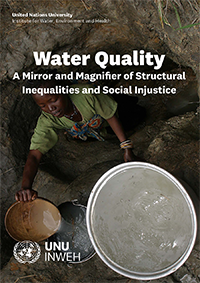
UNU-INWEH Report: Oluwasanya G., Omoniyi A., Matin M., Abu Shomar R., Madani K. (2026) Water Quality: A Mirror and Magnifier of Structural Inequalities and Social Injustice, United Nations University Institute for Water, Environment and Health (UNU-INWEH), Richmond Hill, Ontario, Canada, doi: 10.53328/ INR26RGW001.
This report Water Quality: A Mirror and Magnifier of Structural Inequalities and Social Injustice by the United Nations University Institute for Water, Environment and Health (UNU-INWEH) on its 30th anniversary interrogates that gap, challenging deterministic narratives and unpacking the complex socio-environmental fabric that shapes water security. Drawing on data from 138 countries across the Global South, the report shows that degraded water quality increasingly represents a chronic condition rather than an episodic failure, exposing deep‑seated inequalities rooted in gender, wealth, governance, and historical legacies.
 The report calls for a fundamental shift in how water quality is understood and addressed - from narrow, correlation‑based assumptions that economic growth or progress toward gender equality alone will deliver safer water, to integrated vulnerability management. At the core of this shift is the Water Quality Vulnerability Index (WQVI), which combines drinking water safety, economic capacity, and gender inequality to reveal where and why water systems fail people. The findings demonstrate that wealth alone does not guarantee safe water, nor does progress toward gender equality automatically translate into improved outcomes, emphasizing the importance of governance, inclusive infrastructure investment, and equity-oriented decision-making that actively protects those most exposed to risk.
Importantly, the report frames water quality not only as a site of injustice, but as a strategic entry point for inclusive and resilient development. Investments in safe drinking water have cascading benefits across health, education, gender equality, economic productivity, and climate resilience. By embedding environmental justice principles into water governance and treating water quality as a shared societal responsibility, countries can break cycles of vulnerability and build trust across communities. Acting decisively, before poor water quality hardens into irreversible health, social, and economic losses, offers a tangible opportunity to reduce inequality, strengthen resilience, and ensure that safe water becomes a universal right rather than a privilege.
Support Paper
Oluwasanya, G., Omoniyi, A., Matin, M., Bankole, R., Qadir, M. and Madani, K. (2026). Unpacking the water-wealth-gender nexus: an integrated vulnerability approach. SNF 34, 4 (2026). https://doi.org/10.1007/s00550-026 00586-4