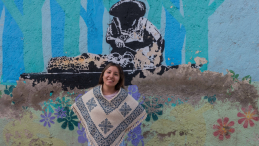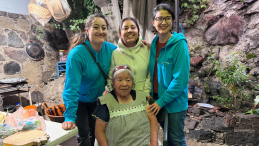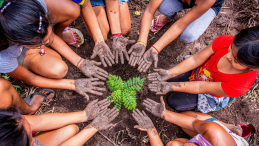


UNU-EHS Expert, Liliana Narvaez, authored an article in EL PAÍS exploring why scientific knowledge should not only reach wider audiences but also return to the communities and places where research begins.
In the article, Narvaez reflects on the experience of "Chinamperos: Preserving Ancestral Farming Practices in Mexico City", a UNU-EHS documentary that tells the stories of farmers maintaining the centuries-old agricultural practice of chinampa farming in Xochimilco, Mexico City.
The documentary emerged from UNU-EHS research on interconnected disaster risks and the need to rethink how societies make decisions about the future. After reaching international audiences, including at COP30 and international film festivals, the documentary returned to Xochimilco for screenings bringing together community members, researchers, students and public officials.
For Narvaez, this return illustrates an important dimension of how research can create impact. Communities are not only recipients of scientific information or sources of stories for research. Through their lived experience and understanding of their territories, they also produce knowledge that can inform how the challenges they live are understood and addressed
Bringing communities, researchers and decision-makers together can create spaces where different forms of knowledge meet and conversations continue beyond the lifespan of a research project.
Reflecting on the experience in Xochimilco, Narvaez calls for a broader understanding of scientific impact, one that considers not only publications, citations, audiences reached or policy recommendations, but also the relationships and conversations that remain afterwards.
Read the full article in Spanish in EL PAÍS here. An English translation can be found below.
Science also needs to come home
Communities are not simply recipients of scientific information or sources of stories that help explain research. They also produce knowledge.
“He felt heard.” That is how Mariana Páez described what it meant for Samuel Avelino, a chinampa farmer from Xochimilco, to see himself portrayed in a story that ultimately travelled far beyond his community.
It is a simple phrase, but it raises an important question for those of us who produce knowledge: when does research really end?
Science devotes enormous effort to generating evidence and, increasingly, to communicating it. We publish reports, produce videos, translate findings and seek to reach policymakers and wider audiences. But communication should not be the final step. If we want knowledge to help transform realities, it also needs to return to the places it comes from, foster dialogue and connect the people who live there with those who study these places and make decisions about them.
Changing course
In 2025, research by the United Nations University on interconnected risks began with a paradox: we understand problems such as climate change, biodiversity loss and pollution better than ever, yet we still struggle enormously to make the changes needed to address them.
The problem is not simply a lack of knowledge. It also lies in how we think and make decisions: we prioritize immediate benefits, treat interconnected problems as though they were separate, and often leave out of the equation those who will live with the consequences of our decisions.
Among the transformations proposed in the report was the need to think beyond the short term and ask ourselves what it means to be good ancestors: not only what we need today, but what possibilities we leave to those who come after us. Xochimilco made that question tangible.
Its chinampas, agricultural plots cultivated for generations in the wetlands of the Valley of Mexico, produce food and preserve knowledge passed down through generations. But this living heritage is under pressure from urbanisation, environmental degradation, climate change and a changing relationship between younger generations and the land. This was the starting point for Chinamperos: Preserving Ancestral Farming Practices in Mexico City. The intention was to take a scientific idea beyond the pages of a report and bring it into people’s lives.
From reach to impact
The documentary travelled. It reached COP30 and international festivals. People who had never set foot on a chinampa were able to encounter the people who cultivate this land, learn about their knowledge and engage with the questions they face about its future.
That is reach. But reach is not necessarily impact. More than a year later, the story made the journey in the opposite direction. The documentary returned to Xochimilco and was screened in Mexico at events that brought together community members, researchers, students and public officials. This time, the aim was not simply to show a film, but to use it as a starting point for conversations about the territory: about water, biodiversity, food, ancestral knowledge and how the people who live there imagine its future. This is where communication ceases to be one-way.
Communities are not simply recipients of scientific information or sources of stories that help explain research. They also produce knowledge. People who work on chinampas every day observe changes in the water and soil, understand the difficulties involved in maintaining certain practices and experience first-hand the tensions between preserving a heritage and adapting it to new realities.
Researchers can contribute evidence and connect these experiences to broader processes. Public officials can translate some of that knowledge into policies and decisions. And communities contribute something that neither of these other actors can replace: the lived, everyday experience of the territory.
Returning in order to move forward
Bringing these groups together does not automatically solve Xochimilco’s challenges. Nor can a documentary do so. But it can create something that is necessary if solutions are to have a chance of lasting: a space where different forms of knowledge can meet and where the conversation does not end when the project does.
In science, we talk a great deal about impact. We measure it through publications, citations, audiences reached or recommendations incorporated into policy. These are all important indicators. But perhaps we should pay more attention to another one: the relationships and conversations that endure afterwards.
At its core, the report that gave rise to Chinamperos asked how we can change course to leave a better future for those who come after us. The experience of Xochimilco raises another question: what happens when science does not simply take knowledge out into the world, but brings it back to the place where it began?
Samuel died this year. One of the last things he shared was a story in which his words and his work as a chinampa farmer appeared. “He felt heard,” Mariana recalled.
Perhaps transformation begins there too: by listening, returning and keeping the conversation open.