

Who: Liliana Narváez, UNU-EHS expert and co-author of the Interconnected Disaster Risks report
When: 1–4 September 2026
Where: Mexico City, Mexico
Why: To bring the story of the Chinamperos back to the people and Xochimilco and continue the conversation about what it means to be a good ancestor.
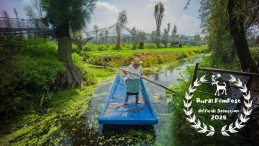
For centuries, people in Xochimilco have cultivated chinampas, an ancestral agricultural system within Mexico City 's wetlands. Still used to grow food, chinampas are part of Xochimilco's biocultural heritage – connecting nature, livelihoods and knowledge passed between generations.
These connections are at the heart of Chinamperos, a short documentary directed by Rodrigo Jardón and filmed in San Gregorio Atlapulco, one of Xochimilco's 18 neighbourhoods. Through the experiences of people keeping chinampa farming and its knowledge alive, the film visualizes ideas from the 2025 Interconnected Disaster Risks report, including one of its five transformations: thinking in centuries and asking what it means to be a good ancestor.
The Chinamperos’ voices have since travelled to the UN Climate Change Conference and film festivals around the world. In September 2026, UNU-EHS expert Liliana Narváez travelled to Mexico City to bring the story home and continue the conversation about what we leave behind for future generations.
The Interconnected Disaster Risks report explores five fundamental changes needed to move towards a more sustainable future. How does San Gregorio Atlapulco in Xochimilco connect with those bigger ideas?
Our research has traditionally focused on understanding how risks are interconnected, for instance through their root causes and the solutions we could propose. With this report, we wanted to go further and ask: “If we understand the problems we face and many of the solutions available, why is it so difficult to change course?”
One of the five fundamental changes explored in the report is moving from thinking in seconds to thinking in centuries: looking beyond immediate needs and considering how today's choices will shape the world inherited by future generations.
Chinampa farming is built on knowledge and practices passed from one generation to another for centuries. The people keeping them alive today are continuing that history while shaping what will remain for those who come next.
Why are human stories like Chinamperos important when communicating research?
Research gives us evidence and helps us understand patterns, connections and the scale of the challenges we face. But data alone cannot always show the impacts on people's everyday lives or motivate us to change. That is where human stories can help.
In Chinamperos, Jardón captured the experiences of people working the chinampas and keeping generations of knowledge alive, with all the challenges this activity carries nowadays. Through their voices, big ideas about transformation become connected to real people, places and decisions.
What did it mean to bring Chinamperos back home after the story had travelled around the world?
The people in Chinamperos generously shared their experiences and voices with us. This visit provided the chance to show how far their stories had travelled and, more importantly, listen to what that journey meant for them.
We travelled through the canals, visited chinampas in San Gregorio Atlapulco and spent time with people connected to the film. Being there allowed us to see the places behind the story, and get closer to their reality, expectations and dreams. Just sitting together, talking and listening, was a great gift that I will keep with me. There is something very different about watching a film at an international event and then being where the story began, alongside the people whose lives and knowledge are represented on screen. It felt like closing the circle.
Why was it important to continue the conversation beyond the community visit?
We held two screenings in Mexico City, at the National Center for the Arts and the Metropolitan Autonomous University in Xochimilco. They brought community members from San Gregorio Atlapulco and other neighbourhoods, researchers, academics, cultural institutions and policymakers into the same conversation.
That mix of perspectives matters. Xochimilco is about ecosystems and agriculture, but also about culture, livelihoods, food, knowledge, identity and people's relationship with their environment. Looking at its future requires bringing these dimensions together.
This also takes us back to being a good ancestor, which means listening to knowledge that already exists, learning from different perspectives and looking beyond our immediate needs. It is about realizing that in our hands we hold the future of millions yet to be born and that our decisions matter in the long term.
People in Xochimilco have inherited knowledge carried across generations. What we do with that inheritance today will help determine what is left for the generations that follow.