

As climate risks intensify and political priorities shift, 2026 is emerging as a decisive year for climate action in Latin America and the Caribbean. From elections and climate diplomacy to city-led initiatives and growing disaster impacts, the region is navigating a complex moment that will shape its climate action trajectory.
In the article “¿Por qué 2026 puede redefinir la acción climática en América Latina y el Caribe?” (“Why 2026 could redefine climate action in Latin America and the Caribbean”), published in El País in January 2026, UNU-EHS senior expert Simone Sandholz examines the key trends likely to influence climate action across the region in the year ahead. The op-ed highlights how Latin America and the Caribbean are not only among the regions most exposed to climate impacts, but how they are also increasingly shaping debates on just and clean transition, urban climate action and regional and international cooperation.
Drawing on recent climate negotiations, political developments and scientific evidence, the article outlines both the challenges facing the region and the opportunities to strengthen climate leadership, particularly through coordinated action and the contributions of young people, Indigenous actors and local communities.
Read the full Spanish op-ed here. A translation into English can be found below.
Why 2026 could be a turning point for climate action in Latin America and the Caribbean
Climate change in Latin America and the Caribbean is no longer a future scenario, it is already reshaping cities, politics and daily life. In 2026, decisions taken in election campaigns, climate negotiations and local governments will intersect with rising disaster risks across the region. These five topics capture the forces likely to shape that turning point.
The legacy from Brazil’s Climate COP will help shaping the next one
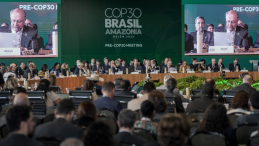
Brazil's COP presidency in 2025 drew attention to Latin America and was a key factor in driving forward climate action in Brazil and the region. This will not end in 2026, even if the location of the climate conference changes to Türkiye. The experience and knowledge gained from Brazil's 2025 presidency, as well as the ‘COP Troika’ – referring to the current, incoming and previous COP presidencies – will help plan the next one and thereby faciliate the continuation of long-term processes. At the same time, COP presidencies also provide important input on innovative formats. The Fiji COP presidency introduced Talanoa dialogues to the world stage, while the Brazilian presidency could have succeeded in making mutirao a format that remains with global community.
Latin American countries are at the forefront of international just transition leadership
At COP 30, 24 countries, including Chile, Colombia, Mexico, Costa Rica, Jamaica, Mexico and Panama launched the "Belem Declaration," a voluntary declaration to phase out fossil fuels. Another 59 countries expressed interest in supporting such a coalition with the aim to build a momentum outside slow COP processes and decisions watered down by countries backing fossil fuels. The governments of Colombia and the Netherlands will co-host the ‘First International Conference on the Just Transition Away from Fossil Fuels’, taking place in April 2026 in Colombia. That will provide a strong opportunity for Colombia and the region to shape the process. It is also an opportunity to strengthen alliances with other countries, including European countries still among the big emitters and others facing strong impacts from climate change such as the Pacific Islands who are also strongly represented in the coalition.
Subnational government action continues to matter ever more
In November 2025, urban leaders gathered in Rio de Janeiro for the COP 30 Local Leaders Forum, to share local solutions from cities worldwide and to strengthen partnerships towards a unified subnational climate agenda. Conclusions have been brought to Belém and will be shaping the 2026 World Urban Forum to take place in Baku, Azerbaijan, in May. Latin American representation was strong in that event, not only because of the strategic location, but also because of Latin America’s high urbanization grade, the many innovative approaches developed in various cities and the potential to learn from them in other cities and continents. Building strong city networks can help joint learning, sustain exchange and link climate action to create better urban livelihoods for all parts of the population. Looking ahead, the new COP 31 president is Türkiye’s Minister of Environment, Urbanization and Climate Change, a chance for urban topics to remain being an important agenda item.
Disaster impacts keep growing
Impacts of extreme weather events keep growing, including due to climate change exacerbating disaster frequency and intensity. Latin American and particularly Caribbean countries are among the most impacted ones in the past years. According to the 2026 Climate Risk Index Dominica and Honduras were among the top three countries most impacted by extreme events over the past 30 years, Haiti and Nicaragua are among those most affected by recurrent events. Hurricane Melissa that hit Jamaica in late 2025 has shown that even countries and their populations who are used to handle extreme events are reaching the limits of their capacity. Looking ahead, a transition toward a new El Niño phase in 2026 could further exacerbate climate extremes like floods and droughts, adding pressure to already overstretched response and adaptation systems in the region.
Political decisions of 2026 will impact the future of climate action
Presidential elections in Colombia in May and Brazil in October 2026 will have implications not only for national climate policies, but also for regional leadership on issues such as fossil fuel phase-out, adaptation and disaster risk management. At the same time, the shifting global political landscape, where climate action is no longer a priority for some major economies, will challenge the region’s ability to sustain momentum and protect hard-won progress. While these shifts will test the region’s climate ambitions, they also offer an opportunity for Latin America and the Caribbean to demonstrate how, when acting together, the region can remain a hub for climate innovation and solutions, driven in large part by the leadership of young and Indigenous activists and local communities pushing for more ambitious action.