

For decades, efforts to move economic policymaking beyond GDP to better account for what actually shapes people's lives and its quality have generated new indicators, dashboards, and measurement frameworks, but have had little effect on how decisions are made. Governments continue to manage economies through metrics that overlook many of the factors that determine human and planetary well-being.
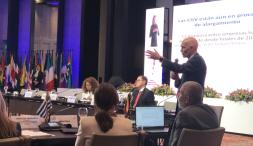
Two recent multilateral frameworks seek to change that. And what they say together matters as much as what each says individually; signaling a potentially important shift in how economic progress is defined and governed. That shift was on display this month at the 2026 UN High-Level Political Forum on Sustainable Development, amplifying the idea that closing gaps in cooperation and delivery matters as much as closing the financing gap itself.
The United Nations High-Level Expert Group's 2026 Beyond GDP report proposes a multidimensional framework for measuring well-being, equity, sustainability and resilience that builds on existing SDG indicator and data architecture. And, critically, integrates those measures into budgeting and policymaking. The World Health Organization's draft Economics of Health for All strategy goes further, arguing that economic policy itself -across taxation, trade, industrial policy, and labor markets – should be organized around health and well-being outcomes rather than treating them as by-products of growth.

Both start from the same diagnosis: GDP was never designed to capture the full range of life outcomes, producing a persistent disconnect between headline growth and lived experience. WHO's strategy is situated within a broader polycrisis – of inequality, fiscal constraints, and climate change. Additionally, both frameworks also consider demographics, technology and scenarios for current and future generations. The recent Ebola outbreak in the Democratic Republic of Congo is a reminder that these considerations are not abstract: underfunded health systems, stressed economies and weak cross-border cooperation can rapidly reinforce each other.
What has shifted is an attempt to align three things at once – how we define progress, how we pursue it through policy, and how we resource it through national and global systems. The two frameworks approach this from complementary angles: Beyond GDP through dashboards and indicators, WHO through missions and policy levers. That pairing is rarer than it sounds in multilateral processes, where measurement reform and policy reform have tended to be pursued in separate institutional lanes.
This matters because the political economy of GDP is stubborn. The metric remains deeply ingrained in global governance architecture – from country credit classifications to investment decisions and media narratives – and changing dashboards without changing underlying structures produces information without transformation.
Both frameworks recognize this. The Beyond GDP report explicitly calls for incorporating additional indicators into international financial institutions' decisions, such as concessional lending and debt analysis. WHO's strategy emphasizes whole-of-government approaches and collaboration between finance ministries, health authorities, and private actors. At the core is a shared imperative: aligning public initiatives and private capital with multi-dimensional, long-term objectives rather than short-term gains.
If these agendas are successfully integrated, they could reshape how resources are allocated globally – how development finance is targeted, how risks are shared, and how global public goods from climate stability to infrastructure to health security are funded and governed.
What feels equally important is the narrowing of a recurrent divide in global cooperation itself. Public health and development have historically evolved on parallel tracks – health organized around sector-specific goals and financing mechanisms; development anchored in macroeconomic frameworks and growth analytics. The result has been a persistent operational gap: health acknowledged rhetorically as central to development, but routinely managed, funded and implemented as its own priority rather than as a foundational economic driver.
The meeting of these two agendas is long overdue, and an intergovernmental process is now underway to establish global norms for benchmarking progress beyond GDP, with a view to incorporating these metrics into global reporting and national policy frameworks. WHO's strategy explicitly links its implementation to wider UN efforts on measurement – creating much-needed space for improved coherence across institutional silos.
Moreover, the implications extend beyond statistical reform. If these agendas are successfully integrated, they could reshape how resources are allocated globally – how development finance is targeted, how risks are shared, and how global public goods from climate stability to infrastructure to health security are funded and governed. In doing so, they could provide the analytical and policy backbone for a new generation of well-being economies.
There are also important signals here for philanthropic and private actors. Both the UN and WHO frameworks point toward a model in which funding, incentives and impact taxonomies are guided by a clearer sense of societal values and policy aims, centering qualitative outcomes over purely financial returns or quantitative outputs alone. In this sense, revisiting measurements can have market consequences (including by influencing ESG or responsible investment initiatives).
Ultimately, this is about the nature and future of international cooperation itself, and whether development and public health continue to operate as adjacent domains even as economies become more interconnected, challenges more systemic, and effectiveness more a premium. The opportunity – and the urgency – lies with Member States, multilaterals and public, private and philanthropic organizations translating emerging convergence into practice: including multidimensional metrics in balance sheets, aligning incentives across institutions and building the political coalitions needed to maintain momentum.
If successful, moving beyond GDP and embracing the economics of health for all could finally deliver on a long-standing promise: not merely to measure what matters, but to organize economies – and international cooperation – around these priorities.