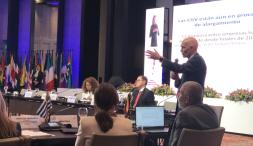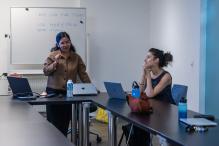


Dr. Nicole Goldin, Head of Equitable Development at UNU-CPR, delivered a formal intervention during Session 3 of the 2026 UN High-Level Political Forum on Sustainable Development, focused on accelerating SDG achievement in African countries, least developed countries (LDCs), landlocked developing countries (LLDCs) and middle-income countries (MICs).
In her remarks, she discussed the challenges facing countries operating under significant fiscal constraints and the need to strengthen cooperation between governments, donors, regional bodies and partners to translate global commitments into national action. Drawing on UNU-CPR’s research, she outlined the role of development diplomacy, institutional continuity and regional coordination in supporting countries to make constrained resources work harder.
Goldin also called for context-specific approaches that reflect countries’ fiscal and institutional realities. Her statement reinforced UNU’s commitment to research and policy solutions that support sustainable development.
The full statement is below, and available to watch here.
Thank you, Mr. President.
Excellencies, Colleagues,
I’m honored to speak on behalf of UNU-Centre for Policy Research.
Governments across Africa, LDCs, LLDCs and MICs are fiscally constrained, and that isn’t changing soon. So a key question isn’t only how to close the financing gap – it’s how to make constrained resources work harder.
That means narrowing the cooperation architecture gap that compounds the resources gap. Global commitments are landing on national institutions coordinating across ministries, donors and partners simultaneously – often without the delivery architecture or fiscal space to absorb them. Under these conditions, coordination itself requires capacity.
This is where development diplomacy matters for acceleration. Turning commitments into delivery is a deliberative task – between governments, donors, regional bodies and the private sector – over how scarce resources get sequenced and shared.
Strengthening that diplomatic layer, the relationships that align actors around a country’s actual priorities, may do as much for SDG progress as any new commitment.
Three things could help:
- Invest in institutional continuity, so ministries can hold a plan across budget cycles, not just project cycles.
- Reinforcing regional coordination as core infrastructure – especially in geographies where connectivity depends on diplomacy between neighbors as much as investment within borders.
- And ensure “context-specific” means built around each country’s fiscal and institutional starting point – not a template applied after the fact.
At UNU-CPR, we treat policy, finance, institutions and diplomacy as one continuous system, and welcome bringing that lens to member states translating this session into practice.
Thank you.