Plastic recycling in the Netherlands is facing a serious problem. The disappearance of three million tonnes of recycling capacity is striking, but it is also a symptom of a deeper issue: users of plastic packaging, including brand owners selling packaged food and other products, pay for the collection and recycling of plastic packaging but remain reluctant to use the recycled material.
Two factors help explain this reluctance. First, packaging made from recycled plastic costs a little more than packaging made from virgin plastic. Second, the quality of plastic recyclate is often lower than that of virgin plastics, something marketers do not particularly like. Chemical recycling can address the quality issue, but it adds to the price tag, causing investors to put new chemical recycling projects on hold.
In the early 2020s, significant investments were made in advanced forms of recycling by newcomers to the sector. Many subsequently went bankrupt when virgin plastic prices fell following investments in plastic production in the United States and China. In the US, shale gas is used to produce plastics. In China, plastics are produced from coal and oil, as well as ethane and propane imported from the US. In general, those sources are less environmentally benign than the natural gas used in Europe for producing plastics.
But our research through the SYSCHEMIQ project suggests that this is not simply a technological or cost problem.
Costs are shaped by governance
One of the lessons from our interviews and workshops was that costs are not a natural phenomenon. They depend on the taxes and regulations that are in place, or not in place, including in other countries.
The claim from brand owners that consumers do not want to pay extra for packaging is bogus or largely false. The more fundamental issue is the reluctance of brand owners themselves to bear additional costs.
They are able to get away with this partly because they dominate the governance system of extended producer responsibility (EPR). The system has been set up around the goal of collecting waste as cheaply as possible, rather than around the goal of circularity.
A further governance failure is the exclusion of citizen organisations from EPR governing boards. Citizens are generally dissatisfied that a substantial proportion of the plastic waste they dutifully separate for recycling is ultimately incinerated, yet this concern has little influence on decision-making.
Our interviews therefore revealed both governance shortcomings and an uneven playing field that disadvantages plastic recycling.
A Dual Track Governance approach
This is where Dual Track Governance (DTG) becomes useful.
DTG recognises that coordinated action by actors along a value chain is essential, but not sufficient. Brand owners and packaging producers also need to be incentivised or compelled to use plastic recyclate.
In the literature on business model innovation, much is expected from ecosystem orchestration. But these efforts will remain weak unless there is also pressure on value-chain actors to make different choices.
Dual Track Governance therefore combines steering at two levels: value-chain arrangements and societal framework conditions, consisting of policies and regulations. Together, these can help move a sociotechnical system towards more circular, low-carbon and socially just practices.
These two levels form the middle layers of what we call the “backbone”, connecting transactions, value-chain arrangements, societal steering, and wider societal goals and aspirations.
In a balanced backbone, everyday practices meet functional requirements while also contributing to societal goals. In an unbalanced backbone, value-chain arrangements and societal steering fail to provide the support and incentives needed to align practices with those goals.
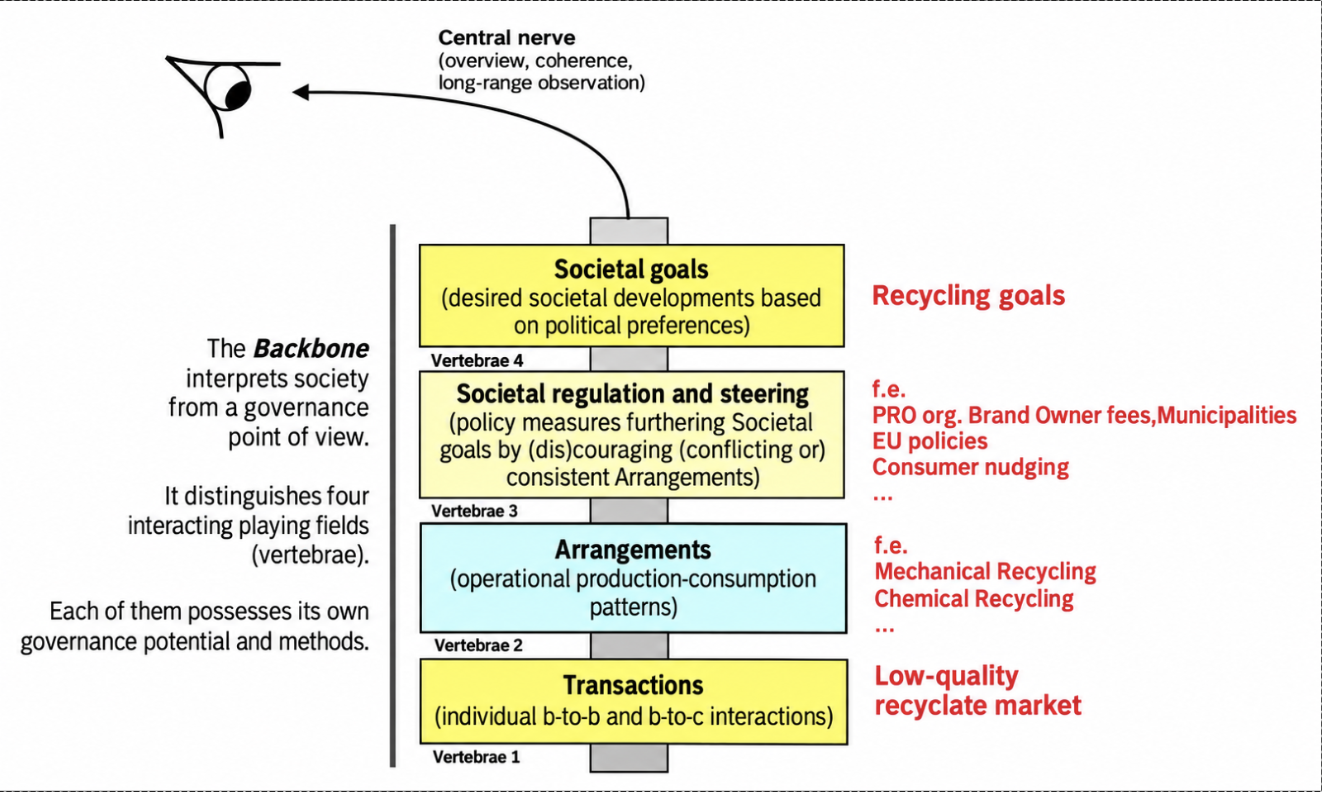
The need for intervention at these two levels is implicitly acknowledged in the policy-mix literature, but it lacks a clear conceptual label. We did not invent the concept of Dual Track Governance, but further developed it and applied it to the issue of plastic packaging recycling.
Its strength lies in connecting coordination with the political economy of collaborative governance: who has influence, who bears the costs, and whose interests shape decisions.
Having developed several frameworks over the years, I see considerable analytical and practical value in this one.
The paradox of change is that no single actor possesses either the understanding or the authority needed to reshape both incentives and value-chain arrangements. DTG offers a way out of the current stalemate by combining actors’ knowledge of interdependencies and barriers with the steering capacities of policymakers and value-chain actors. Together, these can support prudent system change guided by practical experience and ongoing learning.
What needs to change?
Governments, producers and civil society organisations all have a role to play. One of the clearest lessons from the project was that steering measures need to work in tandem and also deal with the negative effects that individual policies can generate.
Based on nine workshops, 30 interviews and many additional discussions, we developed four policy packages for boosting plastic recycling in the Netherlands and Europe:
- Minimum recyclate-content standards for plastic packaging, combined with a tradable credit system for recyclate use and information-disclosure requirements for brand owners.
- Government-supported voluntary value-chain initiatives.
- EU trade measures targeting low-cost plastic and recyclate imports.
- Strengthened eco-modulation of EPR fees, under which packaging that is easily recyclable and contains high levels of recycled material qualifies for lower fees, while packaging that is difficult to recycle and contains little or no recycled content faces higher fees.
The first package is more disruptive and radical than the fourth. The second complements both by relying on coordinated actions by businesses. According to several experts, the third package, involving EU trade policies, is necessary if the other measures are to have much effect.
A ban on plastic packaging waste exports may sound like a good idea, for example, but it does not automatically lead to more recycling: the waste may simply be burned instead. This illustrates why multiple, mutually reinforcing policies are needed.
There is broad consensus among the experts we consulted that the current EPR-based governance system requires demand-stimulation policies capable of triggering upward commitment dynamics, including both material and discursive commitments from businesses.
Dual Track Governance, together with the backbone perspective, offers a structured way of pursuing these dynamics while addressing the multiple barriers that currently hinder effective policy action.
At present, only strengthened eco-modulation fees are being considered for use. Brand owners favour this option, which also fits the government’s preference for maintaining an arm’s-length relationship.
In our view, however, effective action requires changes to the governance system alongside trade measures.
We advocate minimum recycled-content requirements for plastic packaging, combined with disclosure obligations for brand owners. A tradable recyclate-certificate system could reward companies that exceed their obligations while allowing others to meet theirs by purchasing certificates. This flexibility would reduce the overall cost of meeting the collective target.
Innovation still matters
A remaining challenge is to make plastic recycling carbon neutral. We did not investigate this issue deeply within the project, although we discussed it extensively.
Bioplastics and plastics designed for mechanical recycling offer two possible routes. A third is the use of carbon capture and utilisation.
Progress towards sustainability requires innovation, but innovation itself depends on business action being supported and encouraged by policy. That much is clear.
I greatly enjoyed working on the SYSCHEMIQ project, particularly the interaction with business experts and the opportunity to bring different forms of knowledge together. The research resulted in what I believe is a highly relevant framework, as well as useful visualisations showing how policy mixes and business models interact.
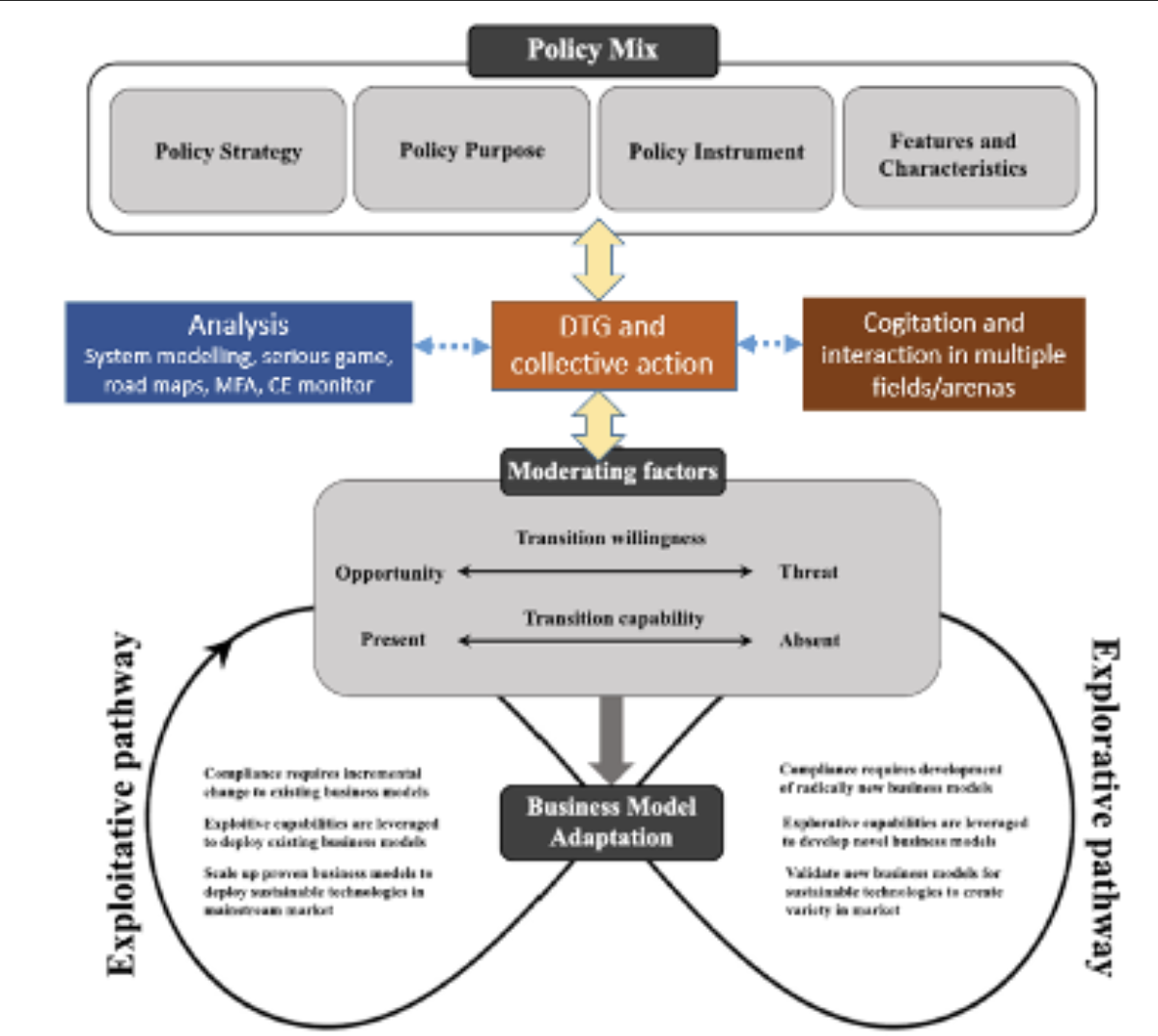
We will now see whether it makes a splash in policy and science.
The research was funded by the European Union through the SYSCHEMIQ project.
The findings are published open access in the Journal of Circular Economy: read the article here.
Suggested citation: Prof. Dr. René Kemp., "Why plastics recycling needs more than better technology ," UNU-MERIT (blog), 2026-10-27, 2026, https://unu.edu/merit/blog-post/why-plastics-recycling-needs-more-better-technology.