The twin transition means integrating digitalisation and sustainability at the same time, in pursuit of efficiency, innovation, and long-term resilience. It has sat near the top of policy agendas for several years now. There is hardly a government that does not treat it as a priority. The two agendas are meant to reinforce each other. Digital tools enable climate goals, and green policies guide the ethical development of new technologies.
But that reinforcement is not automatic. The European Environment Agency warned this year that digitalisation and AI will either accelerate green ambitions or undermine them, depending on how deliberately policy steers them. The same technologies meant to cut emissions carry a growing footprint of their own. Digital technologies already account for somewhere between 8 and 10% of energy consumption and 2 to 4% of greenhouse gas emissions. The rapid expansion of data centres is itself driving rising demand for energy, water and critical raw materials. Electronic waste tells a similar story. A record 62 million tonnes was generated in 2022, up 82% from 2010, and it is on track to reach 82 million tonnes by 2030. Less than a quarter of it was documented as properly collected and recycled.
The lesson policymakers keep running into is that efficiency gains alone do not deliver sustainability. The link between the green and digital agendas is widely accepted in principle, but it is far harder to put into practice than to declare. Research on the EU's twin transitions finds that operational coherence, meaning putting the ideas to work, consistently lags the conceptual agreement that they belong together. Closing that gap depends on people. It needs officials who can hold the trade-offs in view and design policy that steers digitalisation toward green ends rather than away from them. In a field moving this fast, keeping those people genuinely skilled takes continuous effort, not a one-off briefing. That is why we are pleased to offer the Summer School on Digital and Green Transitions again, running from 22 to 26 June 2026 at UNU-MERIT in Maastricht. This is the third edition delivered within the framework of the ITU Academy. Thanks to the generous support of the EU Global Gateway initiative, 28 participants from around the world will join us for a week of lectures and interactive sessions, free of charge. The funding covers tuition, accommodation, meals and extracurricular activities.
Several pillars of the programme return each year. There is a day on the relationship between sustainability, digitalisation and the SDGs, taught by Prof. Mindel van de Laar. There is a day on the value and use of AI in relation to sustainability, taught by Prof. Lili Wang. And there are the design-thinking sessions on e-waste, led by Dr Maria Tomai. New this year is a dedicated day on behaviour change, and specifically on how to encourage more sustainable behaviour.
As Dr Sanae Okamoto, who teaches it, puts it: "Digital infrastructure and green policies are only as effective as the human behaviours that drive them. Therefore, mastering a behavioral science approach is essential to ensuring that digital advancements actively guide communities toward a true green transition."
That behavioural lens matters because the temptation in this field is to treat every problem as a technical one with a technical fix. Researchers have cautioned that the twin-transition framing can quietly narrow what counts as sustainability. It tends to favour the problems digital tools happen to be good at solving over the messier ones, such as biodiversity loss, soil degradation and water depletion, that resist a neat technological answer. Equipping officials to notice that narrowing, and to keep human behaviour and democratic trade-offs in the frame, is part of what the week is for.
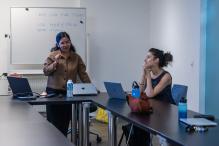
To turn awareness into action, every participant takes part in a "Digital Solution Exercise" that runs through the whole week. Each person brings a societally relevant problem from their own context and deepens it day by day. Critical questions from the teachers, peer feedback and end-of-day reflection moments all work toward a single point. Participants themselves can be agents of change, and even small change is worth pursuing. The exercise has proven to be both a strong learning tool and an energising one. As Prof. Mindel van de Laar explains: "At the end of the week, the participants present not only their own 'green and digital' problem that they came with, but also a suggested way forward through research or institutional change. Articulating what concrete actions, they wish to work on when back home is a powerful tool to retain the learning."
But the value goes beyond the curriculum. The twin transition is, at heart, a coordination problem. It plays out across ministries, across levels of government and across borders. That is why bringing together professionals from different countries and sectors is such an important part of the programme. Participants arrive with different policy challenges, institutional contexts and professional experiences, but quickly discover that many of the questions they face are shared.

For Martha Liliana Marin, an innovation and sustainability strategist from Colombia, one of the main attractions of the Summer School was the opportunity to "engage with experts and practitioners from different countries, exchanging perspectives, and learning about innovative approaches and initiatives that are driving digital and green transitions around the world." She believes that these international experiences and the networks built during the week will help inform more effective and inclusive science, technology and innovation policies in Colombia.That sentiment is echoed by Zakarie Ismael, Digital Infrastructure Specialist and National Designated Entity (NDE) for Somalia's Ministry of Communications & Technology, who saw the Summer School as "a unique opportunity to learn from international experts and exchange experiences with professionals from diverse countries and sectors." Working at the forefront of Somalia's digital transformation agenda, he views these global exchanges as an important source of practical ideas that can strengthen national policies on digital infrastructure, e-government and climate resilience.
These conversations, often continuing long after the formal sessions have ended, are among the most valuable outcomes of the week. Participants consistently tell us that while they come for the knowledge, they leave with something equally important: an international community of peers tackling the same policy challenges from different perspectives. Those relationships become a resource they can draw on long after they return home.
Suggested citation: "Building the skills behind the twin transition," UNU-MERIT (blog), 2026-06-29, 2026, https://unu.edu/merit/blog-post/building-skills-behind-twin-transition.