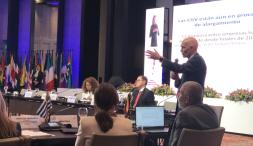


Macau SAR, 7 April 2026 - The United Nations University (UNU), via the UNU Institute in Macau (UNU Macau), and Tsinghua University have jointly launched the UNU Hub on Promoting Ethical and Responsible Artificial Intelligence Development, hosted by Tsinghua University’s Institute for AI International Governance (I-AIIG). Alongside the UNU Hub on AI-Finance in Shanghai, this milestone marks one of the first UNU Hubs in Mainland China, reinforcing UNU’s mission to connect research, policy, and practice in addressing global challenges.
The Establishment Agreement was signed by Prof. Tshilidzi Marwala, Rector of the United Nations University and Under-Secretary-General of the United Nations, and Prof. Bin Yang, Vice Chancellor of the Tsinghua University Council.

Prof. Marwala remarked: “The UNU Hub at Tsinghua University reflects our global commitment to ensuring that AI development is aligned with human values. By joining forces with Tsinghua’s leadership in AI governance research, we are building a platform that will generate practical solutions, cultivate global talent, and strengthen international cooperation. This Hub will help societies address systemic risks and establish trusted frameworks, ensuring AI serves as a force for equity, sustainability, and human well-being.”

Prof. Bin Yang, Vice Chancellor of the Tsinghua University Council
Prof. Yang remarked: “AI has emerged as a transformative force across all sectors of society. To harness its potential responsibly, research and international cooperation are essential. By integrating Tsinghua’s strengths in AI research with UNU’s global academic leadership, this joint Hub creates a unique opportunity to deepen collaboration between our institutions. Together, we can empower the world through AI and make greater contributions to building a community with a shared future for mankind.”
Promoting Ethical and Responsible AI Development
The mission of the UNU Hub on Promoting Ethical and Responsible Artificial Intelligence Development is to deepen scientific understanding of AI’s ethical challenges, develop inclusive governance frameworks, and empower the Global South with practical solutions. Its priorities include risk monitoring, ethical evaluation mechanisms, and targeted capacity-building for policymakers and young leaders, aligned with the UN Sustainable Development Goals.
The Hub will be coordinated by Prof. Liang Zheng, Vice Dean of I-AIIG, and Dr. Jaimee Stuart, Acting Head of Research at UNU Macau.
A Platform for Interdisciplinary Collaboration and Multi-Stakeholder Dialogue
Structured around three core pillars, the Hub will serve as a platform for interdisciplinary collaboration, innovation, and policy engagement.
- Research, Development, and Innovation: The Hub will conduct joint studies on AI risk monitoring, ethical evaluation, and global governance frameworks, with co-publications in the UNU-Springer Artificial Intelligence and Sustainable Development Book Series.
- Education and Capacity-Building: The Hub plans to launch a dual master’s degree program and UNU internships to cultivate diverse AI governance talents, preparing students for careers in UN and international intergovernmental organizations.
- Outreach, Advocacy, and Impact: Through international forums, contributions to the UNU Global AI Network, and multi-stakeholder dialogues, the Hub will amplify knowledge exchange and promote ethical AI practices globally.
Located at Tsinghua’s campus, the Hub is equipped with world-class research and administrative facilities. The Hub is expected to act as a catalyst for dialogue and cooperation, helping shape international standards and ensuring that AI development is guided by shared human values. By fostering trust and inclusivity, the Hub aims to make responsible AI governance a cornerstone of sustainable development.
Following the establishment of the UNU Hub on Humanitarian Innovation and Technology at Lingnan University in Hong Kong in 2025, UNU has now established three hubs in China. UNU Macau will coordinate the work of these hubs, leveraging Macau’s unique role as an international platform and a key node within the Guangdong–Hong Kong–Macao Greater Bay Area to foster international research collaboration and dialogue. The Institute will also actively engage local and Greater Bay Area partners to advance capacity-building initiatives and nurture young talent, further strengthening Macau’s role as a bridge connecting China and the international community.
Press Contacts
United Nations University
Email: comms_macau@unu.edu