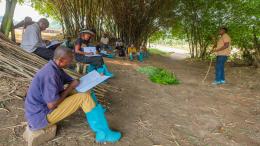


Richmond Hill, 09 March 2026 — Smallholder farmers drive Zimbabwe's food systems, yet structural barriers limit their productivity and resilience. A new policy brief, Digital Agriculture and AI for Climate-Resilient Smallholder Farming in Zimbabwe, published by the United Nations University Institute for Water, Environment and Health (UNU-INWEH), examines how digital technologies and AI can strengthen agricultural systems and improve climate resilience for smallholder farmers. The brief was developed in collaboration with the International Water Management Institute (IWMI), the London School of Hygiene and Tropical Medicine, and Zimbabwe's Ministry of Lands, Agriculture, Fisheries, Water and Rural Development.
Digital tools including mobile advisory platforms, climate information services, and digital financial services can expand market access and improve risk management for smallholder farmers. Smartphones now account for an estimated 64% of mobile connections across sub-Saharan Africa. This expanding mobile ecosystem provides a scalable foundation for digital agriculture.
However, digitalisation is not inherently inclusive. Without deliberate policy design, digital transformation risks deepening existing inequalities along gender, income, and geographic lines. Women farmers face compounded barriers: limited device ownership, lower digital literacy, and restricted decision-making power over financial and technological resources.
To deliver meaningful and inclusive outcomes, Zimbabwe is encouraged to adopt coordinated policy action across infrastructure, affordability, skills, and governance frameworks. Policymakers, development partners, and the private sector are encouraged to invest in rural digital infrastructure, expand affordable access, and embed gender-responsive safeguards across all digital agriculture programmes. These actions will determine whether digitalisation delivers climate-resilient and equitable outcomes for smallholder farmers by 2030.
Key Messages
- Approximately 90% of smallholder agriculture in Zimbabwe is rainfed, leaving farmers highly exposed to climate variability and market shocks.
- Digital tools deliver measurable benefits when embedded within supportive institutional ecosystems. Isolated technology deployments show limited impact.
- Low digital literacy, poor rural connectivity, and affordability constraints restrict equitable digital adoption among smallholder farmers.
- Public investment should prioritise rural broadband expansion, with the Universal Service Fund providing a practical financing vehicle for underserved areas.
- Gender-responsive digital literacy programmes are essential to ensure women, youth, and older farmers participate and benefit equitably.
- Inclusive public–private partnerships can scale digital agriculture solutions when anchored in national development objectives and local needs.
- An inter-ministerial coordination platform linking Agriculture, ICT, Finance, and Energy is critical to align regulatory frameworks and investment pipelines.
Recommended Citation: Choruma, D., Dirwai, T. L., Mugiyo, H.,Chitsungo. B., Jafarzadeh, S., Madani, K., Jiri, O., Masuka, A. J., Mabhaudhi T., Digital Agriculture and AI for Climate-Resilient Smallholder Farming in Zimbabwe. United Nations University Institute for Water, Environment and Health (UNU-INWEH), Richmond Hill, Ontario, Canada, doi: 10.53328/INR26PTM002
Media Contacts:
William Smyth, Public Engagement Liaison and Personal Assistant to the Director, william.smyth@unu.edu
Daniel Powell, UNU Senior Communications Officer, powell@unu.edu
Available for Interview:
Professor Kaveh Madani, Director, UNU-INWEH
Prof. Tafadzwanashe Mabhaudhi, Executive Director of UNU Hub on Resilient Environment, Agriculture, Climate & Health for Africa (REACH-AFRICA) at University of Pretoria
About UNU-INWEH
The United Nations University Institute for Water, Environment and Health (UNU-INWEH) is one of 13 institutions that make up the United Nations University (UNU), the academic arm of the UN. Known as 'The UN’s Think Tank on Water', UNU-INWEH addresses critical water, environmental, and health challenges around the world. Through research, training, capacity development, and knowledge dissemination, the institute contributes to solving pressing global sustainability and human security issues of concern to the UN and its Member States.
Headquartered in Richmond Hill, Ontario, UNU-INWEH has been hosted and supported by the Government of Canada since 1996. With a global mandate and extensive partnerships across UN entities, international organizations, and governments, UNU-INWEH operates through its UNU Hubs in Calgary, Hamburg, New York, Lund, and Pretoria, and an international network of affiliates.