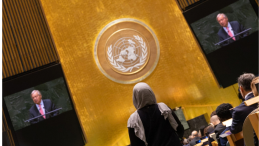


From 9 to 20 November 2026, UN member states, civil society, youth and the scientific community will gather in Antalya, Türkiye, for the 31st United Nations Climate Change Conference (COP 31). Following COP 30 in Belém, Brazil, which marked ten years of the Paris Agreement adoption, attention is shifting from setting climate targets to implementing them. Yet significant challenges remain. Global emissions reductions are insufficient to meet the Agreements goals, climate finance remains difficult to access for vulnerable countries and growing climate risks are placing additional pressure on communities and ecosystems. COP 31 will test whether international climate cooperation can translate political commitments into practical implementation.
Here are five expectations heading into COP 31:
1. Pacific priorities for COP 31: Climate ambition and finance
Climate-vulnerable countries are shaping the road to Antalya. During Pre-COP 31 in Fiji and Tuvalu, representatives from around 30 countries supported the Taku Pakasoa Declaration, calling for faster emissions reductions, more accessible climate finance and stronger ocean protection. Climate finance will be a key test for COP 31. With the adoption of the New Collective Quantified Goal (NCQG) at COP 29, attention is turning to implementation and scaling up. Beyond increasing commitments, countries must address barriers to accessing funding, including complex procedures, limited institutional capacity and insufficient grant-based finance. COP 31 must show whether political commitments can translate into more predictable, accessible and effective financial support, particularly for adaptation and countries facing the greatest climate risks.
2. The Action Agenda seeks to accelerate climate implementation
The Presidency is advancing an Action Agenda to translate climate commitments into practical solutions. Building on the five-year vision for the Global Climate Action Agenda launched at COP 30, the Presidency has identified ten priority themes, including clean energy transition, climate-resilient cities, green industrialization, food security, ocean protection and climate-resilient health systems.
One core priority is to accelerate electrification to reduce emissions while improving energy security and affordability. It emphasizes urban resilience, including measures to address extreme heat, strengthen infrastructure and sustainable housing. Other initiatives focus on reducing methane emissions and waste, supporting climate-resilient agriculture and strengthening cooperation across the climate, biodiversity and land agendas. Through its proposed Climate Implementation Bridge, the Presidency aims to help countries turn national climate and development priorities into projects capable of attracting finance and investment.
A key test for COP 31 will be whether these initiatives can mobilize meaningful partnerships and investment, complement formal negotiations and accelerate climate action beyond Antalya.
3. The political landscape tests international climate cooperation
COP 31 takes place amid a changing political landscape. At a time when countries need to accelerate the implementation of their Paris Agreement commitments, several upcoming national elections could shape national climate priorities and international cooperation. The United Nations is also approaching a leadership transition. As Secretary-General António Guterres concludes his second term in 2026, his successor will inherit a key role in advancing momentum on climate action and international cooperation.
COP31 offers an opportunity to reaffirm multilateralism and ensure continuity in implementing the Paris Agreement. Where global progress is uneven, proactive countries can still advance through targeted coalitions. Fossil fuel phase-out, a longstanding challenge in climate negotiations, is one example. By adopting phase-out roadmaps before and during COP31, countries can lead by example and capture the economic benefits of early decarbonization.
4. Prospect of climate overshoot reinforces the urgency of action
As national climate commitments fall short of what is needed to limit global warming to 1.5°C, climate overshoot looks likely. Recent scientific assessments warn that exceeding this threshold is expected, while returning temperatures below it would require sustained emissions reductions and the removal of CO2 from the atmosphere. However, returning to 1.5°C would not reverse all the impacts experienced during the period of higher warming, according to UNEP's Limiting Overshoot report. The impact and duration of overshoot could have lasting consequences for ecosystems, livelihoods, health and human security, with vulnerable communities facing disproportionate risks. Adaptation needs would also continue to evolve, even as temperatures decline.
COP 31 must strengthen the link between mitigation, adaptation and climate finance. Beyond accelerating emissions reductions, countries need to address changing risks, adaptation limits and ensure that financial and institutional support can respond to the long-term consequences of overshoot. Decisions taken now will determine the future of Earth's temperature, but also the ability of communities to adapt and recover.
5. From Antalya to Africa: preparing the next phase of climate implementation
COP 31 launches the second Global Stocktake (GST 2), which opens the next cycle of global accountability under the Paris Agreement. While GST 1 highlighted ambition gaps, GST 2 must drive tangible implementation. Adaptation will be a key test for COP 31, following difficult negotiations at the June Climate Meetings in Bonn. Parties were unable to agree on the Global Goal on Adaptation (GGA), leaving questions for Antalya, including how to advance the 59 adaptation indicators adopted at COP 30 and how to deliver on the commitment to at least triple adaptation finance for developing countries by 2035.
Looking ahead to COP 32, expected to take place in Africa, agriculture and food security will be particularly important. Climate change is already affecting agricultural production, water availability and rural livelihoods, making climate-resilient agrifood systems essential for sustainable development. Antalya offers an opportunity to resolve outstanding adaptation issues while laying the groundwork for implementation, ensuring that commitments translate into stronger resilience for communities most vulnerable to climate change.
Suggested citation: "5 Expectations for COP 31 in Antalya ," United Nations University, UNU-EHS, 2026-10-14, https://unu.edu/ehs/article/5-expectations-cop-31-antalya.