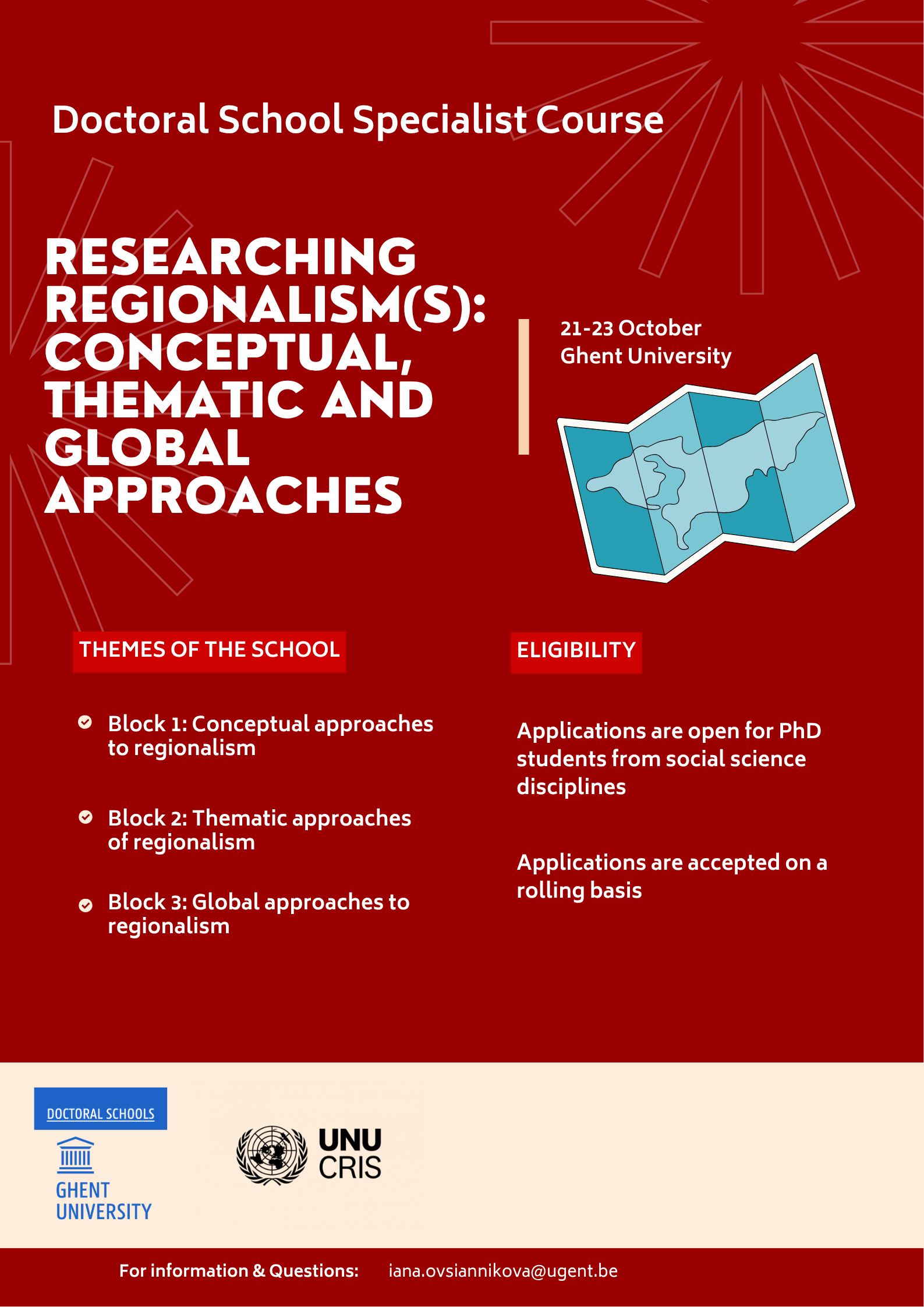


This course is organised by Ghent University in close collaboration with UNU-CRIS.
Why and how do societies cooperate and integrate across national borders? Regionalism as a research framework seeks to capture these dynamics by looking at deliberate projects to create regional rules, identities and socioeconomic structures. Through these processes, regions become a crucial level between global and national governance. Regionalism approaches seek to challenge state-centric and Eurocentric notions by recognising the agency of regions independently of their member states and by acknowledging the theory and practice of regional integration beyond the singular case of the European Union.
This course aims to provide PhD students with input and reflections on how to address regions in their analytical framework. The discussed approaches provide a multi-facetted understanding of regions, be it as imagined constructs, arenas of political negotiation or as global actors in their own right. It thereby spans across various disciplines in social science and remains applicable to a wide range of policy fields, from economics to migration, from climate to security, from diplomacy to law.
The specialist course delves into crosscutting concepts such as governance, agency and integration as well as uncovering the foundations of a critical and constructivist approach to regionalism. The course draws from empirical illustrations in different world regions and captures current trends around regional organisations as building blocks of a global order under stress. Participants will be able to connect the discussions on regionalism with their PhD projects and reflect on how such an approach can meaningfully enhance their research.
For further information, please see https://www.ugent.be/doctoralschool/en/doctoraltraining/courses/specialistcourses/conceptual-and-methodological-approaches-to-regionalism-2627#Organizingandscientificcommittee.