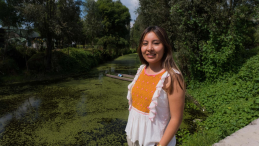


How would agriculture remain productive in a warmer, drier world where water scarcity and soil degradation increasingly threaten food production? During her UNU-BIOLAC fellowship, Layla Paola Chmeit Rangel explored this question by turning to an unlikely ally: extremophile fungi. Naturally adapted to some of the harshest environments on Earth, these microorganisms may hold the key to developing sustainable bioinputs that promote plant growth while reducing reliance on agrochemicals. Her research, conducted at the University of Jaén, focused on understanding how these fungi interact with plants and whether they can help agriculture adapt to the challenges posed by climate change.
While many soil fungi are known to exhibit plant growth-promoting traits, identifying promising candidates is only the first step. Before they can be safely incorporated into agricultural systems, it is essential to determine whether these microorganisms consistently benefit plants or whether certain interactions may instead produce inhibitory effects. Layla therefore evaluated a diverse collection of extremophilic fungi, assessing not only their capacity to tolerate environmental stress but also their influence on seed germination, root development, nutrient acquisition, and overall plant performance. Her work demonstrated that plant-fungal relationships are highly specific, with some strains exhibiting beneficial effects while others may inhibit growth depending on the mechanism of interaction.
A central objective of the fellowship was to uncover how these fungi exert their effects, rather than simply identifying strains associated with improved growth. Layla examined whether growth promotion was mediated by volatile organic compounds that stimulate plants at a distance, by compounds secreted directly into the surrounding environment via the fungal secretome, or by fungi's ability to solubilize phosphorus and make this critical nutrient more accessible to plants. Understanding these pathways is fundamental for translating laboratory findings into practical agricultural applications, as the success of future bioinoculants will depend on matching specific fungal traits to real-world farming conditions.
To accelerate this research, Layla used quinoa (Chenopodium quinoa) as a model system. Because the ultimate goal is to apply these findings to perennial crop trees, evaluating fungal performance directly in long-lived woody species would require years to draw meaningful conclusions. Quinoa provided an efficient and scientifically robust platform for rapidly screening dozens of fungal strains, allowing the identification of the most promising candidates before advancing them to trials in the target crop. The knowledge generated through these experiments is already supporting the next stage of research aimed at improving the productivity and resilience of olive cultivation under increasingly challenging climatic conditions.
Layla Paola Chmeit Rangel conducted this fellowship from the Universidad de Los Andes (Venezuela) at the Universidad de Jaén (Spain). Its success reflects the guidance and support of her mentors and supervisors, Dr. Bárbara Huber Baur (Universidad de Los Andes) and Dr. Ramón Alberto Batista García (Universidad de Jaén), whose expertise in ecology, molecular biology, and environmental microbiology helped shape the project. Special acknowledgment is also due to the Institute of Environmental and Ecological Sciences (ICAE) of the Universidad de Los Andes and the Department of Animal Biology, Plant Biology, and Ecology of the Universidad de Jaén for providing the scientific environment, facilities, and collaborative framework that made this international research experience possible.