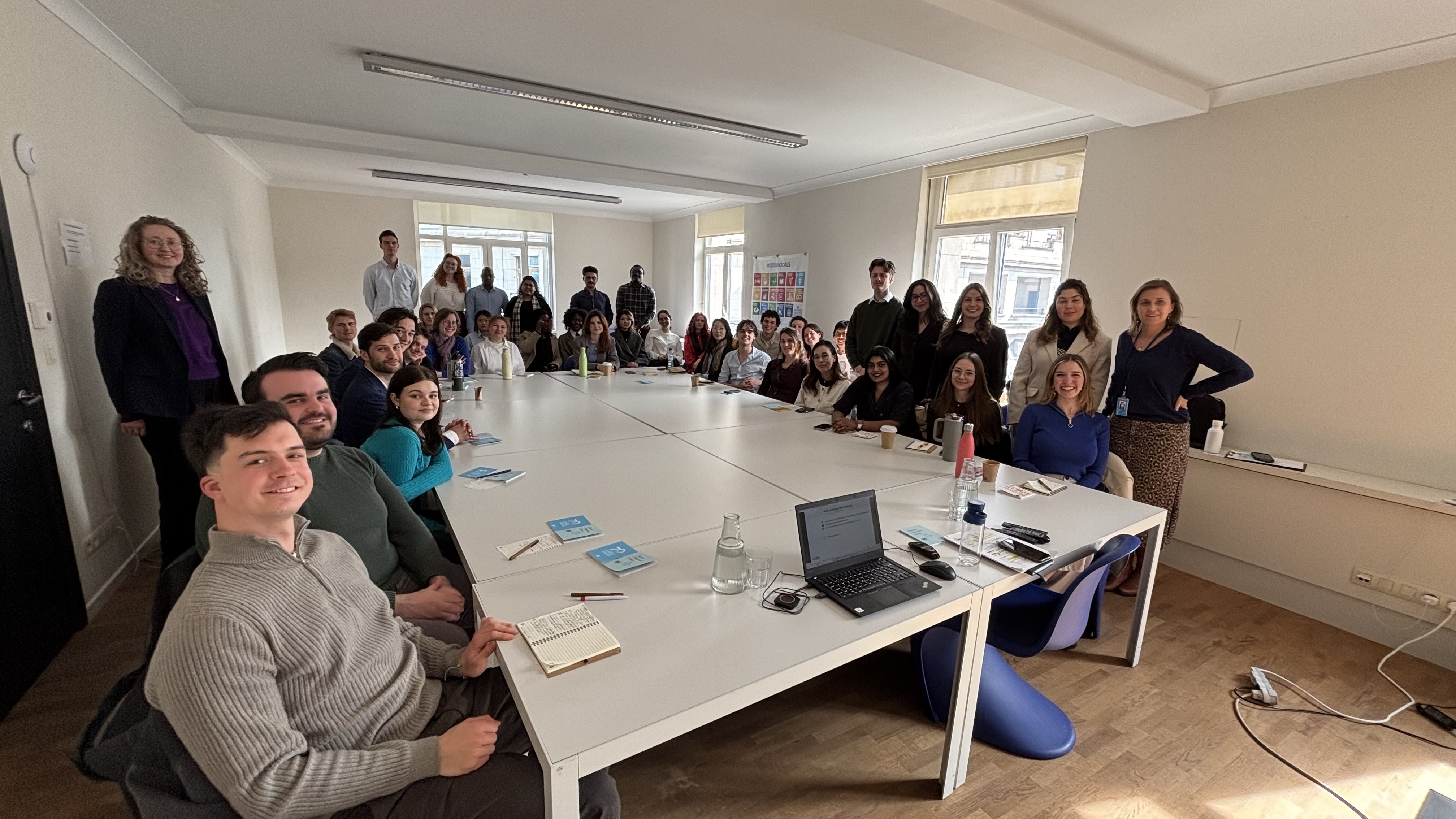
We left Maastricht at 7:45 in the morning, tired and in need of coffee, piling onto a bus in front of the UNU-MERIT building. Two and a half hours later, we were walking into the Residence Palace in Brussels, a grand building on the Rue de la Loi, just steps from the European Parliament and the headquarters of the European Commission. Walking past places where you feel that decisions affecting millions of people are made nearby, we were welcomed into the offices of the UN Regional Information Centre for Western Europe (UNRIC).
On 24 March 2026, the Global Governance for Development specialisation of the MPP had the opportunity to sit down with professionals from four different United Nations organisations. We had open conversations about what it means to do this work right now, in 2026, when the multilateral system is under more pressure than it has been in decades.
Here are some insights from our conversation.
UNOPS: United Nations Office for Project Services
The day started with Mariacarmen Colitti, Head of the UNOPS Brussels Liaison Office. We learned that UNOPS handles the operational side of development: infrastructure, procurement, and project coordination in fragile and conflict-affected environments.
Since 1995, it has been delivering what Ms. Colitti described as “practical solutions,” without a policy mandate of its own. Unlike other UN institutions, UNOPS helps agencies and governments turn development goals into action. It does this as a self-financed UN body, receiving funding only for specific projects — a model not always associated with international organisations.
What stood out was the gap between how much of the UN’s work UNOPS makes possible and how little it features in public discussions. That invisibility is both by design and a broader challenge across the UN system.
UNRIC: UN Regional Information Centre for Western Europe
Next, we heard from Marian Blondeel, Head of the Benelux and EU Desk at UNRIC. UNRIC’s role is to make the work of the United Nations visible and understandable to European audiences — something that has become increasingly complex.
The session focused on the relationship between the UN and the European Union. The EU is the UN’s largest multilateral donor, contributing $3.6 billion in 2024, representing 37.5% of total multilateral contributions. As Marian noted, “the partnership between the EU and UN at this critical time is vital… to protect the universal values of human rights, gender equality, the rule of law, and a rules-based international order.”
With the Secretary-General’s mandate ending and elections on the horizon, there is uncertainty about the future of UN leadership. While the role will remain central, its style may shift. It was also noted that there has never been a female Secretary-General.
We also discussed information integrity. The UN operates in an environment where disinformation spreads rapidly, and where its visibility is declining. A key example was a coordinated disinformation campaign targeting UNRWA.
UNRIC responds by acting as a source of verified information, working with local media and EU institutions to counter false narratives. Their work is guided by the Global Principles for Information Integrity, described as the “gold standard” in the field.
OHCHR: Office of the UN High Commissioner for Human Rights
After a short break, Stefano Sensi, Human Rights Officer at OHCHR, walked us through the international human rights system: treaties, treaty bodies, the Human Rights Council, the Universal Periodic Review, and Special Procedures.
A key question emerged: what happens when states do not comply? The answer was: not much automatically. Enforcement is limited, and decisions from bodies such as the ICJ or European courts depend on political agreement, which is rare.
As Stefano noted, “it is virtually impossible to change the UN mechanism from the inside,” pointing to the P5 veto as a core constraint. States often argue that recommendations are not legally binding. Examples ranged from the unenforced Nicaragua case to Italy’s decades-long delay in establishing a national human rights institution.
Yet the system can still create impact. The Universal Periodic Review generates political pressure through peer scrutiny, particularly when civil society is engaged. As Stefano explained, “Governments are very shy… but when they see the population is against a certain phenomenon, they have to act.”
The challenge is how to generate that pressure consistently. Stefano described the current moment as an “alarm clock,” noting that the expected “golden age” of multilateralism never fully materialised. Today’s geopolitical context was compared to the period preceding the dissolution of the League of Nations — a reminder that these institutions are not permanent.
UNRWA: United Nations Relief and Works Agency
The final session was with Mats Radeck, Advocacy Specialist at UNRWA. UNRWA was established in 1950 following the displacement of Palestinians and now serves over 5.9 million registered refugees across Gaza, the West Bank, Jordan, Lebanon, and Syria.
We learned that the term “Palestine refugee” includes those who lived in Mandate Palestine before 1948 and their descendants. UNRWA maintains registration systems, provides education, healthcare, micro-finance, and social services. In places like Lebanon, where refugees cannot access national schools, UNRWA is the only provider.
Originally a human development agency, UNRWA now operates largely as a humanitarian emergency body. The scale of the crisis is stark: 394 staff killed, 93% of schools damaged or destroyed, and shelters repurposed as classrooms. All of this is funded through voluntary contributions in an increasingly uncertain political environment.
The future of UNRWA, Mats told us, is “completely uncertain.” Its mandate is renewed every three years, and recent statements by the UN Secretary-General and the ICJ reflect the pressure it faces. Israeli legislation banning its operations in certain areas and a no-contact policy have further complicated its work.
Yet UNRWA continues to operate. “Whatever you think about removing the agency,” Mats said, “it won’t make the situation better.” It remains essential for humanitarian aid, public services, and stability.
Ending the Day
Walking through the Schuman neighbourhood afterward, we reflected on the day. Brussels showed us how global governance functions in practice — shaped by constraints, politics, funding challenges, and the efforts of those working within these systems.
One question kept surfacing: who pays, who rules? The answer is always more complex than it appears. As one speaker noted, “the UN is only as strong as its member states.” And those commitments are shaped by political realities.
That is a fragile foundation for multilateralism. But it is also the one we have.
Suggested citation: "A Day at the EU Capital of Global Governance: Our Study Visit to Brussels ," UNU-MERIT (blog), 2026-04-23, 2026, https://unu.edu/merit/blog-post/day-eu-capital-global-governance-our-study-visit-brussels.