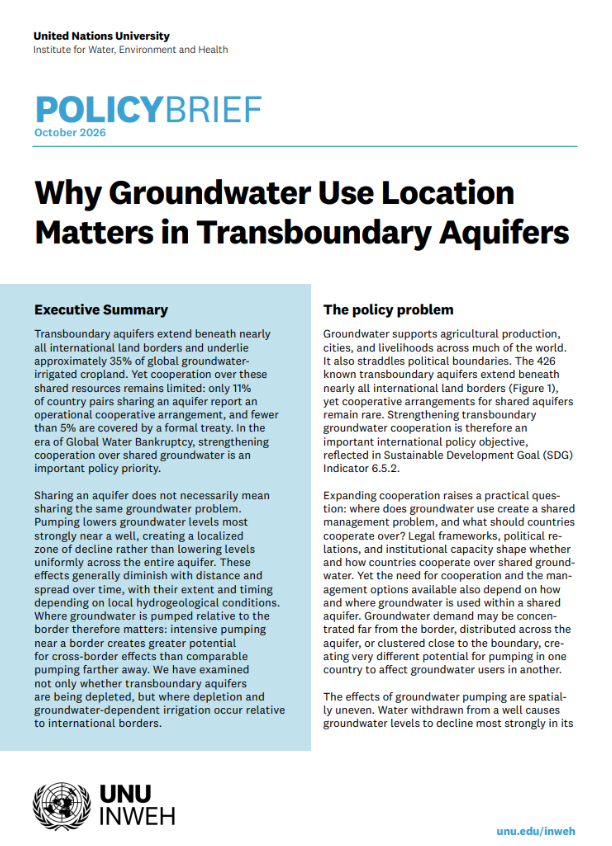
Groundwater depletion and groundwater-dependent irrigation tend to concentrate close to international borders within aquifers shared by two or more countries, where pumping on one side is more likely to affect users on the other, according to a publication by the United Nations University Institute for Water, Environment and Health (UNU-INWEH).
The Policy Brief, Why Groundwater Use Location Matters in Transboundary Aquifers, argues that sharing an aquifer does not necessarily mean sharing the same groundwater problem. It draws on a global analysis by researchers at UNU-INWEH, the Swiss Federal Institute of Aquatic Science and Technology (Eawag), the University of Delaware, Politecnico di Milano and the Colorado River Commission of Nevada, published in the Proceedings of the National Academy of Sciences (PNAS), which combined groundwater-level observations with global irrigation data.
The analysis found that, on average, groundwater depletion is no greater in transboundary aquifers than in comparable aquifers lying within a single country. The difference lies in where it happens. Within shared aquifers, both depletion and groundwater-dependent irrigation sit closer to international borders, a pattern that comparable domestic aquifers do not show.
Location matters because pumping lowers groundwater levels most strongly near the well, with effects weakening with distance and spreading over time. Intensive pumping near a border therefore has greater potential for cross-border effects than comparable pumping farther away. The authors caution that border proximity alone does not show that one country’s pumping is changing groundwater levels or well yields in another. It flags where closer, local hydrogeological assessment is needed.
“Countries often treat a shared aquifer as one shared problem, but that is rarely how groundwater behaves,” said Dr Marc F. Müller, Associate Research Professor for water cooperation and conflicts at UNU-INWEH and lead author of the brief. “A well pumping far from the border may barely register on the other side, while intensive pumping right along the line can affect neighbours directly. Knowing where water is drawn tells countries what they actually need to cooperate on, and where.”
That picture could change as irrigation expands. Under a potential irrigation scenario that maps water-stressed cropland in shared border regions, pairs with agriculture spread across the border region rise from 125 to 211, and Border Locked pairs more than double, from 40 to 87. The scenario does not predict where irrigation will expand, the authors note, but shows where current patterns could shift and the scope to keep pumping away from the border could shrink.
The publication suggests that cooperation should match the geography of use. As a first step, countries sharing an aquifer could map groundwater demand and depletion relative to the border, together with the hydrogeological conditions that determine whether pumping effects can cross it. Where intensive use sits away from the border, monitoring and data sharing alongside zone-based measures such as pumping setbacks or protected areas can help keep the two sides separated, as in the protected and management areas established by Jordan and Saudi Arabia for the Al-Sag/Al-Disi aquifer. Where use is concentrated along the border, countries may need to coordinate how much groundwater is pumped and, where relevant, manage recharge together, as France and Switzerland have long done in the Genevois aquifer.
“In an era of global water bankruptcy, shared groundwater is too valuable to manage on assumptions,” said Professor Kaveh Madani, Director of UNU-INWEH and a co-author of the publication. “This work gives countries a practical starting point: look first at where water is being used, then build the kind of cooperation that fits. Acting before new wells and fields move towards the border keeps far more options open. As governments prepare for the UN 2026 Water Conference in December, evidence like this can help turn commitments on transboundary cooperation into arrangements that work on the ground.”
Key Findings at a Glance
- The 426 known transboundary aquifers extend beneath nearly all international land borders and underlie about 35% of global groundwater-irrigated cropland.
- Only 11% of the 568 country–aquifer pairs report an operational cooperative arrangement, and fewer than 5% are covered by a formal treaty.
- Average groundwater depletion is no greater in transboundary aquifers than in comparable domestic aquifers, but within shared aquifers depletion and irrigation concentrate closer to borders.
- 71% of country–aquifer pairs have limited groundwater-dependent agriculture near the border, 22% have it spread across the border region, and 7% have it highly concentrated at the boundary.
- Under a potential irrigation scenario, Border Locked pairs rise from 40 to 87 and Distributed Agriculture pairs from 125 to 211.
Report Information
Müller, M.F., Davis, K.F., Faure, J.C., Chiarelli, D.D., Hung, F. and Madani, K. (2026). Why Groundwater Use Location Matters in Transboundary Aquifers. United Nations University Institute for Water, Environment and Health (UNU-INWEH), Richmond Hill, Ontario, Canada. doi: 10.53328/INP26MFM002
Supporting paper: Müller, M.F., Davis, K.F., Faure, J., Chiarelli, D.D. and Hung, F. (2026). Geography of groundwater use and depletion in internationally shared aquifers. Proceedings of the National Academy of Sciences, in press. 10.1073/pnas.2619357123
Available for Interview: Interview requests should be submitted to media.inweh@unu.edu
Media Contacts: Marjan Asadullah, Communications Assistant, UNU-INWEH, marjan.asadullah@unu.edu
About UNU-INWEH
Marking its 30th anniversary of operation in 2026, the United Nations University Institute for Water, Environment and Health (UNU-INWEH) is one of 13 institutions that make up the United Nations University (UNU), the academic arm of the UN. Known as ‘The UN’s Think Tank on Water’, UNU-INWEH addresses critical water, environmental, and health challenges around the world. Through research, training, capacity development, and knowledge dissemination, the institute contributes to solving pressing global sustainability and human security issues of concern to the UN and its Member States.
Headquartered in Richmond Hill, Ontario, UNU-INWEH has been hosted and supported by the Government of Canada since 1996. With a global mandate and extensive partnerships across UN entities, international organizations, and governments, UNU-INWEH operates through its UNU Hubs in Calgary, Hamburg, New York, Lund, and Pretoria, and an international network of affiliates.