Parts of sub-Saharan Africa have as few as 88 researchers for every million people. The world average reached 1,486 in 2023 (UN Sustainable Development Goals Report 2026, Goal 9). With so few, the continent cannot rely on professional researchers alone for the evidence its natural resource decisions need. The question is not only how many researchers Africa has. It is also where research is done and how it is organised.
Natural resource decisions are taken at many levels. A ward decides which drain to clear. A municipal assembly decides how to spend a climate grant. A ministry sets the price paid to cocoa farmers. Yet much of the evidence these decision-makers have comes as national averages or regional estimates. It describes the whole country, but rarely the place where the decision is made.
Elinor Ostrom's work, recognised with the Nobel Memorial Prize in Economic Sciences in 2009, shows a way through. She studied forests, fisheries and irrigation systems across the world. Where shared resources were governed well, one common condition was monitoring: the state of the resource, and how it was used, were watched by the users themselves or by people answerable to them (Ostrom, American Economic Review, 2010). In other words, evidence is part of how a resource is governed, not something added afterwards. In the same work she argued for polycentric governance: many centres of decision rather than one.
For a research institute, this has a practical meaning. If decisions are taken at many levels, evidence must be produced at those levels too. It must also meet a standard that lets anyone check it and compare it. UNU-INRA now works in five steps:
- Every piece of research starts with a question tied to a named decision and to the office that takes it.
- The count uses tools and records anyone can reach: a public budget line, a market price, a tape measure, a photograph taken from a fixed point.
- Every finding passes internal quality review before it is shared.
- The authority concerned sees its own figures first and has the right to respond.
- The same measure is repeated after the decision, so that change can be seen rather than assumed.
This approach has been tested on drainage in Kajiado North, Kenya. Between September and October 2026, a UNU-INRA evidence station walked all 10 flood and road works lines in the budgets of two wards. It marked each one as working, blocked or never built, and found several drains that had been paid for but were blocked. The findings went first to the county and to its sub-county and ward offices. By 15 November, according to the station's record, 11 receipts had been stamped in 6 offices. On 14 November, the Umoja box culvert, which had been choked, was carrying water again. The money had already been spent. The count showed the people who could act exactly where the problem was.
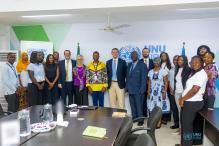
The College of Research Associates was launched on 24 November 2026 to take this approach across the continent. According to the event's attendance record, 147 people from 27 countries took part, and 81 stayed for an hour or more. Everyone was asked one question: what decision in your town needs evidence? The first answers show the same pattern as Kajiado.
- East Legon Hills, Accra: households buy water from tankers while the rain from their roofs runs into the drains. Residents appealed to Ghana Water over supply interruptions in January 2026 (GNA).
- Kpone-Katamanso: the Municipal Assembly chose 11 youth-led groups for climate action grants in November 2026 (GNA). How much work that support creates on the ground has not yet been counted.
- Bamenda: in August 2026 the Minister of Housing and Urban Development warned against building in drainage corridors (Hilltop Voices). The costs of the possible options have not yet been compared.
Each contributor now has one task that can be done in a single day: one place, one formula, three numbers and one photograph, due on 9 December 2026. Researchers in the College, and students and practitioners in the Innovative Affiliation, all follow the same five steps. Because the method is the same everywhere, the results can be compared: where the same gap appears in different towns and countries, and what closed it where it was closed. When the first 100 answers are complete, they will be published together.
A continent with too few researchers can still produce the evidence its decisions need. It does so by doing research where those decisions are taken, with methods simple enough for anyone to repeat and rigorous enough for governments, investors and communities to trust.
Researchers and academics can join the College of Research Associates. Students, practitioners and people in the field can join through the Innovative Affiliation.
Suggested citation: Dr. Richard Munang., "Counting Where Decisions Are Taken: How Africa Can Close Its Research Gap," UNU-INRA (blog), 2026-11-27, 2026, https://unu.edu/inra/blog-post/counting-where-decisions-are-taken-how-africa-can-close-its-research-gap.