


Richmond Hill, Ontario, Canada (3 June 2026) – By 2030, the global data centres powering artificial intelligence are projected to consume 945 terawatt-hours of electricity. This is nearly triple the combined annual electricity use of Pakistan, Bangladesh, and Nigeria—countries collectively home to more than 650 million people. Their associated water footprint will equal the basic annual domestic water needs of all 1.3 billion people in Sub-Saharan Africa, and their land footprint will exceed 14,500 square kilometers, roughly twice the Jakarta metropolitan area, home to more than 32 million people.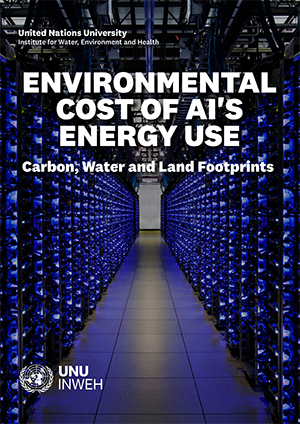
These stark findings are detailed in the new report, Environmental Cost of AI's Energy Use: Carbon, Water and Land Footprints, by the United Nations University Institute for Water, Environment and Health (UNU-INWEH). Researchers have previously warned about the greenhouse gas emissions of data centers before. But the UN scientists now argue that the environmental costs of AI and data centers cannot be understood through carbon emissions alone. In their report, they quantify the carbon, water and land footprints of AI's electricity use across the globe and highlight the big differences between these footprints in the world’s 20 largest data center hubs.
"This report is not a case against artificial intelligence, a technological transformation that is improving the lives of billions of people around the world," said Professor Kaveh Madani, Director of UNU-INWEH who led the investigation team. "It is a call for using it responsibly and addressing its unintended impacts proactively to make it sustainable and equitable. We have a narrow window to ensure that the backbone of the technological revolution of our era develops within planetary limits, and that the communities who provide the critical minerals for advancing AI and the ones that host its infrastructure and e-waste are also among those who benefit from it."
A footprint that is being mismeasured
The report finds that AI's environmental cost is being systematically mismeasured. Most existing assessments focus on the carbon emissions associated with training large models. Yet every kilowatt-hour of electricity used to train or run an AI system also carries a water footprint, from cooling and power generation, and a land footprint, from energy infrastructure and supply chains. These three footprints do not move in the same direction. Switching from coal to bioenergy, for example, can on average cut the carbon footprint of electricity by 70 per cent, while increasing its water footprint more than thirty-fold and its land footprint a hundred-fold. The report concludes that "low-carbon" is not automatically "low-water" or "low-land” and warns that evaluating AI sustainability through a single metric can hide trade-offs and shift environmental burdens onto regions already facing water or land stress.
The numbers compound rapidly at the infrastructure level. Global data centres consumed an estimated 448 terawatt-hours of electricity in 2025. If treated as a nation, they would have been the world's 11th largest electricity consumer, behind France and ahead of Saudi Arabia.
"What surprised us most is how often the choices that look greenest from a carbon perspective end up worse for water or for land," said Dr. Miriam Aczel, UNU-INWEH Researcher and the lead author of the report. "If we keep judging AI sustainability by carbon alone, we might think that renewables make AI infrastructure clean but that is solving one problem while creating other problems, often in places that didn't ask for it."
Inference, efficiency, and the rebound effect
Public discussion has largely focused on the energy required to train massive models. Training GPT-3 was estimated to require 1.3 gigawatt-hours (GWh) of electricity, while estimates suggest GPT-4 consumed between 50 and 70 GWh. However, the report reveals this framing is outdated. Once a model is deployed, inference—the continuous running of models to answer everyday user prompts—becomes the dominant cost, accounting for 80 to 90 per cent of total AI energy use. ChatGPT alone is estimated to process around 2.5 billion prompts per day, translating to roughly 383 GWh of electricity per year for a single product. Offsetting associated carbon emissions would require 2.6 million tree seedlings grown for 10 years, enough trees to cover a land area the size of Manhattan. The water footprint is equivalent to the minimum annual domestic water needs of roughly 500,000 people in Sub-Saharan Africa, and the land footprint is equal to over 800 football fields.
Video generation as an emerging environmental crisis
Per-query energy varies by orders of magnitude depending on the task. A typical conversational chat query is around 200 times more energy-intensive than basic text classification. Generating a single AI image can require around 1,450 times that baseline. A single short AI-generated video can consume as much electricity as 200,000 spam classifications. Model choice, prompt length, output format and resolution all materially shape the footprint. Yet most of these decisions are taken invisibly, by product defaults the user never sees.
The report invokes the rebound effect (the Jevons Paradox), warning that as models become more efficient, they become cheaper and are used more frequently. Without explicit limits on tokens, resolution, or default output length, improvements at the per-query level are easily wiped out by sheer volume growth.
"A lot of people think that the environmental footprint of AI reduces, as technology improves and processes become more efficient. But that is only a partial picture of the overall problem," said Professor Madani, a co-author of the report who was recently named the 2026 Stockholm Water Prize Laureate. "More efficient and affordable AI and energy mean more consumption of AI, making the overall footprint far bigger than what we save through efficiency gains."
Local costs, distant benefits
The benefits and burdens of the massive global expansion of AI are highly unequal. Several site-level cases in the report show how globally distributed AI services create intense local pressures. In Ireland, data centres accounted for 21% of total metered electricity in 2023, exceeding all urban households. The national grid operator has paused new approvals around Dublin until 2028, making Ireland a concrete, documented example of what happens when AI infrastructure growth outpaces energy planning — and a preview of what other countries are heading toward.
In Querétaro, Mexico, expanding compute infrastructure is drawing on water supplies amid prolonged droughts. In Uruguay, plans for a water-intensive data centre coincided with a 2023 drought that depleted Montevideo's freshwater reserves, making tap water unsafe to drink.
Furthermore, AI infrastructure could generate up to 2.5 million tonnes of electronic waste each year by 2030, much of it processed in low-income economies with limited safeguards, while critical minerals are extracted in jurisdictions with weak environmental oversight.
"If you map where data centres are getting built against where water stress is worst, you tend to see the same regions in some instances," said Dr. Mir Matin, Manager of UNU-INWEH's Geospatial, Climate and Infrastructure Analytics Programme and a co-author of the report. "And the communities living near these sites are not necessarily the ones using the AI being run there. That asymmetry is the issue. Without fixing it, we'll just be repeating older patterns, where some places carry the costs and other places capture the benefits."
The digital divide: AI computing is 90% concentrated in two countries
While the AI infrastructure comes with environmental costs, they also have major economic, security and sovereignty advantages that encourage the wealthier countries to build more data centers. Only 32 countries in the world host AI-specialised data centres, and 90% of that capacity is concentrated in 2 countries, while more than 150 countries currently have little or no access to sovereign AI compute. The report frames this not just as an economic divide but as an environmental justice issue: excluded countries bear critical minerals extraction and e-waste burdens while the strategic benefits flow elsewhere.
"The global system building artificial intelligence must also govern it sustainably and fairly," said Professor Tshilidzi Marwala, Rector of the United Nations University and Under-Secretary-General of the United Nations. "The concentrated development of AI infrastructure in the privileged areas of the world is creating a large digital divide that poses profound challenges in the equitable development of AI. AI can certainly advance prosperity and human well-being. Whether it does so equitably is now a governance question, not a technical one."
A roadmap for sustainability and equity
The report calls for a responsible AI ecosystem built on six principles: transparency; efficiency by design; equity and environmental justice; lifecycle responsibility; global cooperation; and sustainable use. Practical recommendations are directed at each major group of stakeholders:
- Governments should integrate AI infrastructure into energy planning, water governance, and land-use permitting, and require standardized environmental footprint reporting.
- Industry and AI developers should treat model selection, default outputs, and routing decisions as footprint determinants, and improve efficiency by design.
- Users and deploying organizations should adopt fit-for-purpose use — selecting the lightest model and lowest-energy format that meets the task.
- Data center operators and utilities should treat siting and energy procurement as environmental footprint decisions and apply cumulative impact assessment.
- Investors should treat electricity, carbon, water, and land footprints as material risks in AI infrastructure portfolios.
- Communities and civil society should be involved early in data center siting decisions, with enforceable transparency and grievance mechanisms.
- International institutions should support harmonized measurement standards, reduce incentives for cross-border burden shifting, and build compute capacity in excluded regions.
By the numbers
945 TWh | Projected global data-centre electricity demand by 2030, almost three per cent of projected world electricity use and roughly twice France's 2025 consumption |
399 million tonnes | The associated carbon footprint from projected 2030 data-centre electricity consumption would require approximately 6.7 billion trees grown over 10 years to offset—roughly twice the estimated number of trees in the United Kingdom. |
9.3 trillion litres | Associated water footprint of 2030 data-centre electricity, equal to the basic annual domestic water needs of 1.3 billion people in Sub-Saharan Africa |
14,500 km² | Associated land footprint of 2030 data-centre electricity, about twice the Jakarta metropolitan area, home to more than 32 million people |
80 to 90% | Estimated share of total AI energy use consumed by inference, the running of deployed models, rather than by training |
2.5 billion | Estimated daily ChatGPT prompts, translating to roughly 383 GWh of electricity a year for a single product |
1,450× | Energy demand of a typical AI-generated image relative to basic text classification |
>90% | Share of AI-specialised cloud compute concentrated in two countries, the United States and China |
2.5 million tonnes | Projected annual AI-related electronic waste by 2030, equivalent to discarding nearly 250 Eiffel Towers each year |
REPORT IN BRIEF
AI's environmental cost is being mismeasured. Most current assessments focus on carbon emissions from training. The report argues this misses a substantial part of the picture. Every kilowatt-hour of AI electricity also carries a water footprint, from cooling and generation, and a land footprint, from infrastructure and supply chains. These three footprints can move in opposite directions, so reducing one can magnify another.
Data centres are becoming country-scale consumers of electricity, water and land. Global data-centre electricity use, estimated at 448 TWh in 2025, could reach 945 TWh by 2030. The associated water footprint is projected at 9.3 trillion litres and the associated land footprint at over 14,500 square kilometres.
Inference, not training, drives most of AI's energy use. Once a model is deployed, billions of daily user interactions consume an estimated 80 to 90 per cent of its total energy. ChatGPT alone is estimated to process around 2.5 billion prompts per day.
Per-query energy varies by orders of magnitude across tasks. A typical chat query uses around 200 times the energy of basic text classification. An AI image uses around 1,450 times. A single short AI video can match 200,000 spam classifications. Model choice and product defaults are footprint decisions.
Energy and water required to generate AI images and videos. The energy required to generate a typical AI image is enough to power a 10-watt LED bulb for 17 minutes, and the energy required for a high-complexity AI video is sufficient to run that same bulb for 42 hours. Similarly, the electricity-associated water footprint is about two tablespoons (29 mL) for a single image, but jumps to 4.1 liters for a complex video—almost equivalent to a two-day drinking water need for one person.
Efficiency improvements alone will not contain growth. The report cites the rebound effect, sometimes called the Jevons Paradox, to explain why per-query gains are typically absorbed by rising volumes. Caps on tokens, resolution and output length are needed alongside efficiency.
AI compute is geographically concentrated. Only 32 countries host AI-specialised data centres. Over 90 per cent of capacity is in two countries. More than 150 countries currently lack sovereign AI compute infrastructure.
The hardware lifecycle is the next frontier. AI infrastructure could generate up to 2.5 million tonnes of electronic waste each year by 2030. Critical minerals required for AI hardware are concentrated in regions with weaker environmental oversight, often in the Global South.
A six-principle governance framework. The report proposes a "responsible AI ecosystem" built on transparency, efficiency by design, equity and environmental justice, lifecycle responsibility, global cooperation, and sustainable use, with specific responsibilities assigned across the AI ecosystem.
KEY POLICY MESSAGES
Carbon-only metrics are no longer sufficient for AI. Disclosure standards for AI's environmental impact should require carbon, water and land footprints jointly, in standardised units, across both training and inference and across jurisdictions, so that regulators and investors can compare like with like.
Inference deserves the policy attention that training has received. Because operational use accounts for the majority of AI energy demand, governance should focus on product defaults, model selection and behavioural levers, not only on the largest training runs.
Siting decisions are environmental decisions. Where data centres are built, and from which grid they draw power, determines the carbon, water and land profile of the same workload. Permitting, environmental impact assessment and community consultation should reflect this reality.
Local capacity-planning needs to keep pace with global compute geography. The Irish, Mexican and Uruguayan cases described in the report show what happens when grid and water systems are asked to absorb workloads that serve users elsewhere. Transparent mitigation and benefit-sharing should accompany expansion.
Efficiency gains require demand-side guardrails. Without resource budgets, token-per-prompt limits, default low-resolution settings and similar guardrails, efficiency improvements will be absorbed by volume growth.
AI compute access is itself an equity issue. More than 150 countries currently lack sovereign AI compute. International institutions can help by supporting capacity-building, harmonising disclosure, and reducing incentives for cross-border burden-shifting.
The full value chain requires governance. Critical-mineral extraction at the upstream end and electronic waste at the downstream end are integral to AI's footprint and currently fall on communities that capture little of the benefit.
Investors and financial institutions can move first. Treating carbon, water and land footprints as material risks in due diligence on AI infrastructure portfolios is described in the report as one of the fastest available levers.
AI within planetary limits is achievable. The report's central argument is constructive. Capability and stewardship can grow together, but only with measurement, transparency, and shared responsibility across the ecosystem.
REPORT INFORMATION
Aczel, M., Chamanara, S., Matin, M., Farsi, A., Marwala, T., Madani, K. (2026). Environmental Cost of AI's Energy Use: Carbon, Water and Land Footprints. United Nations University Institute for Water, Environment and Health (UNU-INWEH), Richmond Hill, Ontario, Canada. doi: 10.53328/INR26RMA002
AVAILABLE FOR INTERVIEW
Interview requests should be submitted to media.inweh@unu.edu
MEDIA CONTACTS
William Smyth, Public Engagement Liaison, UNU-INWEH, william.smyth@unu.edu
Daniel Powell, Senior Communications Officer, UNU, powell@unu.edu
ABOUT UNU-INWEH
Marking its 30th anniversary of operation in 2026, the United Nations University Institute for Water, Environment and Health (UNU-INWEH) is one of 13 institutions that make up the United Nations University (UNU), the academic arm of the UN. Known as 'The UN's Think Tank on Water', UNU-INWEH addresses critical water, environmental, and health challenges around the world. Through research, training, capacity development, and knowledge dissemination, the institute contributes to solving pressing global sustainability and human security issues of concern to the UN and its Member States. Headquartered in Richmond Hill, Ontario, UNU-INWEH has been hosted and supported by the Government of Canada since 1996. With a global mandate and extensive partnerships across UN entities, international organizations, and governments, UNU-INWEH operates through its UNU Hubs in Calgary, Hamburg, New York, Lund, and Pretoria, and an international network of affiliates.