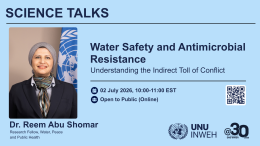


Water quality vulnerability analysis applies an intersectional perspective to reveal how access to safe drinking water functions as both an outcome and a driver of socioeconomic and gender-based structural inequality. Rather than treating water quality as a purely technical issue, it centers on lived experiences shaped by wealth disparities, gender inequality, governance failures, and historical legacies. Without this approach, assessments of water safety risk obscure vulnerability, naturalize inequity, and overlook how water systems reproduce social injustice.
In this Science Talk, Professor Grace Oluwasanya will explore water quality as a fundamental determinant of public health, development, and social justice, and as a powerful mirror of structural inequality. She will introduce the Water Quality Vulnerability Index (WQVI), a novel composite indicator that integrates drinking water safety, wealth, and gender inequality within an environmental justice framework, to demonstrate how multidimensional vulnerability can be systematically assessed. Drawing on evidence from 138 countries across the Global South, she will illustrate how similar income levels can mask starkly different water quality outcomes, and how governance quality, infrastructure performance, social norms, and historical contexts shape these disparities. The talk will highlight global vulnerability hotspots, including contexts where unsafe water, low wealth, and high gender inequality intersect, affecting billions of people. Finally, she will discuss the implications for policy and practice, emphasizing how integrated, justice-oriented water governance can move beyond siloed solutions and support more equitable, inclusive, and resilient development pathways.
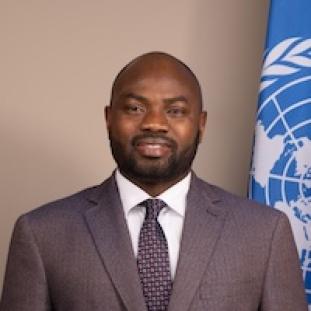
Speaker

Prof. Grace Oluwasanya
Senior Researcher: Water, Climate and Gender