

Drought is among the most complex and costly of climate-related hazards, with far-reaching consequences for land degradation, water security, food systems, ecosystems, livelihoods, and sustainable development. As one of the three pillars of the United Nations Convention to Combat Desertification (UNCCD), alongside desertification and land degradation, drought remains central to global efforts to build resilience and strengthen preparedness in a changing climate.
The prevailing approach treats drought as a temporary crisis: monitor the hazard, respond to its impacts, and recover once the rains return. UNU-INWEH's flagship report, Global Water Bankruptcy: Living Beyond Our Hydrological Means in the Post-Crisis Era, points to a critical turning point that this approach misses. In many regions, long-term water use now exceeds renewable supply, stored reserves, and institutional capacity. Under these conditions, drought is no longer simply a lack of rainfall. It reflects a deeper state of water bankruptcy — a coupled water–human crisis shaped by management decisions, infrastructure, governance, and societal vulnerability, in which each drought begins from a weaker starting point and some losses may be irreversible.
UNU-INWEH is organizing the side event during the 17th session of the Conference of the Parties to the United Nations Convention to Combat Desertification (UNCCD COP17).
Drought Resilience Assessment Frameworks in the Age of Water Bankruptcy
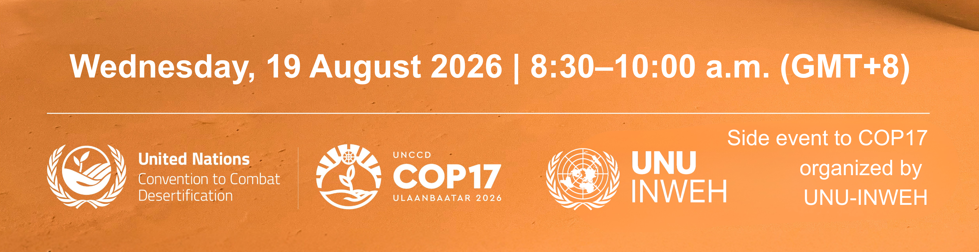
Date & Time: Wednesday, 19 August 2026 | 8:30–10:00 a.m. (GMT+8)
Venue: Room MET-06, UNCCD COP17, Ulaanbaatar, Mongolia
Organizers: United Nations University Institute for Water, Environment and Health (UNU-INWEH) and the UNCCD Secretariat
The side event is expected to advance dialogue on the evolution of drought resilience assessment beyond traditional hazard monitoring toward integrated, impact-based, and decision-oriented approaches. It will strengthen understanding of the interlinkages between drought resilience, water security, and the emerging concept of water bankruptcy, while highlighting opportunities to enhance operational drought monitoring through the integration of Earth observations, artificial intelligence, predictive analytics, impact information, and water management data. The discussion will also identify priorities for strengthening collaboration between science, policy, and practice to improve drought preparedness, adaptation, and resilience. Ultimately, the session will contribute to ongoing discussions under the UNCCD by supporting a shift towards proactive drought management, strengthening resilience to land degradation and climate change, and advancing sustainable and integrated water governance.