

UNU-INWEH Policy Brief: von der Kammer, R., Dinc, P., & Eklund, L. (2025). The Drought– Migration–Conflict Nexus: Was the Syrian
Civil War Really Caused by Climate Change? United Nations University Institute for Water, Environment, and Health (UNU-INWEH), Richmond Hill, Ontario, Canada. doi: 10.53328/ INR25LER002.
DOWNLOAD PDF
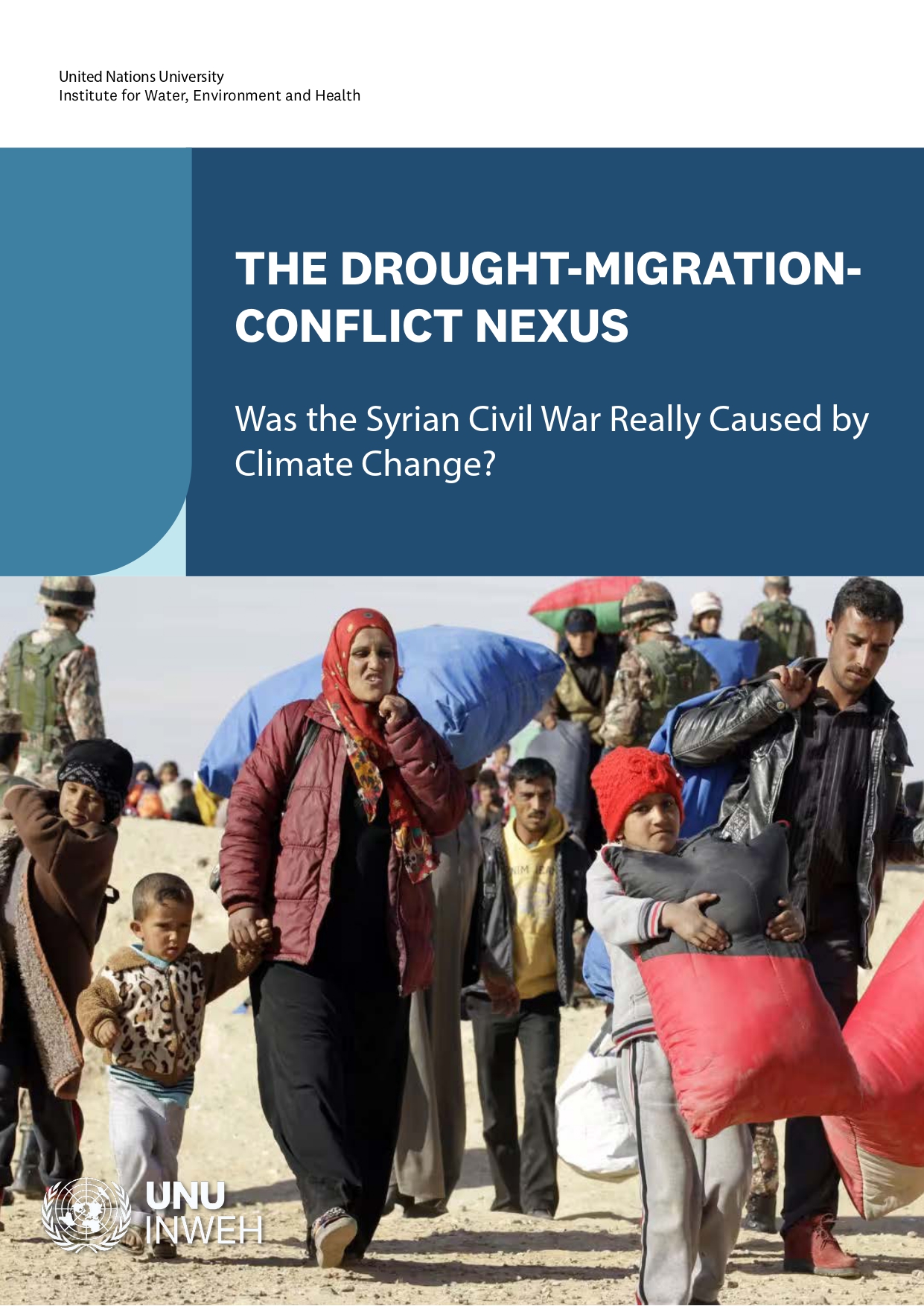
Climate change is increasingly framed as a security threat, yet the links between drought, migration, and conflict remain far more complex than popular narratives suggest. While media and some academic accounts portray the 2007–2009 Syrian drought as a direct trigger of the 2011 uprising, evidence shows that climate stress interacts with longstanding socio-economic, agricultural, and governance challenges rather than acting as an isolated cause.
This report from UNU-INWEH provides a comprehensive reassessment of Syria’s drought–migration–conflict nexus, drawing on meteorological data, satellite-based land-use monitoring, and fieldwork with Syrian farmers in Türkiye. The analysis finds limited drought-related land abandonment and sustained cropland activity before the uprising, indicating that rural decline and mobility pressures pre-dated the drought and were later exacerbated by the civil war rather than caused by climate stress alone.
The findings challenge oversimplified climate-conflict narratives and highlight the central role of structural factors—unsustainable agricultural development, resource overexploitation, and governance shortcomings—in shaping Syria’s vulnerability. As Syria moves toward a post-Assad phase, addressing the compounded impacts of conflict and climate change will require conflict-sensitive policies, combining modern technologies with traditional water-management practices and governance reforms that strengthen long-term resilience.
Read the press release