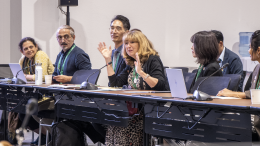
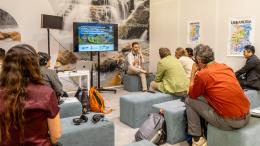
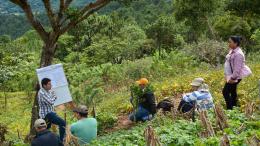
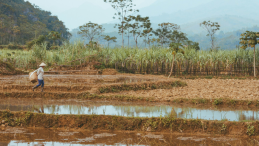
On 24 October 2026, UNU-IAS and the International Union of Biological Sciences (IUBS) co-organized a workshop at the 7th Science-Policy Forum for Biodiversity (SPFB), held during the 2026 UN Biodiversity Conference (CBD COP17) in Yerevan, Armenia. The session examined the gaps and challenges in funding for sustainable landscape governance.
Opening the session, Suneetha M. Subramanian (Research Fellow, UNU-IAS) introduced a UNU-IAS report The True Cost of Governance in Integrated Landscape Approaches, which draws on landscape initiatives worldwide, including by members of the International Partnership for the Satoyama Initiative (IPSI). Tom Derr and Juan Carlos Ramos (Persimmon Co-Lab) presented findings from the report, highlighting that while governance was recognized across several targets of the Kunming-Montreal Global Biodiversity Framework, essential functions such as coordination, participation, communication and monitoring often relied on individual champions, unpaid labour, institutional goodwill and short-term projects. When funding ends, institutions could lose institutional memory and data, while participation, coordination and trust might decline.
In an interactive fishbowl discussion, Terence Hay-Edie (UNDP) stressed that traditional governance systems have long existed but often remained hidden. Bhushan H. Sethi (Founder, GALLOP Initiative) observed that funding was usually tied to projects or single themes such as climate, rather than to landscapes, and called for financing models spanning 20 years or more. Paule Gros (CEO, BiodivEarth) noted that governance was rarely visible to funders and emphasized the need to demonstrate that it is functioning effectively.
A second round of discussion focused on accessing finance. Katie Minderhoud (PBL Netherlands Environmental Assessment Agency) stressed the need to map public funds already allocated to a landscape and to agree governance arrangements before private investors join. Martin Cruickshank (Business for Nature) pointed to the difficulty of connecting investors with those managing landscapes on the ground and called for redirecting harmful subsidies towards resilience. Panellists noted that many developing countries had limited room in their public budgets, while a private sector participant suggested framing governance funding as an insurance premium that protects investments over time.
Key recommendations included recognizing and supporting community-led and traditional governance systems, improving dialogue between funders and landscape actors, and developing financing models that can sustain governance beyond individual project cycles.
In closing remarks, Fumiko Nakao (Secretariat of the Convention on Biological Diversity) emphasized that funding for integrated landscape approaches remained insufficient despite their important role in connecting biodiversity, climate and other priorities. She encouraged participants to continue working together to strengthen recognition of the investment needed to sustain landscape governance.