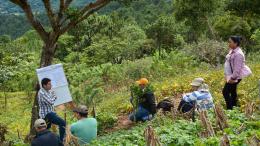
On 23 October 2026, UNU-IAS co-organized a side event at the 2026 UN Biodiversity Conference (CBD COP17) in Yerevan, Armenia, exploring how subsidies and incentives can be reformed to better support biodiversity and socio-ecological resilience at the local level.
Suneetha M. Subramanian (Research Fellow, UNU-IAS) discussed the implementation of Target 18 of the Kunming-Montreal Global Biodiversity Framework (GBF), which calls for the identification, elimination, phasing out or reform of incentives harmful to biodiversity, while scaling up positive incentives. Drawing on the UNU-IAS policy report Impact of Subsidies and Incentives on Socio-Ecological Production Landscapes and Seascapes (SEPLS), she highlighted challenges experienced by communities managing landscapes and seascapes, including the expansion of monocropping, loss of ecosystem functions, declining traditional practices and unequal market relationships. Dr. Subramanian stressed the importance of integrated and inclusive planning, equitable incentives for small- and medium-scale sustainable producers, locally appropriate finance and technologies, and investment in education and capacity development.
Engin Yılmaz (Executive Director, Yolda Initiative) examined how agricultural subsidies and incentives affect traditional and mobile pastoral systems in Europe. Drawing on the EU Common Agricultural Policy and experiences from Lemnos Island, Greece, he noted that support based on land area or production can disadvantage small-scale and mobile pastoralists and does not necessarily reward biodiversity outcomes.
Providing a private-sector perspective, Ivan Paspaldzhiev (Senior Manager, EY denkstatt) discussed efforts to measure business contributions against nature-positive outcomes. He highlighted challenges arising from fragmented certification systems and biodiversity metrics, as well as the issue of who should bear the costs of collecting biodiversity data.
An interactive discussion engaged participants to consider the role of consumer choices, public procurement, certification, biodiversity finance and private-sector engagement, while emphasizing that incentive systems need to reflect different ecological, economic and social contexts. Achieving the goals of the GBF will require not only reforming incentives that harm biodiversity but also ensuring that positive incentives are accessible to the communities and producers managing landscapes on the ground.