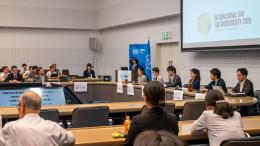


On 24 May 2026, UNU-IAS Operating Unit Ishikawa/Kanazawa (UNU-IAS OUIK) hosted an event to celebrate International Day for Biological Diversity on the theme "Rebuilding Noto through Forest Restoration: Harnessing Nature for a Resilient Future". It discussed how forests can support the recovery of biodiversity and local communities affected by the 2024 Noto Earthquake and heavy rainfalls.
In opening remarks, Daisuke Asano (Deputy Governor, Ishikawa Prefecture) noted that the impacts of the disasters were still visible in the mountains of Noto, and emphasized that both regional recovery and forest restoration were important priorities for the prefecture.
Highlighting the damage caused to the local ecosystems, Seiji Yanai (Ishikawa Prefectural University) stressed the importance of recovery and restoration efforts that use “biological legacies,” such as fallen trees and roots left after the disaster, as well as seedlings and saplings on the forest floor.
In a keynote presentation, Junko Morimoto (Hokkaido University) discussed case studies of windthrow areas where these legacies were left intact and the forest regenerated after 15 years. In contrast, in areas where fallen trees were removed and replanted, sufficient forest regeneration was not observed. It is crucial to promote restoration in a way that supports nature’s resilience by preventing further soil loss and making use of the remaining fragments of the ecosystem left after the disaster.
Yuho Hifumi (Ishikawa Agriculture and Forestry Research Center) highlighted the cultural and economic importance of ate (Thujopsis), a conifer in the cypress family native to Japan, which has long been cultivated in the Noto region. Traditional ate cultivation and forest management practices were recognized as Forestry Heritage in 2023. Noting the earthquake’s impacts on ate forests, he emphasized ongoing efforts to preserve this legacy by engaging people both inside and outside the prefecture.
A panel discussion moderated by Sayako Koyama (Research Associate, UNU-IAS OUIK) explored challenges and opportunities related to forest restoration, resource use, carbon neutrality and nature-positive recovery. Panelists emphasized the importance of engaging youth and involving diverse stakeholders in rebuilding and managing the forests of Noto.
In closing remarks, Tsunao Watanabe (Visiting Research Fellow, UNU-IAS) noted that drawing on nature’s resilience, local knowledge and regional resources were key to recovery. He expressed hope that the region’s experience would inform future efforts to foster coexistence between people and nature.
The event was co-organized by UNU-IAS OUIK, Ishikawa Prefecture and Noto GIAHS Promotion Council/Noto GIAHS Biodiversity Working Group, with support from the Japan Association for Landscape Ecology, Chunichi Shimbun Co., Ltd., and Hokkoku Shimbun Inc.
A video recording of the event is available on YouTube.
On 28 May 2026, UNU-IAS also co-organized a symposium to celebrate International Day for Biological Diversity on the theme “Acting locally for Global Impact – Mobilizing Collective Action toward the Society Living in Harmony with Nature”.