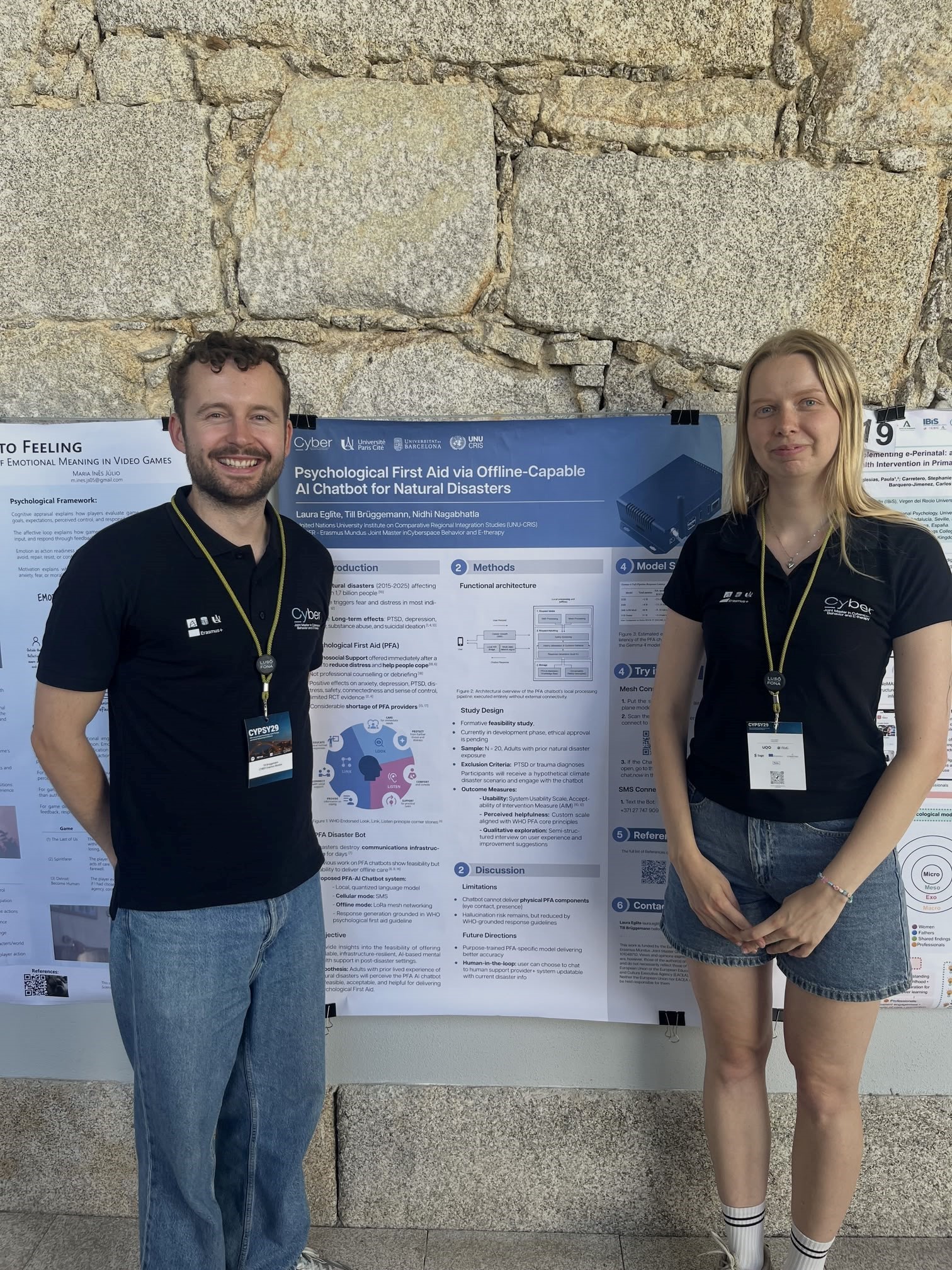


The boundaries between mental health, technology and the impact of changing environments on the psychological well-being are becoming increasingly intertwined. To explore these interconnections and promote interdisciplinary collaboration, experts and researchers in various fields of psychology, health and technology gather annually at the CYPSY Conference: https://cypsy29.ulusofona.pt/. This years' conference, organized by the HEI-Lab Digital Human-environment Interaction Lab at Lusófona University, Laura Eglīte and Till Brüggemann represented UNU-CRIS, presenting their offline psychological first aid bot.
Under the guidance of Nidhi Nagabhatla, the two master's students developed a prototype designed to support resilient communication pathways and psychological first aid in crisis-affected areas. Climate-related disasters are increasing in frequency and severity, with the WHO reporting that mental health problems among affected populations occur at rates two to three times higher than before the disaster. Although post-disaster guidelines incorporate psychological first aid (PFA), human-led teams face limitations in terms of scalability, while digital PFA options depend on communication infrastructure which is often destroyed in disasters. The work-in-progress study by Laura and Till therefore assesses the feasibility of a fully offline AI chatbot delivering PFA to adult climate disaster survivors that adapts to infrastructure availability in real time. They hope that their work will contribute to the ethical use and democratisation of small, domain-specific AI models.