The United Nations University Operating Unit on Policy-Driven Electronic Governance (UNU-EGOV) officially launched today the United Nations University (UNU) Hub on AI-Driven Impactful Digital Governance (AI-DGOV) at Kookmin University in Seoul, Republic of Korea.
The initiative represents the first Hub established by UNU-EGOV and reflects a shared commitment to supporting governments in harnessing digital technologies for inclusive, responsible, and sustainable development.
Established through a partnership between Kookmin University and UNU-EGOV, the Hub will serve as a platform for collaborative research, education, outreach, and capacity development focused on the opportunities and challenges of AI-enabled digital transformation.
It is designed to strengthen connections among academic research, public policy, and practical implementation, particularly to support countries seeking to leverage emerging technologies to improve governance and public service delivery.
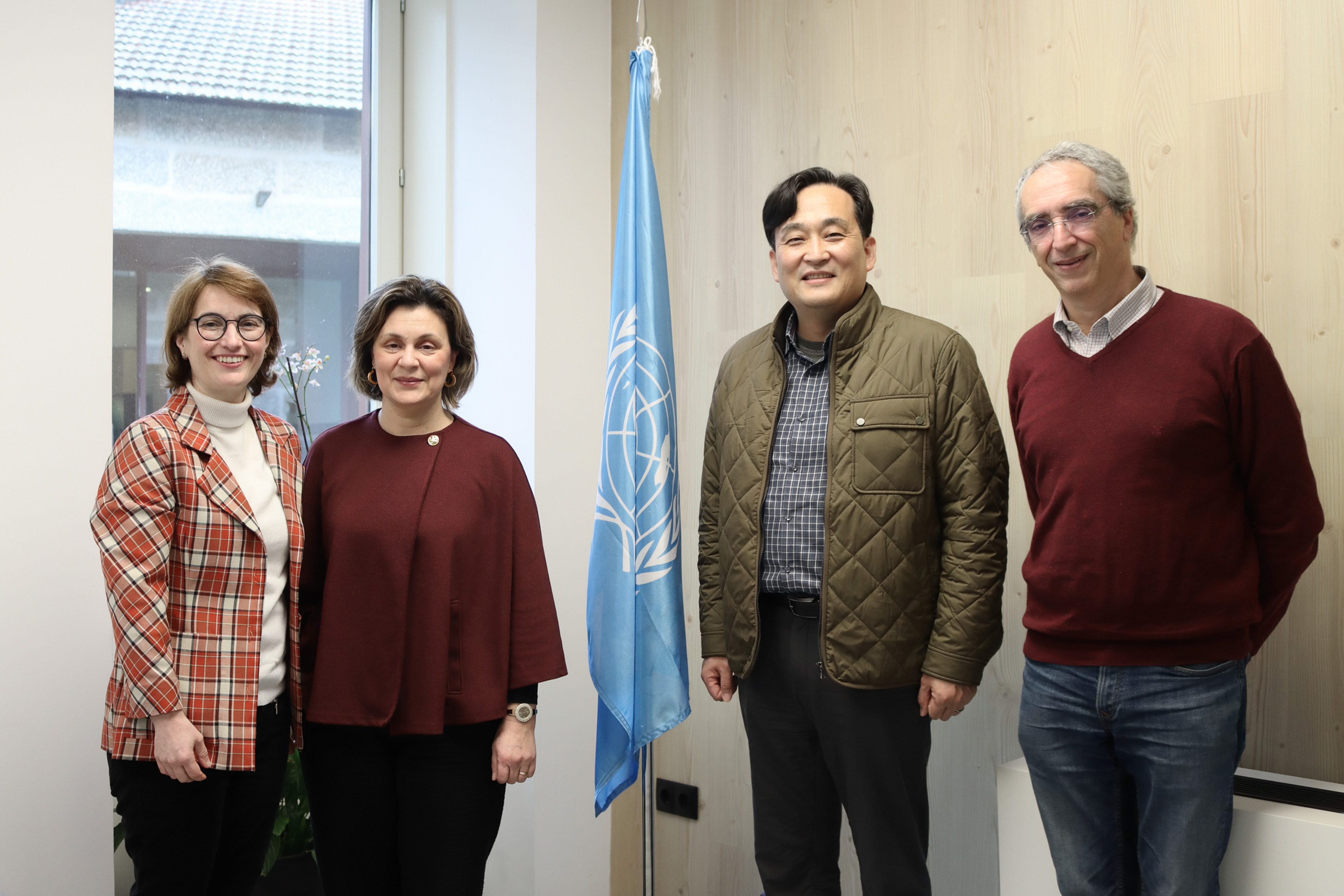
Delfina Soares, Director of UNU-EGOV, and Byoung Joon Kim, Vice President for International Affairs and Professor of Public Administration and Policy at Kookmin University, serve as Co-Directors of the Hub.
“The launch of the UNU Hub on AI-Driven Impactful Digital Governance reflects our shared commitment to ensuring that artificial intelligence serves the public good. Together, Kookmin University and UNU-EGOV aim to advance research, policy innovation, and international cooperation for more effective and inclusive governance”, Delfina Soares stated.
The UNU Hub on AI-DGOV Launching Programme
The launch programme brought together senior leaders from United Nations University and Kookmin University to mark the establishment of the UNU Hub on AI-Driven Impactful Digital Governance (AI-DGOV) in Seoul, Republic of Korea. The event formed part of Kookmin University's 80th Anniversary celebrations and included discussions on internationalisation, artificial intelligence, and future collaboration between the two institutions.
A key moment of the event was the signing ceremony formalising the agreement between Kookmin University and the United Nations University to establish the AI-DGOV Hub. The ceremony featured welcome remarks by Seung Ryul Jeong, President of Kookmin University, and congratulatory remarks by Tshilidzi Marwala, Rector of the United Nations University and Under-Secretary-General of the United Nations, followed by a presentation on the new Hub and the official signing of the agreement.
The programme also featured the official inauguration of the AI-DGOV Hub and the unveiling of its commemorative plaque at its new premises on the Kookmin University campus.
Activity Pillars and Research Clusters
The Hub will focus its activities around three interdisciplinary research clusters: Digital Governance in Cities and Communities; Digital Governance for Global Justice; and Futures Thinking and Strategic Foresight for Digital Governance.
“The Futures Thinking and Strategic Foresight area is particularly important. It aligns closely with the current work of UNU-EGOV and encourages us to look beyond what we are doing today to develop a more forward-looking vision and mission for digital government. Ultimately, our goal is to contribute to a more impactful digital governance landscape worldwide”, stressed the Vice President for International Affairs.
Through these thematic areas, the Hub aims to generate policy-relevant research, foster international collaboration, and support governments in anticipating and responding to emerging governance challenges associated with artificial intelligence and other digital technologies.
“Artificial intelligence will help shape the future of governments worldwide, and this Hub is designed to help ensure that future is human-centred, ethical, and impactful. We are proud to join forces with Kookmin University in building knowledge and solutions that can benefit societies across the globe”, Delfina Soares stressed.
The work will be delivered through three integrated pillars: i) Research, Development and Innovation; ii) Education, Training and Capacity Development; iii) Outreach, Advocacy and Impact.
Planned activities include collaborative research projects, policy briefs, international forums, executive training programmes, joint academic initiatives, and knowledge-sharing activities involving policymakers, practitioners, researchers, and development partners.
The Hub also plans to support the development of joint postgraduate programmes and strengthen opportunities for researchers and public officials from developing countries.
The Global South Mandate
Supporting the needs and priorities of the Global South is a central objective of the AI-DGOV Hub. Fully aligned with the United Nations University Strategy 2025-2029 and UNU-EGOV's commitment to generating policy-relevant knowledge and supporting digital transformation, particularly in developing countries and the Global South, the Hub will build on the complementary strengths of both UNU-EGOV and Kookmin University.
“There is a strong commitment in Korea to supporting developing countries. For the past thirteen years, I have personally worked in this field. During that time, I have travelled extensively throughout Africa, Central Asia, South Asia and South America, working on digital governance initiatives and development projects. For me, this work is extremely meaningful. The Hub is not only about benefiting the University or South Korea. It is also about creating a positive impact at the global level, especially for countries in the Global South”, stressed Byoung Joon Kim.
In 2025 alone, the Unit advanced its work through 38 ongoing projects, 11 new projects, 32 events, executive education initiatives, and specialised training programmes. Through these activities and its engagement with stakeholders across multiple regions, UNU-EGOV continued to strengthen governance capacities, support public sector modernisation, and promote inclusive digital transformation, with a special commitment to addressing the needs and priorities of the Global South.
Drawing on Kookmin University's extensive experience in international development cooperation and digital governance capacity-development programmes across regions including Central Asia, Southeast Asia, and the Middle East, the Hub will expand research partnerships, training opportunities, and policy engagement activities that benefit institutions, researchers, and governments in the Global South.
“I believe this Hub can help connect East and West, North and South, and perhaps even go beyond those traditional geographic perspectives. As part of the UNU system and with a thematic focus on digital governance, the Hub could create significant global synergies. It could help strengthen collaboration and knowledge-sharing across the entire digital government and digital governance ecosystem”, added Byoung Joon Kim.
Why the Republic of Korea and Kookmin University?
The Republic of Korea has established itself as a global leader in digital governance, consistently ranking at the top of major international benchmarks. It ranked first overall across all editions of the OECD Digital Government Index (2019, 2023, and 2025), led the OECD OUR data Open Data Index for four consecutive years, and ranked among the world's highest EGDI (E-Government Development Index) class in the 2024 United Nations E-Government Survey.
According to OECD's Digital Government Review of Korea (2025), this performance has been driven by strong political leadership, coordinated governance structures, and sustained investment in digital public infrastructure, enabling Korea to pioneer proactive, data-driven public services.
The country is also at the forefront of AI-enabled government, with innovations such as the “Guppi” virtual assistant, which serves more than 16 million users and supports Korea's transition from digital transformation to AI-driven governance.
The combination of Korea's recognised leadership in digital government, its advancing AI governance framework, and Kookmin University's experience in higher education, research, and international development cooperation provides a strong foundation for establishing the Hub.
“Korea is emerging as a global leader in AI, making it the ideal place to launch this new Hub. Our ambition is to create a world-class platform that connects research, policy, and practice to help governments harness AI for sustainable and inclusive development”, added the Director of the UNU-EGOV.
According to Kookmin University, a UNU Hub on Impactful Digital Governance located in Seoul would serve “three irreplaceable functions” within the UNU system: anchoring UNU's global network in the world's highest-performing digital government ecosystem and positioning the UNU system at the forefront of the AI governance debate.
The third function, “most importantly for UNU's mission, it would create a dedicated channel through which Korea's hard-won digital governance experience – tested and refined over decades and proven in ODA contexts in Uzbekistan, Laos, Palestine, and beyond – can be systematically translated into knowledge, frameworks, and capacity-development programs accessible to every country, particularly the most vulnerable”, added the University.
“South Korea and Portugal may be on opposite sides of the world, but that is exactly why this partnership matters. It allows us to connect different perspectives and work together on shared digital governance challenges”, Byoung Joon Kim concluded.