



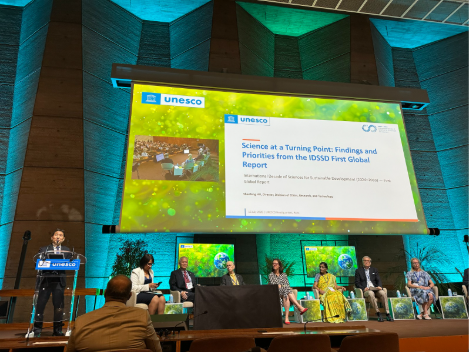
On Thursday 16 July 2026, UNU Paris took part in the flagship launch of the Global Report of the International Decade of Sciences for Sustainable Development (IDSSD), held at UNESCO Headquarters as part of the Decade’s programme. The session brought together UNESCO, scientific organisations, academies, engineering bodies, university actors and international experts to discuss what the first two years of the IDSSD reveal about the role of science in accelerating sustainable development.
The Global Report presented a central message: the challenge is no longer whether science matters for sustainable development, but how scientific knowledge can be translated more effectively into policy, governance and action.
The first two years of the Decade have shown significant mobilisation, with hundreds of initiatives submitted from across the world and activities covering all 17 Sustainable Development Goals (SDGs). Yet the report also points to structural gaps that continue to limit the impact of science on sustainable development outcomes.
Key Findings: Progress, Gaps and Systemic Challenges
Several findings stood out during the presentation. Participation is global, but uneven. Scientific capacities, research infrastructure and access to knowledge remain unequally distributed across regions.
The report also highlights persistent gaps in the SDGs coverage of submitted initiatives, with strong attention to education, innovation, climate and partnerships, but weaker coverage of poverty, oceans, governance and institutional capacity. Another key message concerns the imbalance between innovation and governance: the science system is generating knowledge and technological solutions, but institutional and policy mechanisms are not always able to absorb, steer or scale them.
The discussion also underlined four deeper structural fractures in the global research system:
the R&D investment gap,
the unequal–geographical as well as gender–distribution of researchers,
the infrastructure gap,
and incentive systems that still tend to reward disciplinary publication over transdisciplinary, solutions-oriented and community-engaged research.
These are mutually reinforcing challenges:they shape not only who produces knowledge, but also whose knowledge reaches decision-makers and whose priorities are reflected in science-for-development agendas.
From Evidence to Action
Panelists stressed that moving from evidence to action will require stronger science-policy interfaces, long-term investment, institutionalised cooperation, and more inclusive approaches to knowledge production.
Speakers also highlighted the need to connect science with engineering, economics, humanities, local knowledge, citizen engagement and implementation capacity. The report was therefore presented not only as a monitoring exercise, but as a call to action for Member States, scientific communities and multilateral institutions.
UNU Paris: Addressing the Science-to-Impact Challenge
In her intervention, Sabine Becker-Thierry, Director of the UNU Paris Office, emphasised that the United Nations system does not suffer from a lack of scientific knowledge, but from a science-to-impact challenge.
Across the UN, universities, research centres and public institutions, evidence and data are produced every day. The critical question is how institutions work together so that this knowledge informs better decisions, shapes investment and contributes to tangible change for people.
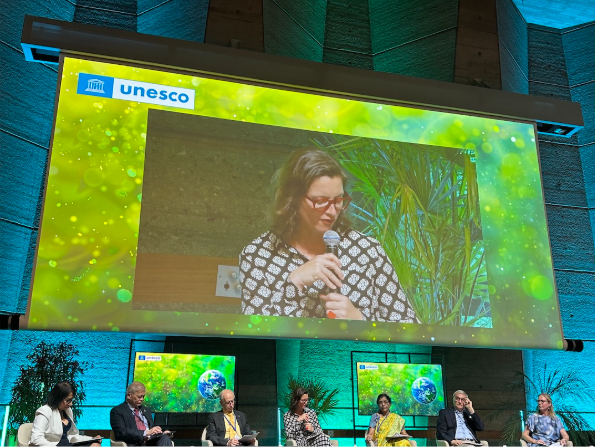
To answer this question, Sabine highlighted four priorities:
First, institutions need to collaborate around problems rather than around organisational mandates.
Challenges such as climate change, artificial intelligence, public health and sustainable development cannot be addressed by one institution alone. They require mission-driven coalitions that bring together researchers, governments, international organisations, civil society, the private sector and local actors.
Second, scientific advice must be embedded throughout policy processes, not treated as an occasional input.
Science-policy interfaces should help anticipate risks, shape options, support implementation and monitor outcomes. This requires sustained exchanges among scientists, policymakers and practitioners.
Third, research should be designed with implementation in mind.
The success of science for sustainable development should not be measured by the number of reports, publications or datasets produced, but by whether evidence changes policies, informs investments, and strengthens capacities.
Finally, institutions can better connect communities that do not always work together.
The UN, including UNU, can contribute by working at the intersection of research, education, policy and multilateral debate. Neutral spaces are needed to convene dialogue across disciplines and sectors, strengthen partnerships and support more transparent, evidence-based policymaking.
Looking Ahead
The launch of the IDSSD Global Report therefore reinforced a core priority: helping connect science, policy and institutions in ways that are practical, inclusive and impact oriented.
As the Decade moves from mobilisation to implementation, the task ahead is clear:institutions must now create the conditions for science to inform decisions, strengthen capacities, and support sustainable development at scale.
Sincere thanks to Amal Kasry (UNESCO), who moderated the session, and Hu Shaofeng (UNESCO) for presenting the Global Report of the International Decade of Sciences for Sustainable Development (IDSSD) and fellow panellists: Michel Spiro (Earth-Humanity Coalition), Dragan Đuričin (World Academy of Art and Science), Indrani Karunasagar (Nitte University), Seng Chuan Tan (World Federation of Engineering Organizations), Vanessa McBride (International Science Council) and Huadong Guo (CBAS) for their insightful contributions to the discussion.