

KEY MESSAGES
Science diplomacy is expanding beyond traditional cooperation towards questions of agenda-setting: the defining issue has shifted from whether knowledge crosses borders to who dictates the framing of the problems it addresses.
Science diplomacy complements rather than replaces diplomacy: its distinctive contribution is keeping scientific knowledge, evidence, dialogue and trust alive where political channels narrow or close.
The security of the knowledge chain belongs alongside energy, health and food security: countries with limited scientific capacity depend not only on others’ technologies, but on how others frame their problems.
Open science is a human-oriented governance choice: autonomous, collectively owned knowledge infrastructures show that access can be widened without reproducing dependency.
Knowledge becomes development when translation is designed in from the start: through needs assessment, institutions, community engagement and shared values, not technology alone.
Never has science diplomacy been so frequently invoked or so severely tested. Great-power technological competition is redrawing the map of research collaboration; debates over strategic autonomy and research security are changing how governments treat knowledge; and critical technologies, from artificial intelligence to the data infrastructures of science itself, are increasingly being handled as strategic assets rather than shared goods. Trust in the diplomacy of multilateral institutions is eroding precisely when the challenges that most require it – climate, nuclear risk, pandemic preparedness – are becoming more complex and transnational.
In this environment, science diplomacy is changing its shape. For decades, the field was essentially about facilitating cooperation: building collaborations, opening channels, affirming the universality of science. Science diplomacy is expanding beyond cooperation to address political questions: who owns critical scientific infrastructure, who governs data and publication systems, and who retains the capacity to set research agendas? The decisive element has shifted from whether knowledge crosses borders to who dictates the framing of the problems it addresses.
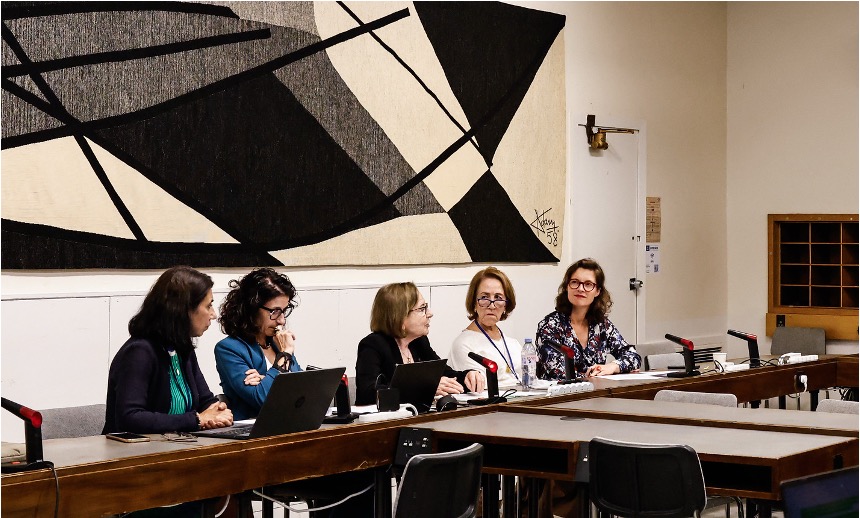
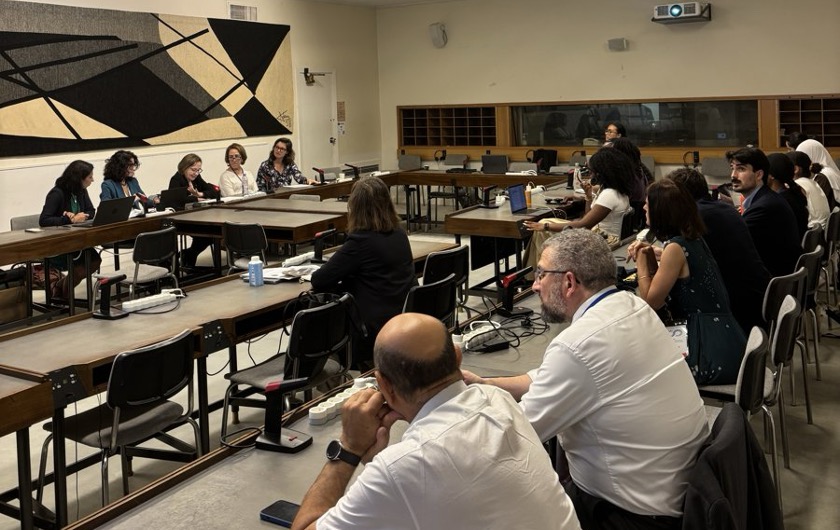
A dialogue convened during the International Decade of Sciences for Sustainable Development (2024–2033) examined this shift. It took place as the Decade's first Global Report was launched at the same conference; a report whose central finding is that the core problem is no longer the production of scientific knowledge, but its translation into policy, governance and action at scale. UNU Paris deliberately structured the dialogue around three trajectories: from knowledge of risk to engagement for peace; from participation to scientific sovereignty; from innovation to development outcomes, because together they test where that translation succeeds and where it breaks down. Three scientific careers spanning nuclear governance, high-energy physics and sustainable energy engineering supplied the evidence. Five insights emerged.
1. Science diplomacy begins where diplomacy stalls but does not replace it
The idea that scientists can simply step in when diplomats fail flatters science and misreads diplomacy. The dialogue opened with a firmer proposition: scientists and diplomats practise different crafts, and science diplomacy works only when both are respected. A scientist is not a diplomat, Ana María Cetto insisted, and it is precisely this difference that makes science-diplomacy interaction valuable.
What science diplomacy distinctively offers is the capacity to keep dialogue, scientific knowledge, evidence and trust alive when formal channels narrow. The UN Independent Panel on the Effects of Nuclear War, which Cetto chairs, illustrates the point: a deliberately non-political scientific body charged with reporting to the General Assembly, by 2027, on the consequences of an event that has never occurred, and must never occur. Its challenge, beyond being evidentiary, is civic: the findings must be credible to governments and compelling to educators, local leaders and younger generations, at a time when the public authority of science has weakened. Diplomats remain the essential relay carrying such evidence into capitals.
Large research infrastructures show the same logic from below. Rajaâ Cherkaoui El Moursli’s three decades in the CERN collaborations taught her that laboratories can be spaces where nationality, religion and politics recede behind a shared standard of evidence; spaces that do not resolve political conflict, but keep people talking, publishing and training the next generation across divides. Certain domains, she argued, must transcend geopolitical tensions: nuclear safety, radiation protection, peaceful nuclear applications and medicine, public health, climate science, emergency preparedness. Not all of this knowledge is risk-free, but these are shared global challenges to human security that no single nation can solve alone.
When it comes to protecting lives and using nuclear science for peaceful purposes, cooperation is not an option — it is a responsibility.
– RAJAÂ CHERKAOUI EL MOURSLI
Keeping the channels open, however, addresses only part of the problem—the rest concerns who builds, and who owns, the capacities that flow through them.
2. The knowledge chain is a security issue
Security dominates today’s policy lexicon – from energy and food to supply chains. Yet as Emanuela Colombo noted, policy debates also need to confront the security of the knowledge chain. This involves far more than protecting sensitive research, as it is fundamentally about whether a country has the scientific capacity to set its own agenda and to negotiate from a position of competence. When links in this chain break, dependency compounds: countries end up outsourcing not just technology but the very framing of their problems and solutions design.
This reframing carries three implications, as per Colombo:
- First, equity: scientific expertise cannot prevent conflict only if it remains concentrated among a few countries. As dependency erodes security and cooperation, capacity building must be treated as strategic infrastructure, not charity.
- Second, interdisciplinarity: the SDGs cannot be addressed from disciplinary silos; scientists, particularly in the hard sciences, must be trained to see themselves as actors of international cooperation.
- Third, realism: research communities must balance openness to build trust with protection to manage genuine risk, with no one-fits-all formula across fields.
The Decade’s first Global Report provides the empirical weight behind this argument. Europe and North America boast more than 4,300 researchers per million inhabitants, compared to just 88 in Sub-Saharan Africa: a fifty-fold disparity compounded by the fact that a handful of major economies account for nearly two-thirds of global research spending. The report identifies these gaps in investment, talent, infrastructure and incentives as mutually reinforcing dimensions of a single structural challenge. Viewed as an issue of knowledge-chain security, this divide is no longer just a development deficit, but an urgent geopolitical vulnerability.
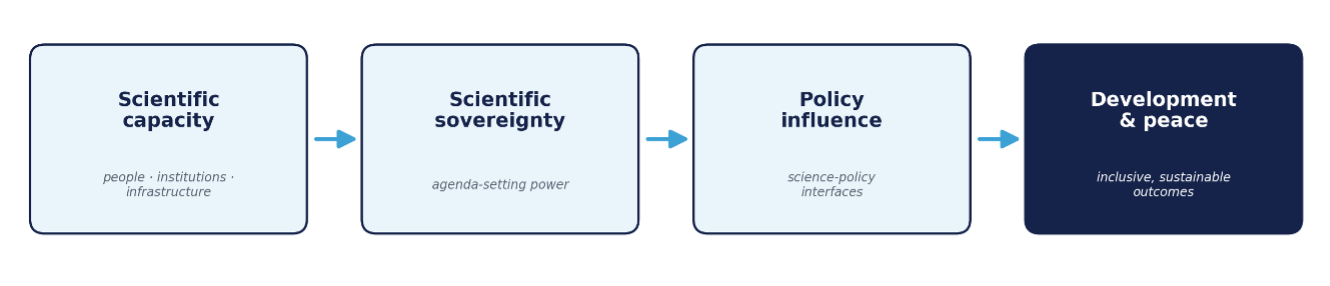
This is where the evolution becomes visible: Science diplomacy is increasingly shaped by the institutions that produce, secure, and translate knowledge into influence. With the analytical frame UNU Paris brought to the dialogue, the chain runs from capacity and sovereignty to policy influence and eventually development outcomes (Figure 1).
3. Sovereignty means co-authoring the agenda
If knowledge has become a strategic asset, the immediate question is who controls the agenda. One number captured the stark imbalance: of more than 150,000 papers published on the energy transition over the past five years, only around 5% include African authors. Even for research focused specifically on Africa, over half comes from non-African institutions. The disparity extends to digital infrastructure: Western Europe and North America host 85% of open data repositories compared to Africa’s 2%. The consequence is direct: whoever writes the literature frames the transition, and whoever frames the transition directs the policy.
This segment of the discussion turned on a vital distinction: transferring expertise versus building sovereignty. Partnerships that transfer expertise merely treat downstream consequences, while those that build sovereignty operate at the very root of the causal chain – determining who frames the problem, who engineers the solution, and who advises policymakers. As Cherkaoui El Moursli emphasised, true leadership begin when a country starts training others and contributing new ideas, rather than merely consuming external knowledge. The aim is to create not followers but future scientific leaders.
A partnership that only transfers expertise works on the consequences. A partnership that builds scientific sovereignty works on the causes: it changes who is able to define the problem, who designs the solution, and who speaks to policymakers.
– EMANUELA COLOMBO
Several viable mechanisms already point the way forward: co-designed funding agendas where African institutions help shape programme priorities rather than merely respond to them. The ARISE programme, implemented by the African Academy of Sciences, was cited as a worthwhile model. South–South cooperation is emerging yet remains strikingly underdeveloped: North African institutions often look to Europe before engaging with one another. Meanwhile, diaspora engagement must evolve. Rather than mourning emigration as a “brain drain”, countries should treat scientists abroad as a national asset to be reconnected through visiting positions, joint doctorates and joint laboratories. Talent, though, lives inside institutions. As Colombo put it: without strong local universities, academies and research centres, countries may train talent yet never have the ecosystem that allows them to stay and lead. Behind all of these lies demography: by mid-century, Africa will be the world’s youngest continent, and cultivating its scientists becomes an urgent global imperative.
4. Open science is a governance choice
Agenda-setting power depends, in turn, on who governs the systems through which knowledge circulates. While open science is usually discussed as a matter of access, the dialogue pushed deeper: access on whose terms, sustained by whose money, and governed by whom? Ana María Cetto’s answer draws on three decades of Latindex, the information system she founded to make Latin America’s scientific journals (long dismissed as “grey literature”) visible, searchable, and quality-assured. It now covers over 30,000 titles and rests on a deliberately unusual model: one member institution per country, and no external funding, by design. Autonomy is not a constraint on the system; it is a strength. A knowledge commons that depends on external project funding inherits the priorities, and the fragility, of its funders.
The governance argument extends outward. Sharing knowledge horizontally with the public, with educators and communities, rebuilds trust in science and contributes to a cultural dialogue that is itself a contribution to peace. It also extends upward, to the state. For Cetto, the underlying tension is between the global commons and narrowly defined national interests: if the right to knowledge is universal, national interest ought to encompass it rather than override it. A pointed observation at a time when heavily funded science increasingly serves strategic and military ends. Access alone, moreover, does not dissolve dependency: open science serves development only where people and institutions can absorb, assess, adapt and produce knowledge locally.
Access to knowledge alone does not resolve dependency: open science serves development only where people and institutions can absorb, assess, adapt and produce knowledge locally.
– ANA MARÍA CETTO
These goods do not automatically align. Open science, research security, strategic autonomy, scientific sovereignty: the four are routinely invoked in the same breath, yet they pull in different directions. Openness widens access but can deepen asymmetries when the underlying infrastructure is owned elsewhere; security protects but can entrench exactly the concentration of knowledge that the Decade seeks to undo.
The discussion framed this tension as the defining governance challenge, to be addressed explicitly rather than avoided. Acknowledging research security, dual-use risks and export controls strengthens international cooperation instead of weakening it. The challenge is to distinguish knowledge that must circulate to solve global problems from that which requires safeguards. Yet regulations alone are never sufficient; cooperation holds only when anchored in shared values. The Global Report documents the urgency. In its portfolio, science addressing innovation outweighs science addressing governance and institutions by more than three to one. The Decade, in its own words, is generating more science than governance capacity to steer it.
One instructive disagreement surfaced here. Cetto resists the “Global North / Global South” vocabulary altogether, viewing it as an outdated dichotomy that obscures more than it reveals. In contrast, her co-panellists use it strategically to highlight real asymmetries. The divergence is itself a reminder that the categories of science diplomacy remain objects of negotiation.
5. Translation must be designed and grounded in values
Capacity, sovereignty, governance: none of it matters unless knowledge eventually changes lives. Why, if the technology exists, do hundreds of millions of people still lack access to energy? A decade of research by Colombo’s group reached an uncomfortable conclusion: the failures were rarely technological. They stemmed from inadequate needs assessment, weak business models, missing community engagement and absent impact evaluation. From how solutions were designed, not from what they were made of. Studying failure as seriously as success, the group built a people-centred Comprehensive Energy Solution Planning framework (CESP). The framework treats energy not as kilowatt-hours delivered but as an enabler of services and development; it is now referred to by institutions such as the IEA, UNDP and rural energy agencies. Research became a development outcome because translation was embedded by design.
Translation also runs on alliances. Universities generate knowledge and train people; industry, far beyond a mere funder, is a strategic partner that turns knowledge into scalable technologies; governments provide enabling frameworks; communities remain vital for context and uptake. The obstacle, as the Global Report notes, is misaligned incentives: academic reward systems still penalise the transdisciplinary, solutions-oriented, community-engaged research that translation demands, and disproportionately penalise the women who often lead it.
The same logic applies to fundamental research, often dismissed as a luxury for countries under fiscal pressure. Rajaâ Cherkaoui El Moursli reminded us that at CERN, fundamental research produced, among much else, the World Wide Web; and her own participation in the ATLAS experiment enabled her to establish Morocco’s first Master’s programme in Medical Physics in 2006, whose graduates now work in radiotherapy, nuclear medicine and medical imaging, improving patient care. Frontier science, she argued, is not disconnected from development; it creates the people, technologies and innovations that transform society.
When does a scientist become a science diplomat? The panellists converged on an answer that had little to do with titles: when knowledge is no longer produced but translated beyond the laboratory, into cooperation, trust, policy and common action. Such scientists are recognisable by the way they work across disciplines, countries and institutions. Not every scientist needs to make that move. But those who do must carry their values with them: integrity, reciprocity, accountability, respect for human dignity, commitment to the peaceful use of science. Values, the discussion concluded, should be taught at every level of education, starting in primary school.
Looking Ahead
These questions do not have final answers, which is precisely why they require sustained institutional attention. The International Decade of Sciences for Sustainable Development runs to 2033; whether it changes practice or merely vocabulary will depend on precisely the questions raised: how to measure scientific sovereignty, how to design translation into research from the outset.
The dialogue also reinforced a core hypothesis of the UNU Paris Office: if science diplomacy is indeed expanding towards agenda-setting, universities must be viewed not only as knowledge producers, but as diplomacy actors in their own right. They are institutions that convene across divides, sustain ties where governments cannot, and provide scientific sovereignty with its practical infrastructure. They would not act alone: academies, as the African Academy of Sciences shows, already connect expertise across borders, support younger researchers and keep cooperation alive across political divides.
The discussion’s most practical conclusion was simple: trust takes time. Capacity is not built in just one training course, trust in one single call, impact in one project cycle. Science diplomacy may begin, as Cherkaoui El Moursli argued, in relationships of trust among scientists. It becomes durable only when universities, academies and research institutions give those relationships time, resources, equality and continuity. The Office is exploring this hypothesis as part of its work at the science–policy interface, from a position that is unusual by design: academically independent yet embedded in the multilateral system.
If the Global Report is right that the binding constraint is no longer science production but its translation, and if translation depends on institutions, then this is precisely where universities may become indispensable diplomatic infrastructure for the decade ahead.
ABOUT THE DIALOGUE
Event: “From Atoms to Sustainable Development Agendas” — Parallel Thematic Session #64
Conference: 2026 Global Conference of the International Decade of Sciences for Sustainable Development (IDSSD, 2024–2033)
Date: 17 July 2026, 14:30–15:45
Venue: UNESCO Headquarters, Paris
Moderators: Dr. Sabine Becker-Thierry (Director, UNU Paris Office) and Dr. Antonella di Trapani (Senior Research Fellow, UNU Paris)
Speakers: Prof. Ana María Cetto Kramis (National Autonomous University of Mexico; former Deputy Director General, IAEA); Prof. Rajaâ Cherkaoui El Moursli (Mohammed V University, Rabat; CERN ATLAS collaboration); Prof. Emanuela Colombo (Politecnico di Milano; UNESCO Chair in Energy for Sustainable Development)