A UNU Paris, Andalus Committee and Paris Peace Forum public event
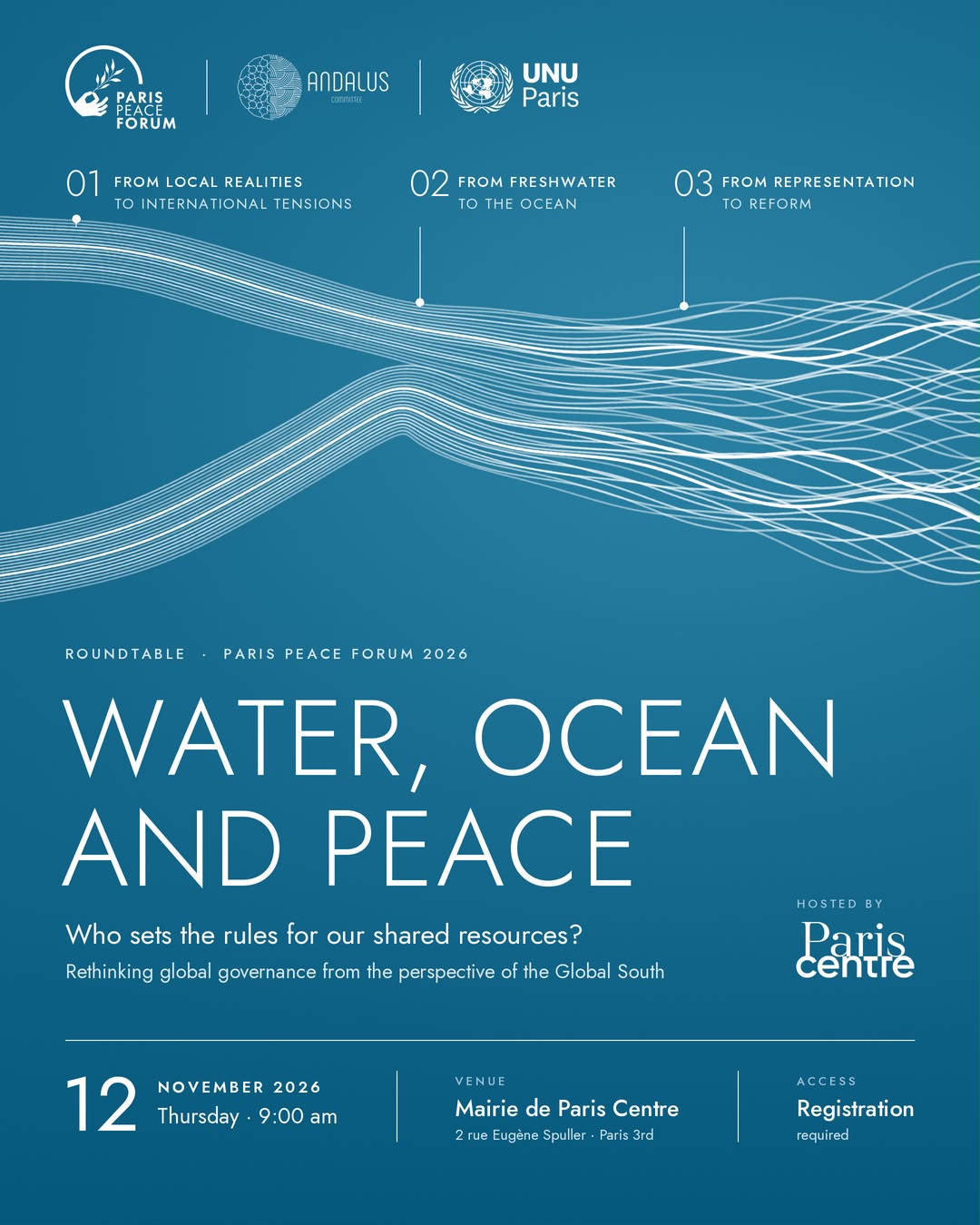
12 November 2026 | 09:00-11:30
Mairie de Paris Centre, Paris
Who shapes the rules governing the world's shared water and ocean resources? How can international governance frameworks become more equitable, inclusive and responsive to the needs of those most affected by environmental change and resource scarcity?
On 12 November 2026, the United Nations University (UNU) Paris Office, in partnership with the Andalus Committee and the Paris Peace Forum, will bring together researchers, practitioners, policymakers and project leaders for a discussion on the future of water and ocean governance in an increasingly interconnected world.
The event, "Water, Oceans and Peace: Who Defines the Rules of Our Shared Resources?", will explore how questions of cooperation, equity, representation and knowledge shape the governance of shared natural resources at local, regional and global levels.
From Rivers to the High Seas: A Shared Governance Challenge
Water and ocean governance are often discussed separately. Yet rivers, groundwater systems, coastal zones and marine ecosystems are deeply interconnected.
From the management of transboundary river basins to negotiations over marine biodiversity beyond national jurisdiction, decisions about who can access, use, protect and benefit from shared resources have significant implications for peace, development and environmental sustainability.
Questions of governance are therefore not only technical. They are also political.
Who participates in decision-making processes? Whose knowledge is recognised? Which actors have the resources and influence necessary to shape international norms and priorities? And how can governance systems better reflect the experiences and needs of countries and communities that are often most exposed to the consequences of environmental degradation and resource insecurity?
These questions sit at the heart of contemporary debates on water security, ocean governance and international cooperation.
Three Sessions, One Common Question
The discussion will be organised around three complementary themes.
Session I: From Local Realities to International Tensions: Water as a Matter of Power and Sovereignty
Session II: From Freshwater to the Ocean: Governing Shared Resources Beyond Borders
Session III: From Beneficiaries to Agenda-Setters: Strengthening the Influence of the Global South in International Governance
Featured Speakers
The event will feature contributions from experts working at the intersection of environmental governance, international cooperation and public policy, including:
- David Blanchon, Université Paris Nanterre and LAVUE (CNRS) – hydropolitics and water conflicts
- Patrick Thaunay, Project Lead, Plastic Vortex – river, coastal and marine pollution
- Georgina Castro-Proal, Project Lead, Pesca Alternativa de Baja California – ocean resilience and Global South perspectives
- Francesco Notari, Project Lead, Ogyre– ocean resilience and ecosystem protection
- Hemal Thakker, LISIS and Institut Montaigne
- Julia Tasse, IRIS – ocean geopolitics
- Camille Mazé, CEVIPOF, CNRS and Sciences Po – ocean geopolitics
- Bertrand Badie, Professor Emeritus, Sciences Po – international relations and global governance
- Denis Bailly, Senior Fellow, UNU Paris – ocean governance and Global South perspectives
- Divya Hegde, Project Lead, Baeru Environmental Service – ocean resilience and Global South perspectives
From Dialogue to Policy Recommendations
The discussion will also contribute to a report prepared by researchers from the Andalus Committee. The report will build on the exchanges during the event to identify practical policy recommendations and governance reforms relating to water, oceans and international cooperation.
Particular attention will be given to questions of representation, knowledge production, scientific cooperation, benefit-sharing and participation in international decision-making processes.
By bringing together academic expertise, practical experience and policy perspectives, the event aims to foster a constructive dialogue on how shared resources can be governed in ways that are not only effective and sustainable, but also fair and inclusive.