Effective science, technology, and innovation (STI) policies enable countries to set clear goals, mobilise resources and coordinate actors to leverage STI in addressing complex sustainable development challenges. However, many countries, particularly developing ones, face significant capacity gaps in STI policymaking.
On 6 May 2026, the UN Inter-Agency Task Team on Science, Technology and Innovation for the SDGs (IATT), Work Stream 6 on Capacity Building hosted the online STI Forum side event: “Scaling Science, Technology and Innovation (STI) Policy Capacity Building: Lessons Learned, Gaps and the Way Forward.” By bringing together policymakers, regional organisations, researchers, UN entities, and development partners, the session was designed to foster knowledge exchange, partnership building, and collaborative approaches to strengthening STI policy capacity. The event attracted approximately 150 participants worldwide, and the insights were both valuable and timely.
The IATT WS6 has implemented several STI policy capacity-building initiatives in the past 3 years. Those included 12 training workshops and 6 dialogues, benefiting over 2000 STI policymakers and practitioners from over 110 countries across Africa, Asia, the Middle East and Latin America. Zengmei Wang (UNESCO) shared the IATT WS6 training results and evaluation notes with the audience. The evaluations of these initiatives have demonstrated appreciation for the training but also a strong demand for policy capacity development from stakeholders in Member States. Recent training workshops and their evaluations confirm both the high relevance and positive impact of these capacity-building activities. However, there is one key challenge: while demand for STI policy training and advisory support continues to grow, sustained financial resources to scale and maintain these efforts remain limited. This creates a gap between the demand expressed by Member States and the capacity of international partners to respond. As Zengmei Wang (UNESCO) states, “The discussion at the side event helped us understand how capacity building is evolving — from simply delivering knowledge to fostering collaboration, peer learning and long-term institutional connections. Through this event, we wanted to understand better what kinds of partnerships IATT Workstream 6 and development partners should build to provide more sustained and impactful support”.
While STI policy design is a critical activity, the implementation of policies is perhaps an even greater challenge. There are several sources of implementation challenges, and a major one is the need to improve human capacity in policy work. Dimo Calovski (UNCTAD) stresses that “while market failure, systems failure and transformation challenges are well-known issues in academia, there are difficulties in recognising and dealing with these in everyday policy work. As well, moving towards a challenge-based and mission-led framework for implementing STI policy requires a deeper understanding of the intricacies of STI and its relevance for socio-economic and sustainable development”.
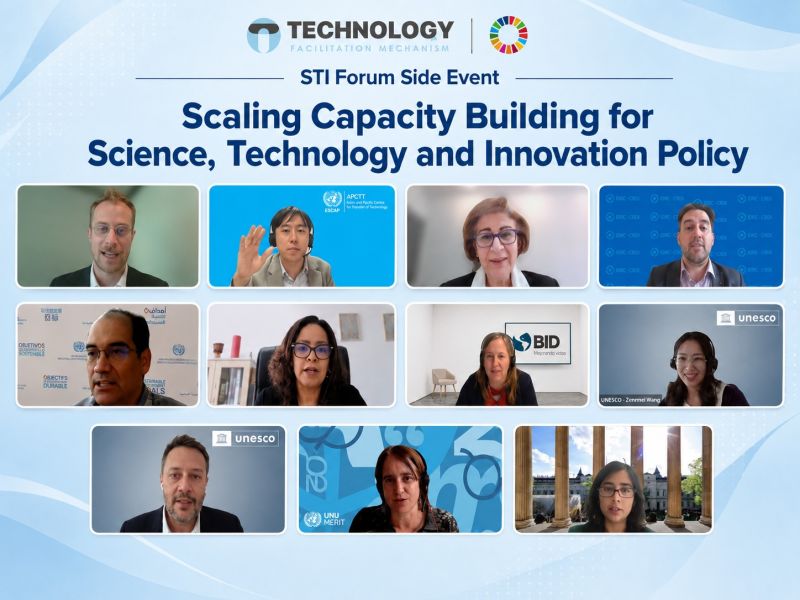
The first panel discussion of the online event, guided by Nibal Idlebi (Senior Advisor for Digital Transformation & Innovation Policies and former director at UN-ESCWA), zoomed in on the STI needs, as they were reviewed from the various perspectives of the speakers. Ms Mahlet Teshome (African Union Commission Department of Education, Science, Technology and Innovation) highlighted that in Africa, STI policy deserves more focus, in particular in relation to. implementation of relevant policy gaps, institutional capacity and system transformation (in line with the STISA2034 framework). Ms Bipashyee Ghosh (UCL) shared the academic update showcasing three capacity gaps: 1) setting directionality, 2) stakeholder engagement, and 3) learning from failures. Her examples related to Malaysia, Indonesia and Singapore in particular, but could easily be extrapolated to other regions. The panel was complemented by Fernando Santiago Rodriguez (UNIDO), who added the UN perspective. He highlighted that, at the institutional, operational, and individual levels, policymakers face challenges in formulating STI policies that are consistent with industrial development goals. The panel’s engaged contributions brought us the following learning:
1. STI capacity-building should be strengthened across regions and move beyond generic skills development toward a targeted, sectoral, and policy-driven approach that reflects diverse national contexts.
2. Implementation should combine scalable, cost-efficient training with targeted technical support at the country and institutional levels, supported by additional and sustained resources.
To deepen our understanding of how to offer STI policy support and to learn from best practices feasibly, Manuel Ricardo Galindo Moreno (UNESCO) asked the development partners who joined the second panel to share their experiences. And even though Alison Cathles (IADB), Eloi Asier (AXA Foundation of Human Progress), Matthew Wallace (International Development Centre) and Soohyung Kim (ESCAP) represented very different institutions, they all agreed that what works is long-term, system-level capacity-building, not one-off training. All four panellists made the same point in different ways: capacity grows when programmes strengthen institutions and networks, meet actual demand, and connect with the people who will use the work.
They also stressed that no single development partner scales STI Governance capacity alone. A partnership, with IATT-WS6 as a connecting platform, is a path to sustained impact. As I reflect on this event from the perspective of UNU‑MERIT and our work within IATT WS6, the challenge is clear. While we must remain mindful of contextual differences, it should be feasible to scale our capacity development initiatives. To do so, IATT WS6 needs to rely even more on its network of UN partners and academic and research stakeholders, who together possess a wealth of knowledge and skills. Our focus now should be on deepening collaboration with these partners, and with the countries and donors we serve, to co‑create practical and scalable capacity development solutions for STI policy.
Suggested citation: Mindel van de Laar., "Building STI Policy Capacity: A Multi-Agency UN Effort in Action ," UNU-MERIT (blog), 2026-05-13, 2026, https://unu.edu/merit/blog-post/building-sti-policy-capacity-multi-agency-un-effort-action.