

Richmond Hill, Ontario, Canada – 04 September 2026 — Artificial intelligence has become a major new pressure on the electricity grid at the same time as it is emerging as one of the most promising tools for making that grid resilient, according to a new publication by the United Nations University scientists. The policy question, the authors argue, is no longer whether to deploy AI for grid resilience, but under what guardrails.
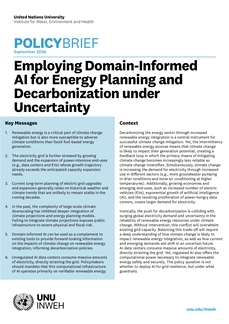
The Policy Brief, “Employing Domain-Informed AI for Energy Planning and Decarbonization under Uncertainty”, published by the United Nations University Institute for Water, Environment and Health (UNU-INWEH), warns that governments are approving electricity infrastructure with 15-20 year lifespans on the basis of historical weather records that are unlikely to hold in the coming decades. Written for national regulators and climate-finance institutions, the publication is a step forward to set out safeguards supporting the acceleration of decarbonisation targets through 2030.
At the centre of the energy transition, the Policy Brief describes a feedback loop. Renewable energy is a critical instrument of climate change mitigation, yet it is more susceptible to adverse climate conditions than fossil fuel-based generation, so the technologies deployed to slow climate change become less predictable as it advances. Warming is simultaneously pushing demand upwards through more air conditioning and more groundwater pumping in drier conditions. The renewable sector is projected to nearly triple in size by 2030, according to the International Energy Agency’s Renewables 2024, but that expansion is being planned against shifting rather than stable weather.
Demand is rising faster than planners assumed. The authors warn that the growth trajectory of power-intensive end-uses, including data centres and electric vehicles, already exceeds anticipated capacity expansion needs. Unregulated AI data centres consume vast amounts of electricity and directly strain the grids they are built on.
“We are asking the grid to absorb more renewable energy and more demand at the same time, and we are making those decisions with data that describes a climate we no longer live in,” said Dr Renee Obringer, Research Fellow of Urban and Interdependent Infrastructure Systems at UNU-INWEH and lead author of the publication. “The uncomfortable part is that AI sits on both sides of the ledger. It is one of the reasons demand is climbing, and it is also the fastest route we have to planning for what is coming.”
The Policy Brief identifies the failure of long-term capital planning to account for forward-looking climate risk as a primary barrier to grid resilience, and frames it as a fiscal exposure rather than a technical one. Deploying capital on stationary historical data, for assets that will run 15 to 20 years, accumulates stranded assets as physical climate risks materialise. For climate-finance institutions, that makes forward-looking risk assessment a condition of sound capital allocation. Research on climate impacts has advanced, the brief concludes, but it is not consistently reaching the regulatory agencies responsible for capacity planning, which still rely on historical weather data to anticipate demand spikes.
Domain-informed AI, the publication argues, is one of many necessary solutions rather than a remedy on its own. These algorithms are more transparent about how they are trained and are tailored to a specific application area such as energy systems, which sets them apart from large language models and general-purpose deep learning. Built for the problem, they often outperform general-purpose alternatives, and because their reasoning is legible, planners can fold them into existing processes.
Their value lies in what current tools cannot do. The general circulation models underpinning state-of-the-art climate impact assessment are hard to integrate, hard to downscale to the spatial scales infrastructure decisions turn on, and slow to yield the variables energy systems modellers need. Domain-informed AI models, by contrast, already deliver highly accurate short and long-term renewable forecasts, and AI climate emulators are progressing rapidly in accuracy.
The authors call on regulators to institutionalise adaptive governance frameworks, to bring energy systems modellers together with climate scientists in integrated modelling across water, transport and information and communications technology networks, and to mandate transparent, domain-informed AI models as an enforceable standard for capacity planning approval. To ensure safety and public trust, regulators should classify opaque deep learning systems as severe operational hazards and enforce strict guardrails against algorithmic training bias, while policymakers should require that AI data centres operate primarily on verifiable renewable energy.
“AI is being offered to governments as an answer to the energy transition while quietly becoming one of its largest new burdens, and both of those things are true at once,” said Professor Kaveh Madani, Director of UNU-INWEH and a co-author of the Brief. “Rejecting these tools would slow decarbonisation. Adopting them without transparency rules or limits on their own energy use would simply exchange one risk for another. The task is not to choose between the two, but to set the conditions under which AI is allowed near critical infrastructure.”
Key Messages at a Glance
- Renewable energy is central to climate change mitigation but is more susceptible to adverse climate conditions than fossil fuel-based generation, creating a feedback loop in which mitigation becomes less reliable as the climate changes.
- Growth in power-intensive end-uses such as data centres and electric vehicles already exceeds anticipated capacity expansion needs.
- Long-term grid planning relies on historical weather and climate trends that are unlikely to remain stable in the coming decades.
- Capital deployed on stationary historical data, for infrastructure with 15-20 year lifespans, accumulates stranded assets as climate risks materialise.
- Domain-informed AI can complement existing tools with fast, reliable estimates of future extreme events and improved modelling for generation and transmission planning.
- Unregulated AI data centres strain the grid directly; policymakers should mandate that this infrastructure runs primarily on verifiable renewable energy.
Read the Publication
Obringer R., Matin M., Madani K. (2026). Employing Domain-Informed AI for Energy Planning and Decarbonization under Uncertainty. United Nations University Institute for Water, Environment and Health (UNU-INWEH), Richmond Hill, Ontario, Canada. doi: 10.53328/INR26RRO001.
Available for Interview
Interview requests should be submitted to media.inweh@unu.edu
Media Contacts
Marjan Asadullah, Communications Assistant, UNU-INWEH, marjan.asadullah@unu.edu
About UNU-INWEH
Marking its 30th anniversary of operation in 2026, the United Nations University Institute for Water, Environment and Health (UNU-INWEH) is one of 13 institutions that make up the United Nations University (UNU), the academic arm of the UN. Known as ‘The UN’s Think Tank on Water’, UNU-INWEH addresses critical water, environmental, and health challenges around the world. Through research, training, capacity development, and knowledge dissemination, the institute contributes to solving pressing global sustainability and human security issues of concern to the UN and its Member States.
Headquartered in Richmond Hill, Ontario, UNU-INWEH has been hosted and supported by the Government of Canada since 1996. With a global mandate and extensive partnerships across UN entities, international organizations, and governments, UNU-INWEH operates through its UNU Hubs in Calgary, Hamburg, New York, Lund, and Pretoria, and an international network of affiliates.