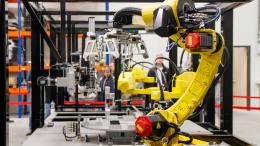
In 1988, roboticist Hans Moravec described a paradox that still challenges our assumptions about artificial intelligence (AI). He argued that computers could relatively easily perform tasks involving sophisticated reasoning yet struggled to match a young child’s perception and dexterity. Steven Pinker later summed up this reversal: the hard problems are easy, and the easy problems are hard.
Nearly four decades on, AI can draft contracts, write software and analyze financial statements. Yet robots still struggle to handle unfamiliar objects reliably in unpredictable environments. Moravec’s paradox remains. What has changed is its economic significance, especially for Africa.
Intelligence is easier to automate than dexterity
Digital AI has advanced through vast quantities of text, images and code, powerful computing systems and scalable training methods. Robots, by contrast, must navigate friction, balance, force, touch and the endless variability of the physical world. A language model can learn from billions of documents, but a robot cannot gain comparable practical experience simply by reading about how to grasp a glass.
Robotics has made striking progress in locomotion, perception, and manipulation, but controlled demonstrations should not be mistaken for dependable performance in homes, farms, hospitals, or construction sites. Reproducing human dexterity across diverse settings remains exceptionally difficult. Evolution refined our sensorimotor abilities over immense stretches of time, while many forms of formal reasoning are comparatively recent human achievements.
The paradox doesn’t guarantee that manual work will remain safe. It describes a technological asymmetry that shapes the order in which tasks become automatable.
Africa’s disappearing first rung
For much of the industrial era, mechanization displaced physical labour, while education opened a path to more secure cognitive work. Moving from farm to factory, then from factory to office, became an aspiration tied to economic development. Generative AI complicates that path. Some of the tasks easiest to digitize, routine drafting, bookkeeping, customer support, coding and document processing, are exactly the kinds of work that have offered educated young people entry-level opportunities.
This doesn’t mean entire professions will disappear overnight. Jobs bring together tasks, responsibilities, relationships, and accountability. AI may support workers in some settings while replacing specific functions in others. But when firms can automate the tasks through which graduates traditionally gain experience, the first rung of the professional ladder becomes less secure.
In Closing the Gap: The Fourth Industrial Revolution in Africa, I argued that technological transformation must be understood in light of the continent’s development realities. Economist W. Arthur Lewis’s influential development model envisioned workers shifting from low-productivity activities into expanding modern sectors, with productivity growth eventually supporting employment and rising incomes. AI raises the possibility that output could grow without a proportionate increase in labour demand.
This is the danger of premature de-professionalization: the erosion of accessible white-collar career paths before economies create enough alternative productive jobs. Just as premature deindustrialization constrained manufacturing-led development, premature de-professionalization could weaken the services-led path on which many African economies increasingly depend.
A reprieve is not a development strategy
Moravec’s paradox gives a temporary advantage to jobs that combine judgment with hands-on work. Electricians, nurses, technicians, builders, and agricultural workers operate in settings that remain difficult to automate fully. This strengthens the case for technical and vocational education, long undervalued in many policy debates.
But a reprieve is not a refuge. Advances in simulation, robotic learning, sensing and hardware are broadening what machines can do. When deployment will become practical and affordable remains uncertain, especially in African operating environments. Even so, governments should not base a generation’s skills strategy on the assumption that robots will always be clumsy.
Africa should do more than try to preserve existing occupations. The greater opportunity lies in using AI to boost productivity in agriculture, manufacturing, healthcare, and infrastructure and to turn those gains into new businesses and skilled jobs.
Four priorities for policy
First, reward augmentation, not just displacement. Public procurement, incentives and development finance should favor applications that expand workers’ capabilities and improve services. An AI tool that helps a nurse reach more patients or an extension officer support more farmers can generate broad social returns. Policymakers should also examine who owns the technology and captures its gains.
Second, reconnect the mind with the hand. Education must bring together digital fluency, practical skills, critical reasoning, and the ability to work alongside intelligent systems. The future belongs not just to coders or artisans, but to people who can diagnose problems using software, act in the physical world and exercise sound, accountable judgment.
Third, build meaningful technological sovereignty. Africa cannot remain mainly a supplier of raw data, minerals and talent while importing the most valuable technologies. Sovereignty does not require every country to build a frontier AI model. It means having credible options in computing infrastructure, data governance, research capacity, local applications and regional collaboration.
Fourth, renew the social contract. Instead of relying on a simplistic robot tax, governments should modernize taxation, competition policy, social protection and lifelong learning for economies where value can grow faster than employment. Workers need realistic pathways between occupations, not the promise that a single qualification will sustain an entire career.
The question Africa must answer
The contrast with aging societies is revealing. In countries facing labour shortages, more capable robots may help maintain essential services and production. Africa faces a different demographic imperative: turning a large and growing youth population into productive employment and shared prosperity. The same technological breakthrough can ease one economy’s constraints while intensifying another’s.
Moravec’s paradox is neither reassurance nor destiny. It warns about the pace and sequence of technological change: cognitive tasks are becoming cheaper to automate, while many physical tasks remain harder for now. Africa’s challenge is to use this window to build industries, institutions and skills that turn technological progress into broadly shared opportunity.
The decisive question isn’t when a machine will master a child’s hands. It’s whether, before then, we’ll have built economies that value every human being’s work, ingenuity and dignity.
Suggested citation: Tshilidzi Marwala. "Moravec Was Right about the Hands, and That Is Africa’s Problem," United Nations University, UNU Centre, 2026-11-20, https://unu.edu/article/moravec-was-right-about-hands-and-africas-problem.