

There is often a perception that geographical distance reduces vulnerability – an idea that can be particularly appealing in neutral countries with long-standing stable and strong economies.
Switzerland is a clear example: its long-standing neutrality, formally recognised at the Congress of Vienna in 1815 and still recognised as a central part of its foreign policy, combined with its economic strength, has helped keep it outside major conflicts historically and reinforced the perception that distance, stability and wealth provide protection.
But in a world where energy, food, finance and even the atmosphere are tightly interconnected, distance (and neutrality) doesn’t shield Switzerland, or any other nation.
Take the Strait of Hormuz. Roughly a fifth of the world’s oil and liquified natural gas passes through it. When it’s disrupted, the effects don’t stay local; they ripple outward through longer shipping routes, strained supply chains and shifting economic decisions in ways that reach far beyond the countries directly involved and could cause long-term environmental damage.
More often than not, this appears as subtle environmental and economic changes rather than sudden shocks.
Switzerland offers a particularly instructive example. It is neither an energy exporter nor a strategic actor in the conflict. Yet it sits at the intersection of multiple global systems: shipping and transport routes, European agriculture, high-value manufacturing and international finance.
Shipping routes and ice melt
When maritime routes are disrupted, as is currently happening, shipping does not stop. It adapts. Tankers take longer routes and fuel efficiency declines. The result is an increase in particulate emissions, including black carbon. These particles can travel vast distances. In high-altitude environments, their impact is amplified. When deposited on snow and ice, black carbon reduces reflectivity, increasing heat absorption and accelerating melt. In the Swiss Alps, where glaciers are already under pressure, even small increases can have measurable effects. Therefore, what begins as a logistical adjustment in global shipping can end up altering the physical state of distant mountain systems.
Switzerland’s industrial base offers another useful illustration. When firms face restricted or more expensive products, they often shift to alternative production methods. For instance, in the pharmaceutical industry, disruptions to chemical supply chains can force firms to switch suppliers or change elements used in production. While this may make economic sense, such changes are often not environmentally neutral. Different processes generate different byproducts, introducing new compounds into waste streams. The result may not be an immediate environmental crisis, but could create a gradual shift in the composition of pollutants.
Another example is the global fertiliser trade. In 2024, Iran, Qatar, Saudi Arabia, the UAE and Bahrain together accounted for 23% of global ammonia trade, 34% of global urea trade, and 18% of global ammoniated phosphate trade, key inputs for fertiliser production. Disruptions do not simply raise prices; they constrain availability, forcing adjustments across farming systems worldwide.
In parts of Europe, including Switzerland, there could be some positive and negative affects on the environment. Reduced fertiliser use may lower nutrient runoff into waterways, easing pressure on rivers such as the Rhine River and improving conditions in some lakes. Ecosystems long stressed by excess nitrogen may experience a degree of relief. Yet this comes with trade-offs. Swiss agriculture depends on high levels of this type of fertiliser and so may see declining yields and shifts in crops if this is reduced. Alpine pastures, in particular, depend on carefully managed nutrient balances influenced by nitrogen availability. Change can disrupt that equilibrium, exposing how deeply even local ecosystems depend on global supply chains.
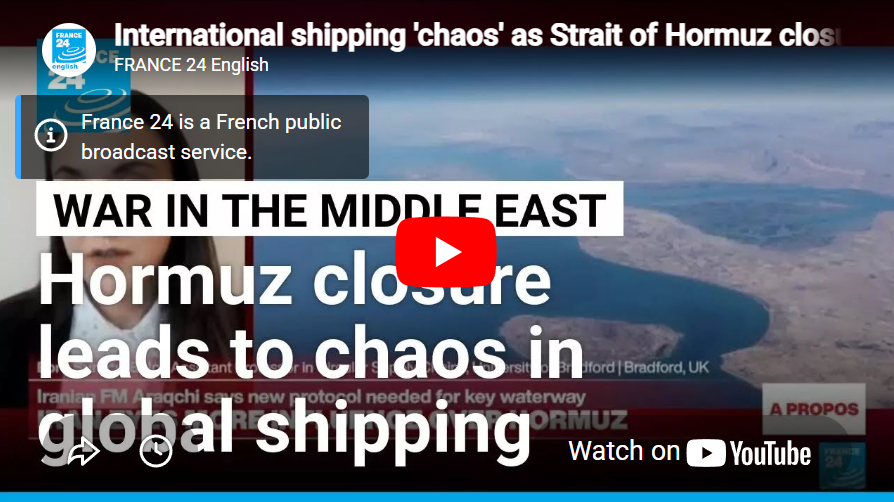
Shipping routes are getting longer because of constraints on travelling through the Strait of Hormuz.
Environmental change can also be shaped by investment decisions. In periods of geopolitical tension, capital tends to become more cautious. Liquidity, resilience and short-term risk management take priority over long-term projects.
Finance and migration
For financial centres such as Switzerland – home to huge reinsurance firms such as Swiss Re – this shift matters. Roughly 25% of total global cross-border assets (financial investments outside your home country) are managed in Switzerland. When uncertainty rises, risk models are recalibrated and capital is redirected.
For financial centres such as Switzerland – home to huge reinsurance firms such as Swiss Re – this shift matters. Roughly 25% of total global cross-border assets (financial investments outside your home country) are managed in Switzerland. When uncertainty rises, risk models are recalibrated and capital is redirected.
The unintended consequence is that long-term environmental investments – such as ecosystem restoration – can be delayed or scaled back. Environmental resilience depends on steady, long-term commitment; interruptions, even temporary ones, could be detrimental.
Large-scale conflicts also tend to reshape migration patterns, sometimes indirectly. Even countries that are not primary destinations can experience increased migration or adjust policies in response to broader European dynamics. In small countries such as Switzerland, even modest population increases translate into land-use pressures.
Housing demand pushes outward, infrastructure expands, and previously marginal areas come into use. Reports suggest that agricultural land in Switzerland is reducing. Approximately one square metre is lost every second, with about 80% converted into settlement areas and the remaining 20% transitioning into forests. The environmental impact is gradual: increased resource consumption, greater strain on water and waste systems. None of these changes is dramatic on its own, but together they form a pattern of slow encroachment.
The effects of distant conflicts on neutral or far away countries are rarely direct. They are mediated through systems that operate quietly, often below the threshold of public attention.
Switzerland is not unique in this respect. It is simply a clear example: a country where environmental conditions are closely tracked, where economic systems are deeply integrated, and where small shifts can be observed with unusual precision. Neutrality may shape foreign policy, but it does not deliver environmental or economic immunity. In an interconnected world, exposure is universal.
Read the full article on The Conversation
Suggested citation: Nima Shokri, Salome M. S. Shokri-Kuehni. “Strait of Hormuz: why even neutral and distant countries like Switzerland can’t escape the fallout.” The Conversation, 17 April 2026. https://doi.org/10.64628/AB.w5agyeywm