

UNU-IAS contributed to the 17th session of the Conference of the Parties to the United Nations Convention to Combat Desertification (UNCCD COP17; 17–28 August 2026) in Ulaanbaatar, highlighting the importance of locally grounded and participatory approaches to scaling landscape restoration.
Delegates from UNCCD Parties joined government, business and civil society representatives, scientists, youth, Indigenous Peoples, pastoralists and smallholder farmers to address desertification, land degradation and drought, highlighting land restoration as a key strategy.
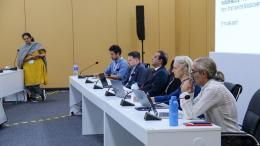
On 21 August, the Action Agenda event Scaling Landscape Restoration Innovation Bundles: From Evidence to Investable Action explored how ecological, social, financial, institutional and governance innovations could be combined and adapted to specific landscapes to make restoration more inclusive, investable and scalable. It also examined the evidence, partnerships and monitoring systems needed to move restoration initiatives beyond individual pilot projects.
Ichiro Hama (Programme Coordinator, UNU-IAS) shared experiences from the International Partnership for the Satoyama Initiative (IPSI), a global, multi-stakeholder partnership that promotes sustainable management of socio-ecological production landscapes and seascapes (SEPLS). He emphasized that successful restoration solutions were context-dependent and ultimately implemented at the local level. Rather than replicating individual interventions, global platforms can help to scale learning and partnerships, creating the conditions for locally adapted solutions.
On 23 August, UNU-IAS co-organized the panel discussion Participatory Landscape Restoration and Social-Ecological Safeguards as part of the Resilience Day programme of the Green Zone. The event brought together Indigenous knowledge holders, researchers and international organizations to examine how participatory landscape restoration can strengthen resilience to drought and desertification while safeguarding the rights and livelihoods of Indigenous Peoples and local communities.
Mr. Hama presented preliminary findings from ongoing research by the IPSI Secretariat and the Asian Development Bank on restoration in SEPLS. Based on a stocktake of 150 cases since 2016 and a survey of 44 organizations, 89% of cases reported integrating Indigenous and local knowledge into restoration activities, while 64% reported community involvement in project design and implementation. The findings also indicate that restoration can generate benefits beyond ecological recovery, including stronger community cooperation, livelihoods, institutional coordination and participation by women and youth.
He also presented tools and initiatives that place communities at the centre of landscape management, including the UNU-IAS publication Indicators of Resilience in Socio-ecological Production Landscapes and Seascapes, which support communities in assessing, planning and monitoring socio-ecological resilience in their own contexts. The event introduced Community Development and Knowledge Management for the Satoyama Initiative (COMDEKS), implemented by the UNDP GEF Small Grants Programme, which has supported more than 400 community-based projects in 20 countries, including Mongolia.
The two events stressed that restoration should address relationships between people and nature, rather than ecosystems alone. UNU-IAS highlighted the need to recognize communities as knowledge holders, decision makers and stewards, while using global multi-stakeholder networks to connect and scale learning from locally grounded restoration efforts.
On 17 August 2026, UNU-IAS also hosted an event under the theme The Imperative to Finance Landscape and Territorial Scale Governance to Achieve Multiple Policy–Action Goals.
A recording of the event Scaling Landscape Restoration Innovation Bundles is available on UN Web TV.